
Revolutionary Girl Utena Review: Cutting Open Anime's Fairy Tale
 By Mika Tanabe · Editor
Revolutionary Girl Utena asks to be decoded as much as watched. Kunihiko Ikuhara's shoujo landmark begins as a boarding school melodrama, complete with student council duels for the hand of Anthy Himemiya, the girl known as the Rose Bride. Every contest carries the gravity and repetition of a religious rite. At first, the setup resembles a magical girl variation: Utena Tenjou is a tomboy in a boy's uniform who wants to become a prince. Gradually, the glittering facade gives way. The series turns into one of anime's least compromising examinations of gender, abuse, and the stories people accept as definitions of who they are. Its beauty never softens its cruelty, and its comedy can sit uncomfortably close to either. The result can be frustrating and maddeningly opaque, but that difficulty has purpose. Nearly three decades on, few anime move like Utena, and almost none think in quite the same way.
The Story and Its Rules
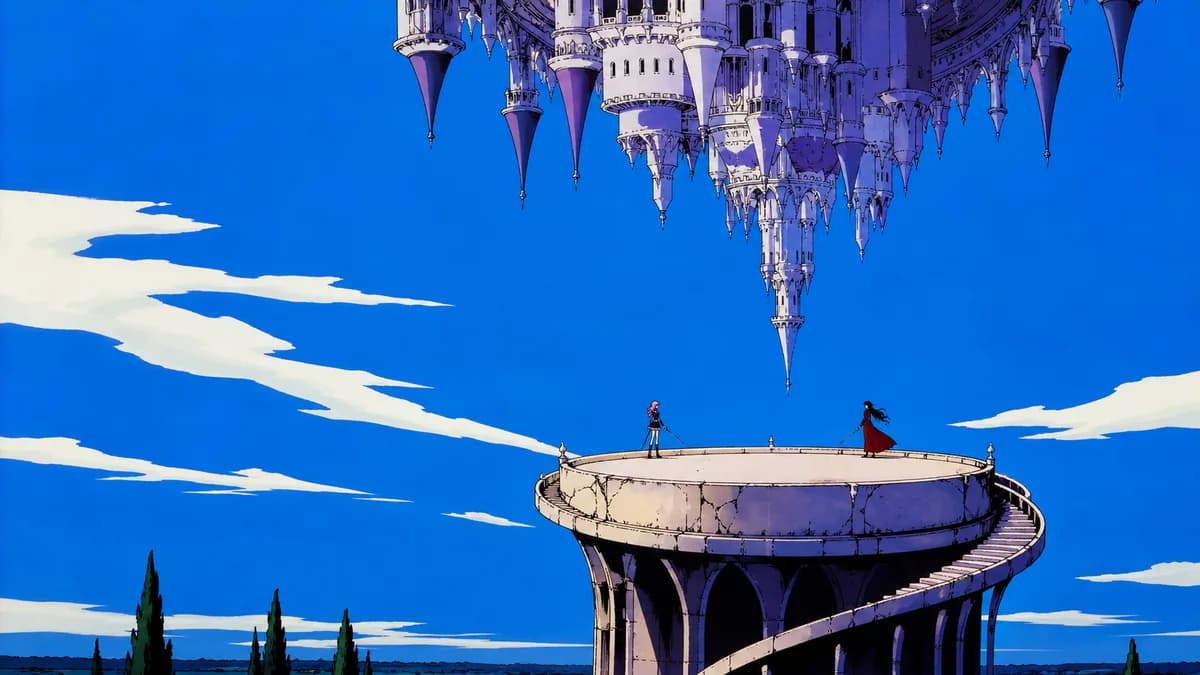
Utena Tenjou was orphaned when she was young. A prince comforted her, gave her a rose crested ring, and left her with a vow that shaped her life: she would grow up to become a prince herself. The promise eventually leads her to Ohtori Academy, where she wears a boy's uniform and walks the halls on her own terms. An insult aimed at her friend pulls her, almost accidentally, into a secret contest. The dueling arena lies at the top of a spiraling stair, beneath an upside down castle. There, the absurdly powerful Student Council fights for possession of Anthy Himemiya. Anthy is the quiet, smiling Rose Bride, and her engagement transfers to whoever wins. When Utena wins, she is appalled by the arrangement and refuses to regard another person as a prize. The opening portion follows a duel of the week format, with every Student Council member bringing a private hurt into the arena. Those seemingly separate matches slowly join into a broader conspiracy. The questions become harder and uglier as the series proceeds. Someone is directing the duels, the competitors have been promised a mysterious revolution, and Anthy's true nature remains hidden. What starts with the shape of a fairy tale gradually spoils into a much darker account of control. The familiar structure is important because Utena keeps returning to the same contest while changing what each victory means. Even when the plot appears to stand still, the meaning under it is shifting.
Utena, Anthy, and the Duelists
Utena is an unusual protagonist because her admirable qualities and her central mistake come from the same place. She is principled and genuinely kind, with a hot temper when someone is being mistreated. She is also unable to see how fully she has accepted the prince fantasy she hopes to live out. Anthy Himemiya stands across from her and becomes the show's finest creation. As the Rose Bride, Anthy behaves with such passivity that she can seem absent from her own life. Her fixed smile covers thoughts and feelings that remain unreadable for a long time. Her relationship with Utena alternates between tenderness and toxicity, and it supplies the emotional structure for everything around it. The Student Council provides the other duelists. Touga preens and manipulates, while Saionji is volatile. Juri is a champion fencer carrying a love that makes her despise herself. Miki is gifted and sheltered. Nanami, Touga's sister, first fuels the series' vicious comedy with her vanity and slapstick disasters, only for the story to make that comedy hurt. The later cast exposes further decay within Ohtori Academy. Akio Ohtori, the academy's honeyed acting chairman, has a pull that distorts the lives of everyone near him. Even Chu-Chu, Anthy's chimeric companion, has a real function rather than serving as decorative comic relief. Ikuhara presents each character as a person and as a place within the larger design. Each one shows a different way that love can sour into ownership. The symbolism never erases their pain, which is why they remain recognizably human even when the academy feels like a stage built for allegory.
How the Show Looks and Sounds
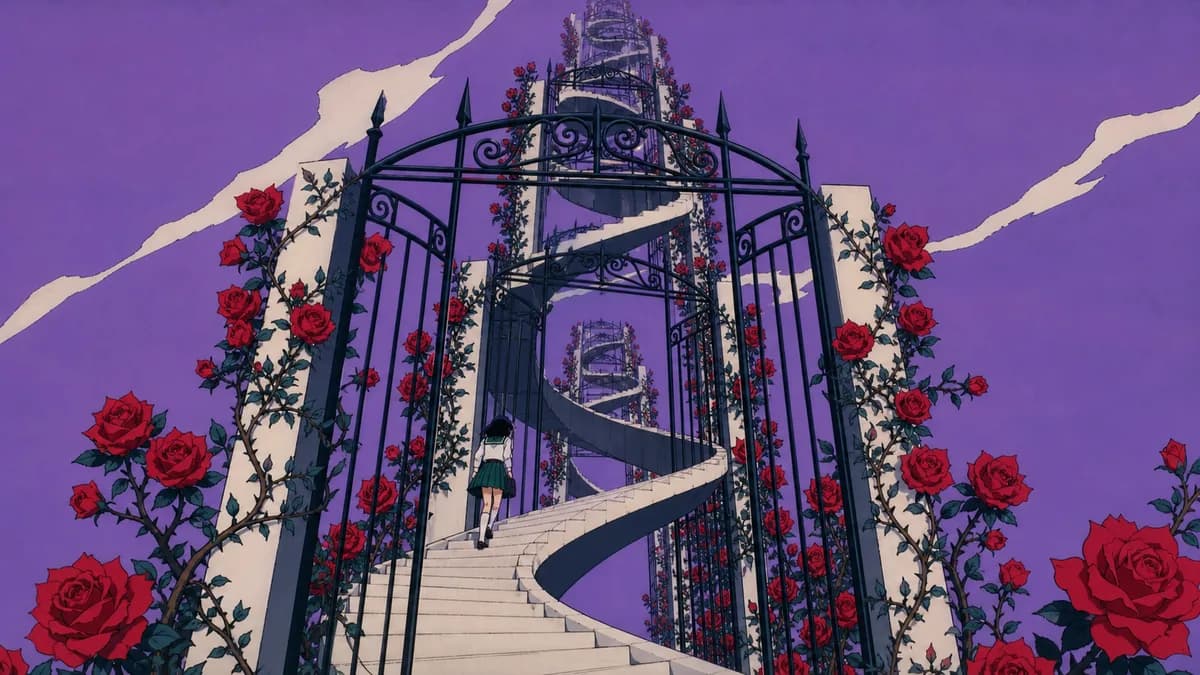
Utena was made on a television budget, and its direction converts those limits into ritual. Every duel repeats familiar material. Utena climbs the endless spiral stair, presses her ring to the gate, and passes through the opening rose doors. Above the arena, the castle hangs in the air. Reusing that footage saved resources, but the result does not feel like ordinary corner cutting. The repetition works like an incantation. It gives each confrontation the weight of a familiar text being read again, now with a different character and a changed emotional charge. J.A. Seazer's choral music accompanies the ascent. The thunderous and cryptic chants of 'Absolute Destiny Apocalypse,' driven by pipe organ and massed voices, sound unlike anything else used to score the medium. Visually, the angular character art is elegant and unmistakably late-90s shoujo. The animation often relies on still frames, yet Ikuhara's direction surrounds them with audacious graphic compositions. Silhouettes and shadow plays interrupt literal reality. A rotating stage can take over the frame, while roses and long expressionist shadows turn the school into a theatrical space. Guest artists add their own precision, including a young Mamoru Hosoda working on storyboards. Nobody could reasonably call the series lush. Its age is visible in the linework, and movement is limited. Yet its command of form remains striking. The show knows when repetition will gather meaning, when an abstract image can say more than direct action, and when withholding an image is stronger than supplying one. Anime with many times its drawing budget often shows less visual nerve.
Princes, Princesses, and Other Cages
The sword fights carry an argument about assigned roles. Utena examines who is allowed to act as the prince, who must play the princess awaiting rescue, and what kind of violence can hide within such a sweet looking arrangement. Utena wants to become a prince so she can save Anthy. Over time, the series challenges the assumption behind that desire. Prince and princess may be two different cages, and the wish to rescue somebody can become another claim of ownership. Gender appears here as both costume and prison. The central relationship is queer and unresolved, which makes its emotional truth stronger rather than weaker. The story does not force that bond into a neat label or an easy resolution. Around it, the series deals with abuse and exploitation. It also shows adults grooming young people into patterns passed down to them. These subjects arrive through allegory instead of direct instruction, so understanding them depends on watching how the same images and behaviors recur. Ikuhara keeps returning to the image of a coffin as the story someone else has written for a person. Escape requires breaking out of that script. In this context, 'revolutionizing the world' means ending the cycle that makes every character perform the same injury again. The fairy tale is therefore both a source of comfort and a mechanism of confinement. Utena's ambition is unusually high, and its methods are deliberately strange. It succeeds because the direction commits completely to those methods, even when clarity would be easier. Few anime attempt an argument this demanding, and fewer make the emotional ending carry the full weight of the ideas behind it.
Where It Excels and Where It Drags
Watching Utena can be hard work. Its symbolism is intentionally obscure. Cars stand in for sex, the floating castle represents illusion, and the shadow puppet girls deliver their commentary in riddles. A viewer who wants every idea explained plainly is likely to find the series alienating. Repetition creates a ritual for some people, while others will reasonably see padding. The duel of the week structure loses momentum in places, and the Black Rose arc in the middle of the run can wear down a viewer's patience before the finale wins it back. The animation also bears the limits of its budget and vintage. Motion can be stiff, held frames are common, and recycled footage does a great deal of work. Some drawings look crude beside the polished surfaces of modern productions. The series is equally stubborn about answers. On a first viewing, its refusal to explain itself can feel like a deliberate attempt to keep the audience at a distance. Those frustrations are real and persist even for many admirers. They also sit beside equally substantial achievements. The show has rare thematic nerve, and Utena and Anthy form a devastating central pair. Seazer's music is impossible to forget. Most important, the climax changes how the preceding story reads, giving earlier repetitions and evasions a new purpose. That ending does not excuse every slow stretch or turn opaque imagery into effortless viewing. It does make the long route feel worthwhile for many viewers. Utena demands attention and tolerance for uncertainty, then uses both to deliver a conclusion with a force that a cleaner, easier series could not produce.
The Verdict
Revolutionary Girl Utena is a poor choice for a newcomer looking for an easy binge, and plenty of experienced viewers will dislike it too. The symbolism is thorny, the pacing is uneven, and the animation plainly shows its age. Viewers willing to engage with those difficulties will find one of anime's most singular and intelligent works, as well as one of its quietest emotional wrecking balls. It takes the fairy tale apart to see what its promises conceal, especially the roles people accept before they understand the cost. The pageantry of roses and swords remains gorgeous, while Seazer's chants stay lodged in the memory. Above all, the relationship between Utena and Anthy earns a conclusion that changes the meaning of the entire run. Patience helps. Rewatching reveals connections that the first viewing can only suggest, and comfort with ambiguity is practically a requirement. The series is flawed and difficult, but it remains essential because almost nothing else offers the same experience or arrives at the same hard won feeling of release.
FAQ
Yes, provided you have patience with ambiguity and enjoy ambitious stories built from dense symbolism. It is a certified classic, and its eventual payoff earns the effort it asks from the audience. Someone seeking a quick and direct watch may find the demands frustrating instead. Our score of 93 reflects a great series that expects active attention from its viewers.