
Why Anime Keeps Bringing the World to an End
 By Mika Tanabe · Editor
Anime has flattened so many cities that another falling skyline can feel almost routine. The number of ruined worlds matters less than what writers do with them. An apocalypse clears the room faster than any other device. Institutions disappear, tomorrow is no longer guaranteed to arrive on schedule, and every choice made afterward reveals something about the person making it. This is why many of anime's most distinctive endings are not detonations. They happen slowly, as a society gives way to attrition and exhaustion. Texhnolyze sits at the far end of that spectrum and plays like a diagnosis. The bomb supplied the earliest vocabulary. The medium turned the long shutdown into an art form of its own.
The bomb came first, but it does not explain everything
Akira begins by wiping out a city inside a silent dome of light. That image escaped anime completely. Its shockwave appears in music videos, games and blockbusters made by people who have never watched the film from beginning to end. Fist of the North Star looked at similar rubble and used it to create a moral arena. In its wasteland, strength has become the only institution left standing, while mercy must be defended as if nobody has heard the case for it before. Terror in Resonance takes this inheritance out of metaphor and places it in a recognizable contemporary Tokyo. There is an obvious nuclear reading, and it is true as far as it goes. It accounts for the vanished skylines and poisoned air, along with survivors reduced to counting days. It does not account for the idea's durability. Other national traditions also carry catastrophe in their history, yet they have not produced three generations of storytellers who put the end of the world into comedy, romance and children's television alike. The historical source explains the visual language. It cannot, by itself, explain why anime keeps finding fresh uses for it.
The apocalypse turned inward
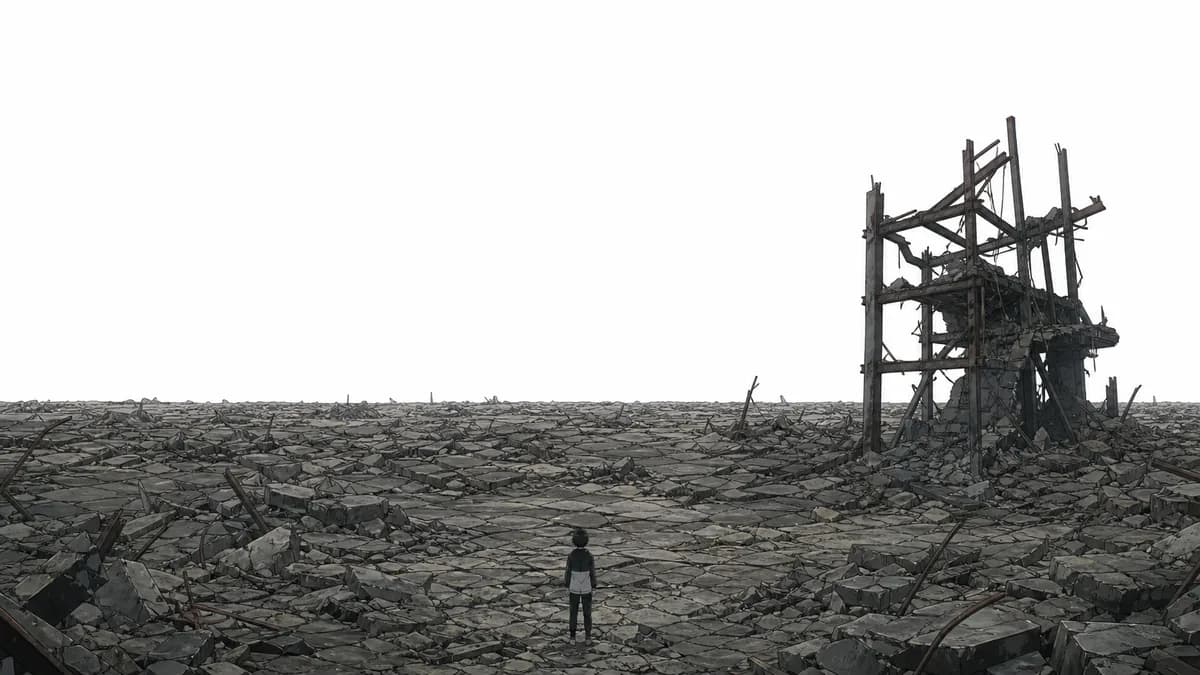
A major change arrived when destruction stopped coming from outside the characters. Neon Genesis Evangelion presents the end as an interior event. The physical catastrophe feels almost like a byproduct of one boy's refusal, and the harshest feature-length version turns an apocalypse into a therapy session while the world breaks apart beneath it. Serial Experiments Lain pushes the same move further. Reality dissolves so gradually that there is no single frame where you can say it broke. Texhnolyze is the terminal case, as well as the most uncompromising thing Madhouse ever put on television. Hiroshi Hamasaki directs. Chiaki Konaka writes, Yoshitoshi ABe designed the cast, Hajime Mizoguchi scores it and Gackt sings over it. That absurd concentration of talent is trained on Lux, a buried city that is never destroyed by one decisive event. It simply runs down. A prize fighter named Ichise is maimed and rebuilt with machine limbs. He is then absorbed into Oonishi's syndicate, while Ran watches from the margins as a girl who can already see where all of it goes. The opening stretch of its two-cour run is nearly wordless. Its silence establishes the show's view of collapse: nothing needs to explode for a world to be finished.
Ending the world lets the adults be wrong
Once the sentiment is removed, the anime apocalypse starts to look like a clearing operation. Adults and institutions are taken off the board. The inherited account of how life works goes with them, leaving the survivors to work out an ethic without instructions. Attack on Titan spends its early run with a walled humanity that believes it is the last of its kind. The walls are eventually revealed as a lie passed down by the previous generation. In The Promised Neverland, children discover that their idyllic home is a farm. From the New World imagines a pastoral far future, then shows the unspeakable thing required to preserve its apparent gentleness. Dr. Stone says all of this plainly through its premise. The species has been petrified and civilization is gone, so the show's real project is to derive civilization again from first principles, using a stone-age lab and enormous cheer. Devilman Crybaby puts the same operation on fast forward. Its institutions hardly have time to decay before they curdle into a mob overnight. These shows sound nothing alike, but they use the same mechanism. First they empty the room. What the characters choose to build in the space tells us whether the old rules deserved to survive.
The strongest objection: apocalypse as costume
There is a fair objection to all of this: sometimes the apocalypse is a convenience, not a philosophy. Few premise engines are as efficient. A ruined world gives the writer a blank map where the police no longer matter. Teenagers can carry weapons and become important without much explanation, while the social hierarchy can be redrawn however the story prefers. The stakes arrive ready-made. Guilty Crown wears its ruined, quarantined Japan like a jacket over a chosen-one power fantasy. Darling in the Franxx has a dead Earth largely because the plot needs one. The criticism lands, and denying it would require ignoring much of the genre's middle tier. The useful test is what happens on the day after. Cowboy Bebop leaves its wrecked Earth in the background and never claims it is doing anything else. It is a jazz noir that happens to have a ruin in the corner. Trigun makes scarcity essential to its story, which means pacifism on a desert planet carries a real cost. Nausicaa of the Valley of the Wind places its poisoned world at the center instead of treating it as an excuse for action. Anime absolutely has a reflex for wreckage. The strongest work is distinguished by what the wreckage changes.
The apocalypse learns to tell jokes
Comedy is the newest mutation of the form, and it suggests confidence rather than exhaustion. Zom 100 treats the outbreak as liberation. The world ends, and a young man finally gets his life back from a job that was already consuming it. The joke has a sharp edge because his old routine looked like an apocalypse before the real one arrived. Apocalypse Hotel maintains immaculate service standards long after its guests have stopped arriving. Its stubborn devotion to the work finds something close to grace. Nyaight of the Living Cat turns the outbreak into a purely absurd premise. Zombie Land Saga begins as a gag, then gradually becomes a story about receiving a second run at a life left unfinished. These are not parodies that stand outside the tradition. They extend it by approaching the same concern from an angle their solemn predecessors rarely used. Their characters have to decide what remains worth doing after the audience is gone and nobody is grading the result. Texhnolyze raises that problem with a straight face and offers no comfort. A hotel full of perfectly folded towels can pose it with a smile and still mean it.
What anime finds among the ruins
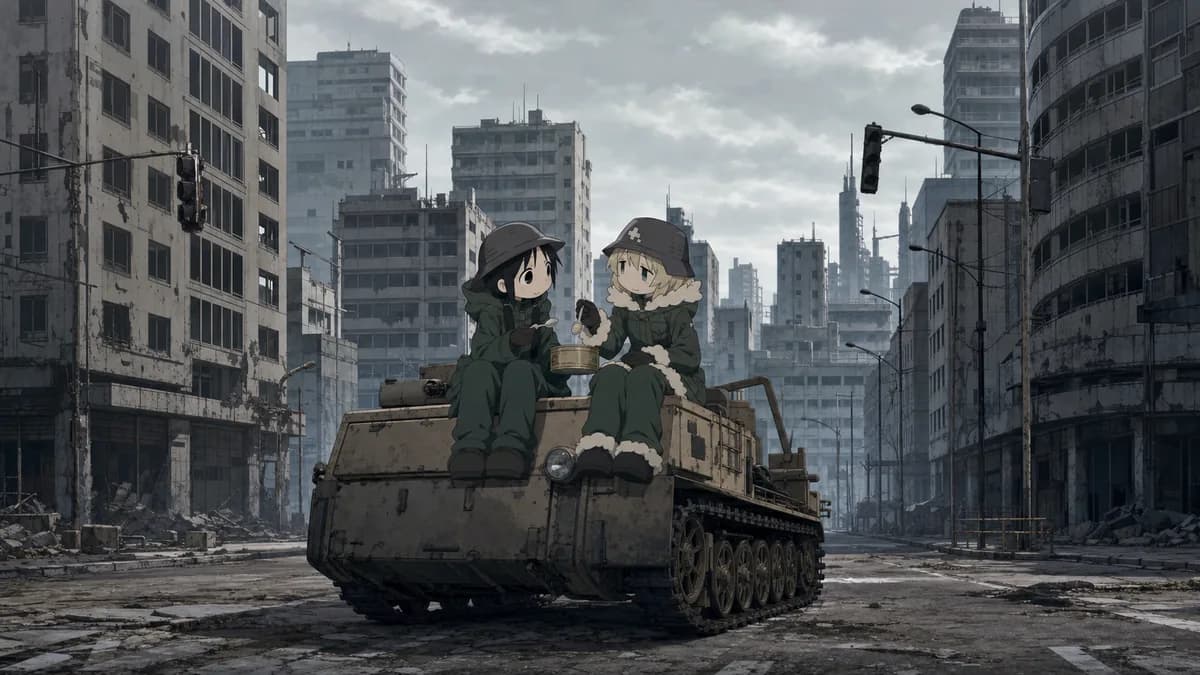
Calling the medium nihilistic misses how rarely these stories finish at absolute zero. Most of them leave behind a seed. Gurren Lagann offers anime's loudest rebuttal to despair, even though it starts from the same premise as Texhnolyze. Humanity lives underground in a hole, and the sky has become a rumor. One story drills upward and will not stop. The other remains below until it runs out of reasons to continue. Wolf's Rain allows the world to die with the understanding that it will begin again. Nausicaa finishes on a green shoot. Even the bleakest reading of Evangelion leaves two people on a beach, and their survival still counts for something. Texhnolyze is the great exception. Its force comes from knowing that this tradition normally grants its characters the seed, then watching this show withhold it on purpose. The refusal reads as a statement rather than a passing mood. Anime ends the world for something like the reason a scientist runs a control. Remove everything around the subject and you can finally see which part had been holding it up.
FAQ
Start with Akira for the landmark that established the visual grammar. Choose Dr. Stone if the rebuild interests you more than the ruin, or Attack on Titan if you want the epic-length version. Texhnolyze belongs at the deep end and is not a good starting point, so save it until you know that is what you want.