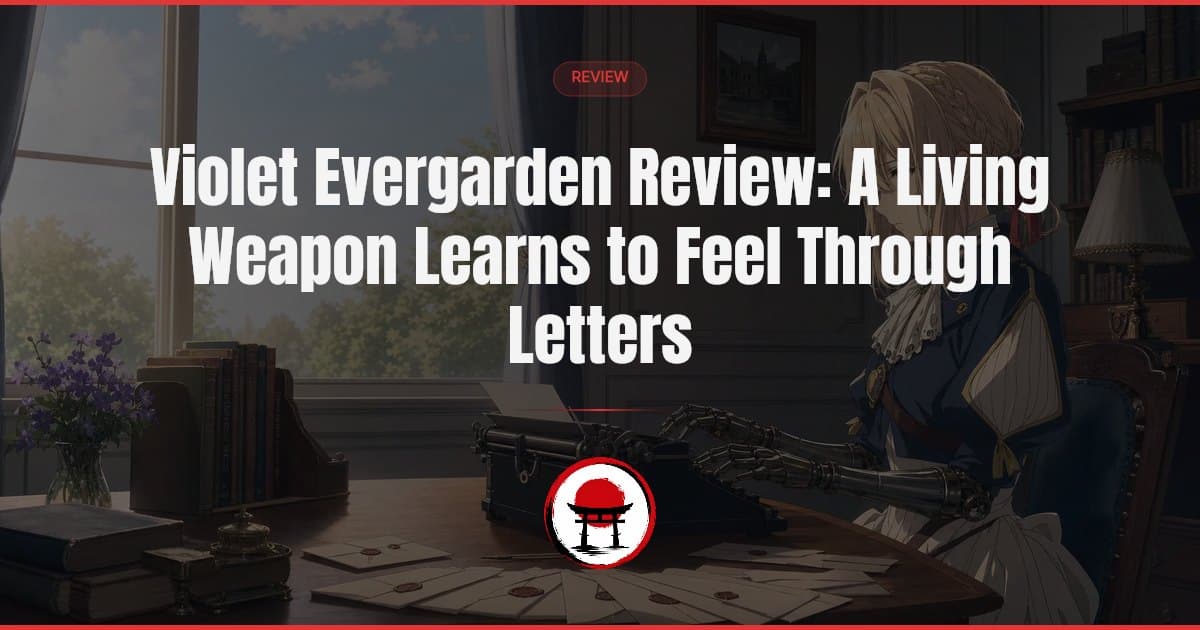
Violet Evergarden Review: A Living Weapon Learns to Feel Through Letters
 By Mika Tanabe · Editor
Some anime make you cry. Violet Evergarden makes you understand where those tears come from, then offers a handkerchief embroidered by the same studio that caused them. Kyoto Animation's adaptation of the light-novel drama follows a girl who was raised as a battlefield weapon. Once the war ends, she finds work putting other people's feelings into letters as an Auto Memory Doll. Love and grief are still foreign to her, and she cannot understand the words a dying man asked her to carry. This is the most beautiful-looking television anime KyoAni has ever produced, as well as one of its most emotionally direct. The series does sometimes push too hard for a reaction. When its stories work, though, very few shows can hit with the same force. Violet's education in feeling succeeds because the animators express emotion in every glance and pause.
Story and Premise
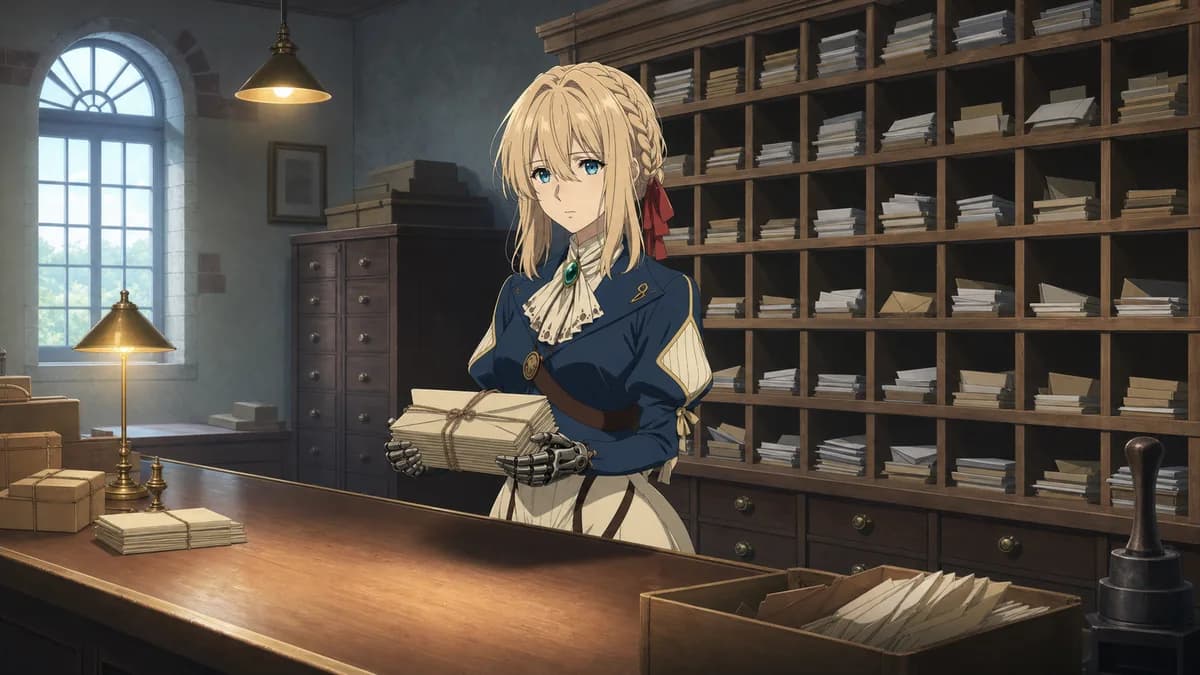
The premise sounds small. Violet leaves the postwar military and takes a job at a postal company. There she learns about Auto Memory Dolls, ghostwriters who turn a client's unspoken feelings into polished correspondence. Violet has spent her life being aimed at enemies, so love notes and condolences are an entirely foreign discipline. That gap gives the story its momentum. The series is largely episodic, with Violet traveling to meet a new client and accepting a different commission each week. Every assignment asks her to understand an emotion she knows by name but has never truly felt. She works for a grieving playwright, a dying mother, and a homesick princess. Their letters become compact dramas with their own beginnings and endings, while Violet's development joins them into a larger story. One thread continues beneath all of these encounters: she needs to understand the words her commanding officer left with her. The pace is patient, and there are stretches when it becomes too patient. Still, the slow movement fits Violet herself. Her heart does not transform after one moving conversation. Each client leaves her with a little extra knowledge, and the effect builds by degrees. The series gives those changes room instead of forcing a sudden breakthrough. Its restraint is deliberate because Violet has to learn what ordinary emotional language means before she can use it for herself. That gradual process can demand patience from the viewer, but rushing it would rob the later letters of their impact. The individual stories matter because each one teaches Violet something she could never have learned on a battlefield.
Characters
Violet ranks among the great anime protagonists because she shows so little emotion at the beginning. She has the blank, polished appearance of a porcelain soldier and adamant prosthetic hands. Feelings are reported as if they were field data. Watching that rigid expression slowly give way, one letter at a time, provides the series with its deepest pleasure. The performance depends on understatement. A faint softening in Violet's face can carry the force that another show might chase with shouting. The supporting characters help us see sides of her that she cannot yet recognize. Claudia Hodgins is her gruff but kind employer, and his guilt makes him a protective guardian. Fellow Doll Cattleya supplies warmth and worldly experience. Young Iris and Benedict bring humor to the postal office and make it feel lived in rather than solemn all the time. Most clients appear for a single chapter, yet their lives leave permanent marks on Violet. A soldier's sister changes what she understands about loss. A doomed mother hires her to write birthday letters for the daughter she will not live to see grow up. Above every new relationship hangs Gilbert Bougainvillea, the officer whose final words remain beyond Violet's understanding. None of these relationships is especially tangled. The show pares them down until the emotion is direct and hard to avoid. Such purity could easily feel contrived, especially when a client arrives with little screen time to spare. The characters are specific enough to prevent that. They have particular regrets and particular people they cannot reach on their own. Violet does not solve their lives. She finds the language they were missing, then carries what she learned into later journeys and letters. That accumulated experience makes her growth feel earned rather than arranged for a convenient emotional payoff.
Animation and Sound
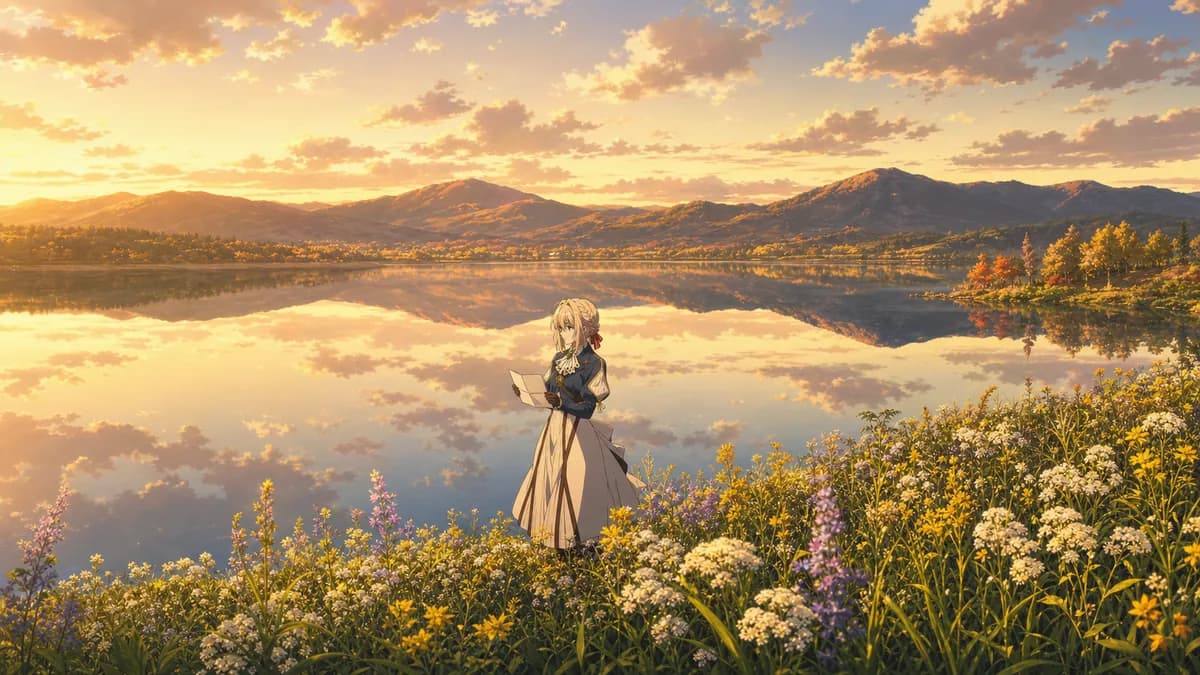
Superlatives are hard to avoid when discussing the production. Frame for frame, Violet Evergarden contains some of the most lavish television animation ever made for a broadcast schedule. KyoAni's photorealistic detail defines the series. Light filters through lace curtains. Ink gathers on the nib of a pen. Rain crosses cobblestones with the weight and texture that most studios save for feature films. None of this beauty sits apart from the story. The character acting works on an almost microscopic scale, whether it is a trembling eyelash or fingers pausing above typewriter keys. Those movements communicate what Violet and her clients cannot say aloud. The gaslit pseudo-European nation around them is filled with steam trains and telegraph lines, all rendered with obsessive, painterly warmth. Every commission feels grounded in a place where letters still carry enormous weight. The score aims for the same emotional height. Its swelling strings sometimes approach melodrama, but they usually earn the feeling they ask from the audience. Minori Chihara's closing theme stays in the mind like a letter read again after the first shock has passed. Reiko Yoshida's series composition gives each standalone story a clear emotional form while preserving the longer movement of Violet's recovery. The sound design also understands when to step away. Quiet scenes are allowed to remain genuinely quiet, which makes the scratch of a pen or the strike of a typewriter key matter. Even viewers who reject the show's sentimentality tend to recognize the craft. KyoAni is working near the limit of what television anime can look like, but the achievement goes beyond technical display. The animation gives physical shape to emotions that the script deliberately leaves unspoken.
Themes and Its Distinctive Approach
Beneath the beautiful surface, Violet Evergarden follows one enormous idea: a person learning how to feel. Violet is essentially post-traumatic, a child raised to kill who must now confront an inner life she was never permitted to develop. Making her an Auto Memory Doll is the show's smartest decision. Her profession requires her to translate emotions that belong to somebody else, so every job makes her examine grief, longing, and love before she can recognize any of them in herself. Empathy is treated as a skill built through attention and practice, not a switch waiting to be flipped. This connects the series to KyoAni's other tearjerkers. It shares the emotional register of A Silent Voice and the raw ache of Clannad. Its fantasy-adjacent setting and ghostwriting premise give the material a character of its own, however. Again and again, Violet encounters words that survive the person who first spoke or dictated them. The letters ask what people leave behind and who must carry it after they are gone. That question gives the melodrama a firm philosophical foundation. Mono no aware, the bittersweet awareness of impermanence, runs through every commission. A letter cannot stop death or undo the war, but it can preserve a feeling long enough for another person to receive it. Violet begins as a messenger who understands none of what she carries. Her work slowly teaches her that words have consequences beyond their literal meaning. It also lets the series consider recovery without pretending that damage disappears. Broken people put themselves back together by paying attention to others and accepting care in return. The tears are obvious, yet the thought beneath them is unusually disciplined. Each assignment offers another practical lesson in how one person reaches another when direct speech has failed.
Strengths and Shortcomings
The production craft is extraordinary, and Violet's restrained performance is finely judged. Several standalone chapters belong beside the best emotional television in any medium. The story about the dying mother's letters is the clearest example. When Violet Evergarden connects, the result is devastating without feeling messy or confused. Its weaknesses are equally easy to identify. An episodic structure will always produce some variation in quality, and a couple of the weekly client stories feel like altered versions of a formula the audience has already cried through. The show's complete sincerity can also work against it. It reaches for tears often. Viewers who dislike melodrama may read the rising strings and slow-motion emotion as manipulation instead of honest feeling. Violet's development is beautifully rendered, but sometimes resembles a dial being turned little by little rather than a chain of difficult choices she has fought to make. The war in her past remains deliberately vague as well. Anyone looking for detailed worldbuilding in place of feeling is likely to leave frustrated. These problems do not erase what the series does well, because its best episodes reach an exceptional height. They do explain why the show will not work equally well for every viewer. It asks the audience to accept its emotional pitch directly and without irony. Someone who resists that appeal may see only beautiful excess. Someone willing to follow Violet's gradual education will find that the same deliberate pace gives the strongest chapters their power. The show can overstate an emotion through music or staging, yet its best moments trust a face or a silence. Those moments reveal how precise the series can be when its script and production pull in the same direction.
The Verdict
Violet Evergarden earns a 90 because it accomplishes two things at an elite level. It looks unlike anything else on television, and it turns the act of feeling into a story worth following. It still stops short of perfection. The episodic formula becomes thin in places, while the melodrama occasionally runs ahead of the drama meant to support it. Even with those faults, the series reaches astonishing heights. Watching a weapon gradually become a person is the sort of story anime handles better than any other medium, especially when KyoAni puts so much meaning into tiny physical details. This is not the most complex show the studio has made, but it may be the most beautiful. Its finest chapters are unforgettable because the spectacle always serves an intimate human need: someone has words they cannot express, and Violet helps those words reach their destination. Viewers who can accept the show's sincerity will probably be wrecked by it, then feel strangely grateful. It is a modern classic despite its flaws and essential viewing for anyone who doubts that animation can make grown adults sob. The 90 reflects that balance. There are repeated ideas and a few commissions that do not strike as deeply as the best ones, but the high points justify the slow build. Violet's journey leaves an impression long after the last letter has been read.
FAQ
Yes, especially if you are open to a drama that makes no apology for being emotional. It combines some of the most beautiful animation produced for television with a moving story about a former soldier learning to understand human feeling. Go in knowing that the series wears its heart openly and often aims directly for tears. If melodrama tends to make you roll your eyes, adjust your expectations. For everybody else, Violet Evergarden is easy to recommend and remains one of anime's most reliable tearjerkers.