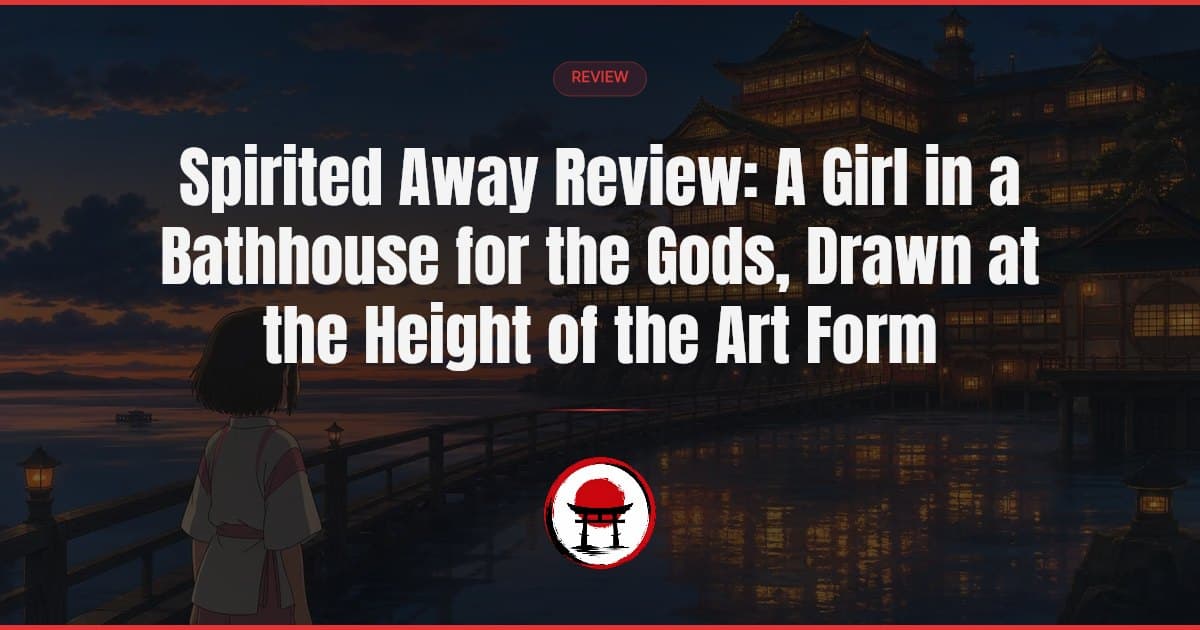
Spirited Away Review: A Girl in a Bathhouse for the Gods, Drawn at the Height of the Art Form
 By Mika Tanabe · Editor
Spirited Away deserves to be called a masterpiece, but even that word feels too familiar for what Hayao Miyazaki achieves here. His sulky ten-year-old heroine wanders into a bathhouse for the gods, then has to survive in a place that treats humans as a nuisance. There is no chosen one waiting to fulfil a destiny. Chihiro has no villain to defeat or power-up to earn. Her story still holds the viewer with a grip that most conventional fantasies never find. Children can watch it as an adventure, while its account of growing up carries equal force for adults. It also works as a hallucinatory trip through Japanese folklore, presented without ever talking down to its audience. The film is hand-drawn and comfortable with silence. Its strangeness seems to have no bottom, yet every scene feels exactly where it belongs. That is why it has lasted as a genuine classic. My view is straightforward: no animated film before or since has cast quite this spell, and Spirited Away casts it again on every viewing.
The Story and Its Strange New World
Chihiro Ogino does not arrive looking like anyone's idea of a heroine. She is a whiny kid slumped in the back seat, unhappy about moving to a new town. Miyazaki lets that ordinary bad mood stand because it makes everything she later does feel earned. After her family takes a wrong turn, they find what appears to be an abandoned theme park. Her parents discover unattended food and start eating without permission. Their punishment comes quickly and grotesquely when they turn into pigs. Dusk settles over the park, spirits begin to fill its empty spaces, and a sudden sea cuts Chihiro off from the human world. She is now the only human in a place that has no use for her. Haku, a boy who claims to know her, helps smuggle her into the enormous bathhouse where gods come to soak. He gives her one practical route to survival: she must get a job. From there, the film avoids the shape of a standard quest. Chihiro has to earn her parents back by completing shifts, dealing with one strange guest after another, and finding the nerve to act whenever the bathhouse puts her under pressure. Her progress comes through work rather than destiny, which gives this fantastic story an unusually solid footing.
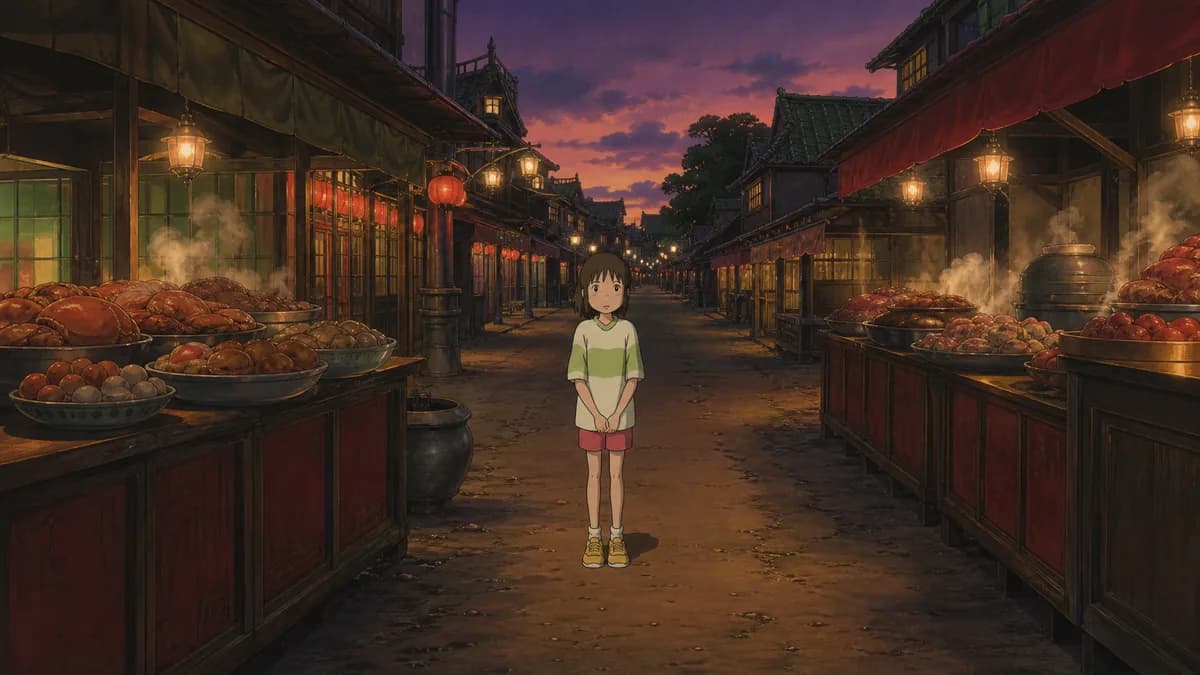
Chihiro and the Bathhouse Residents
The quiet way Chihiro changes is one of the film's finest achievements. She enters the spirit world frightened and nearly useless, then leaves it resourceful and kind. Miyazaki never stops the film for a triumphant declaration that she is brave now. She becomes brave by turning up for the next problem and doing what needs to be done. The people and creatures around her form one of animation's richest supporting casts. Yubaba is the hook-nosed witch in charge of the bathhouse. She takes Chihiro's name, along with part of her sense of self, and renames her Sen. Yubaba's identical twin, Zeniba, has the same face but meets Chihiro with gentleness. Haku can be warm in one moment and coldly menacing in the next. He is a boy carrying a secret that even he has misplaced. No-Face is the boldest character idea in the film: a lonely shade without a face who reflects whatever others feed into him. He begins as a meek presence, but the bathhouse's greed makes him monstrous. Even the characters at the edges feel fully alive. Kamajii works the boiler with his many arms, while the brisk older worker Rin helps Chihiro learn the job. A giant baby throws tantrums. Soot sprites scuttle around carrying coal in exchange for star-shaped sweets. They all seem to come from a mythology that began long before this story and will continue after Chihiro leaves. None of them exists merely to fill the screen.
Hand-Drawn Animation and Joe Hisaishi's Score
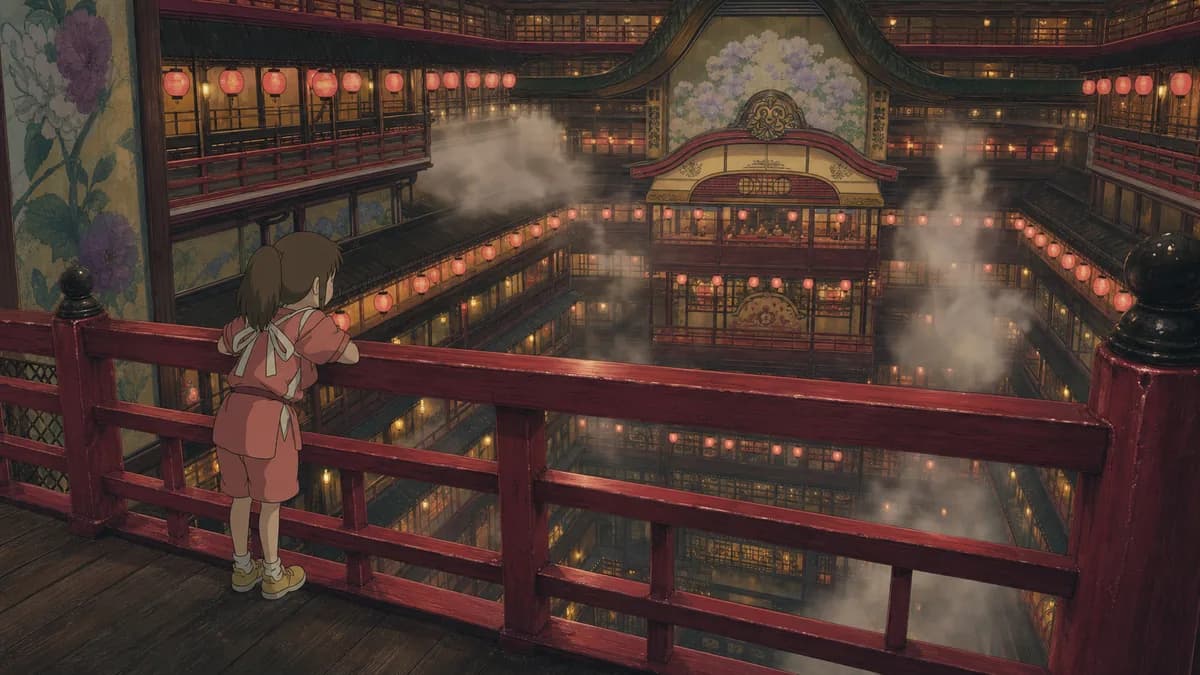
The hand-drawn animation sits at the summit of the form. The bathhouse could support a whole film by itself, with steam drifting past wooden balconies and lanterns reflected in black water. Its hundred spirits do not move as a generic crowd; each seems to have a different gait. Miyazaki gives just as much care to actions that other films would skip. Chihiro fumbles while putting on her shoes, and the animators catch the particular weight of a child whose body is slowly learning not to freeze with fear. Colour guides the film through muddy dusk, the warm neon glow of the bathhouse, and the cool blue-grey of open water. Those shifts never break the dream's internal feeling. Joe Hisaishi's music has become impossible to separate from the images. The score is anchored by the aching solo-piano theme 'One Summer's Day,' yet it never tries to tell the audience what to feel every second. During the wordless train journey across a flooded plain, music and image turn a simple ride into the most moving passage in the film. Hisaishi knows when the score should rise. He is equally precise about stepping away so that water and the other sounds of the scene can carry it. Good speakers reveal how carefully the film uses that space. Its craft makes the case for its greatness without needing to announce it.
Names, Greed, and the Power of Silence
Beneath the spectacle, Spirited Away is concerned with what happens when someone forgets who they are. Yubaba does not need chains to keep her workers trapped. She steals their names, and anyone who forgets their own can never leave. Chihiro has to protect the memory of being Chihiro even as everyone in the bathhouse calls her Sen. That struggle holds the rest of the story together. Miyazaki builds his ideas about greed and appetite around it. Chihiro's parents gorge on food until they become livestock. No-Face tries to buy affection by producing fistfuls of gold, only for that gold to become nothing. The film's environmental anger appears most clearly when a foul, sludge-covered visitor arrives as a supposed 'stink spirit.' Once Chihiro and the bathhouse staff pull out the human garbage lodged inside it, the creature is revealed as a polluted river. Miyazaki refuses to turn any of this into an explanation delivered to the audience. Nobody gives a lore lecture, the film supplies no map, and no character reads the rules aloud. The spirit world simply exists on its own terms. Its gaps do much of the expressive work: pauses are allowed to remain pauses, characters exchange silent looks, and the train sequence holds its shots for longer than most animated films would dare. Dialogue would only weaken those moments. Very few films place this much trust in what remains unsaid.
What Works and Where It Falters
The score is 97 rather than a clean 100 because a near-perfect film still shows a few seams when examined closely. For all its beauty, the middle section wanders. No-Face's rampage through the bathhouse continues a little longer than it needs to, and the move from whimsy into real menace may jar younger viewers or people watching for the first time. The dream logic gives the spirit world much of its charm, but now and then it becomes opaque. A few moments resolve because the story needs a resolution, rather than because the film has shown enough to earn one. The climax also depends on a conveniently timed return of memory to bring its threads together. Chihiro's growth is handled with lovely restraint, though viewers looking for a clear chain of cause and effect may find that the second half offers more mood than forward motion. These problems are minor rather than damaging. They are overwhelmed by the film's unmatched craftsmanship and by the seriousness of its moral ideas, which Miyazaki carries lightly. Chihiro also remains a rare kind of heroine. She succeeds through kindness and grit instead of gaining power. An honest review should acknowledge the faint seams, even in a film whose strengths exceed them by such a wide margin.
The Verdict
Spirited Away comes about as close to flawless as animation can. The small gap between it and perfection explains the 97: its middle wanders, and its dream logic occasionally declines to explain a turn in the story. Almost everything else feels untouchable. This is a coming-of-age story without cynicism, set inside a fantasy epic that somehow fits within one bathhouse. Its hand-drawn work remains a technical benchmark that decades of digital tools have not surpassed. A child can see an adventure in Chihiro's journey. An adult is more likely to notice its ideas about labour, memory and greed, along with the fear of losing one's identity. Neither reading cancels the other, and both remain present each time the film is watched. Few films give as much to someone seeing them for the first time while still rewarding a tenth viewing. If a person were to choose only one animated film to see in their life, Spirited Away would be an entirely defensible choice. It is a timeless classic, missing perfection by only the narrowest margin.
FAQ
Yes, without reservation. It is one of the most acclaimed animated films ever made and an Academy Award winner. A first-time viewer can enjoy it as readily as someone who has loved it for years, and repeat viewings keep revealing small choices in the animation and storytelling. If you plan to watch only one anime film in your life, choosing this one is easy to defend. It is a timeless classic, and not one frame feels dated.