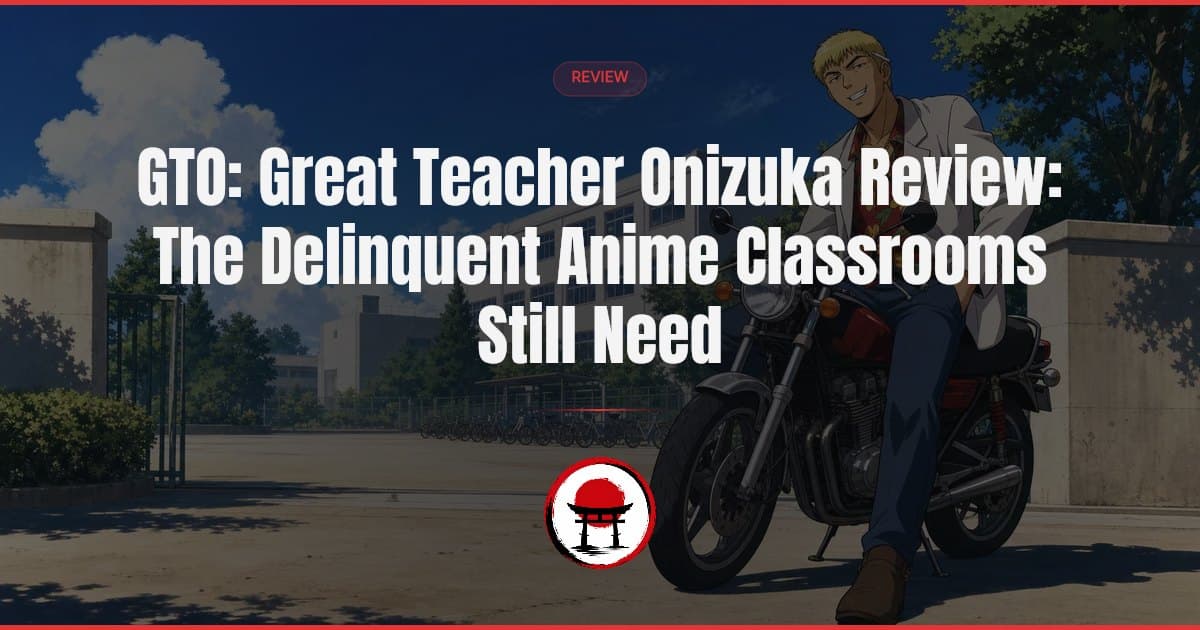
GTO: Great Teacher Onizuka Review: The Delinquent Anime Classrooms Still Need
 By Mika Tanabe · Editor
Eikichi Onizuka is twenty-two years old, an ex-bosozoku, an unrepentant pervert, and somehow a homeroom teacher. His reason for barging into Holy Forest Academy sounds vile on paper: he wants to ogle high schoolers. GTO puts that ugliness in plain view, then spends the rest of its run showing why this hopeless candidate may be the only adult in the building who can reach its students. Beneath the crotch-grabbing jokes and German suplexes is a remarkably sincere story about damaged kids. Its setup gives the series an easy momentum. A poisoned student or corrupt adult crosses Onizuka's path, and he responds with reckless empathy instead of anything resembling a lesson plan. The comedy can be crude, and the age of the production is visible in almost every scene. Neither weakness stops the emotional turns from working. Few school dramas can move from a fart joke to real heartbreak without making either side feel false. GTO repeatedly manages it, because the ridiculous teacher at its center never treats an abandoned child as a lost cause.
Story and Premise
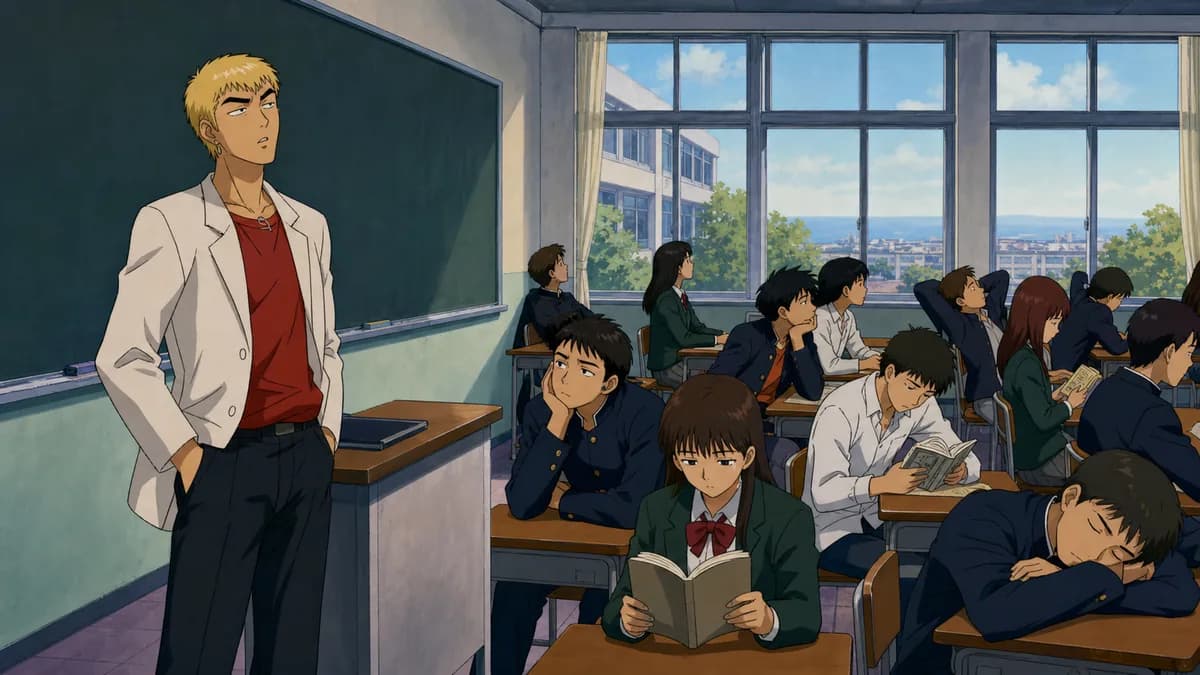
The setup looks almost too neat. Holy Forest Academy, a prestigious private school, gives its most notorious homeroom to the least qualified man imaginable. This class has already broken down every adult sent in to control it, and its students know exactly how to exploit a teacher's pride, fear, and private weaknesses. Onizuka arrives without the professional instincts that would make those tactics effective against him. The show then finds a case-of-the-week rhythm, with each arc built around a wounded student or a scheming grown-up. The resolution usually comes when Onizuka violates protocol in some spectacular fashion. He might spend his own money, sleep on a rooftop, or accept a beating if that is what it takes to reach a student whom everybody else has dismissed. Those acts never look like conventional teaching, but the show makes clear that attention and loyalty are exactly what these kids have been denied. The feature-length opener establishes the pace early. It runs nearly twice a normal slot because the series wants enough room to introduce Onizuka's particular variety of chaos. Later plots keep the formula alive by raising the cruelty of the attempts to expel him. The administration becomes pettier too, especially the endlessly humiliated vice-principal and his doomed Toyota Cresta. What begins as broad comic sabotage can turn genuinely dark once a student's pain becomes part of the scheme. Although the structure is episodic, the accumulated effect feels serialized. Across those cases, GTO keeps testing whether one reckless lunatic can show enough love and persistence to beat a broken system.
The Cast
Onizuka carries the series because his contradictions never settle into a tidy moral. He can be lecherous and childish, then notice exactly what a hurting teenager needs before any respectable adult in the room does. GTO does not clean him up for easy approval. His progress feels convincing because the idiocy remains part of him, even when he gets something profoundly right. The students give that contradiction real weight. Miyabi Aizawa begins as the ice-cold ringleader who frames teachers for entertainment. The betrayal underneath her behavior does not excuse the cruelty, but it changes how we understand it. Noboru Yoshikawa, a bullied boy driven to the brink, is at the center of some of the series' hardest material. His story shows how quickly routine torment becomes invisible to the adults responsible for stopping it. Urumi Kanzaki may have the best arc in the show. She is a genius who turns her intellect into a weapon after being abandoned, so meeting her cleverness head-on would only confirm what she already believes. Even Tomoko, the airhead idol hopeful, is treated with unexpected grace rather than being left as a disposable gag. The adults have their own clear roles. Rookie teacher Azusa Fuyutsuki brings a sweet, low-key will-they-won't-they thread to Onizuka's life, while vice-principal Uchiyamada endures one comic humiliation after another. Together, the ensemble expresses the show's most persistent belief. The apparent monsters in this classroom were children failed by adults before Onizuka ever met them. That idea gives the cast its bite, because every prank or act of cruelty carries the possibility of an older wound underneath it.
Animation and Sound
The visuals unmistakably belong to late-'90s television animation. Studio Pierrot was working with a TV budget, and the limitations are easy to spot in stiff in-betweens, reused cuts, and the soft, muddy color associated with pre-digital cel work. Viewers looking for sakuga will not find GTO especially generous. The production still understands where its visual effort pays off. Thick, assured linework makes the character designs suited to caricature, while Onizuka's face becomes the show's greatest animation resource. It stretches and twists into grotesque rubber-mask expressions, and those reactions remain genuinely funny because their timing is so precise. A fluid action scene would contribute less to this comedy than a perfectly held look of panic or depravity. That economy gives the series a recognizable personality even when movement is limited. The sound has aged more kindly. L'Arc-en-Ciel's opening theme, 'Driver's High,' is a bona-fide J-rock banger. It immediately places the anime in its period while giving the whole production an extra jolt of energy. The voice cast is equally important, particularly the bark in Onizuka's performance. Those voices can sell blunt slapstick, then adjust when a scene drops into painful territory. The animation remains the weakest part of the adaptation, and modern polish will only make its limitations clearer to a new viewer. The performances and music are genuine strengths, so the series rarely feels lifeless even when the drawings barely move.
Why Its Themes Still Hit
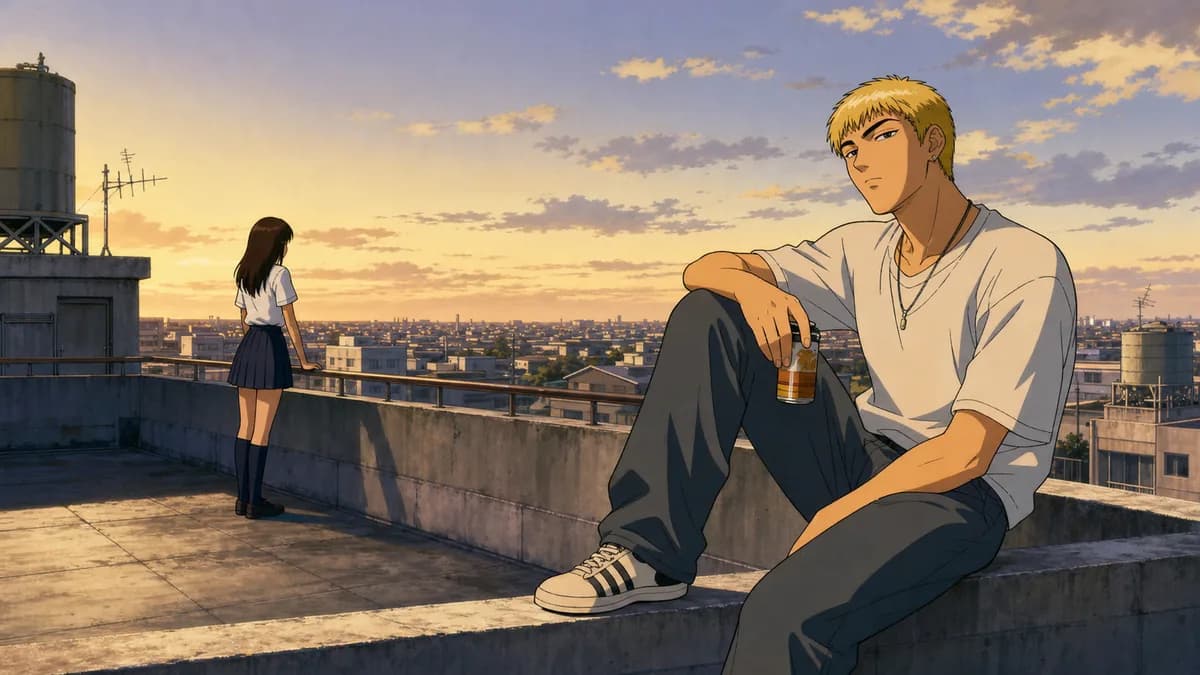
Once the ecchi jokes are set aside, GTO becomes an angry but compassionate account of the ways adults fail children. It deals directly with bullying and parental neglect. It also confronts the particular despair that can push a teenager toward suicide, along with the instinct of institutions to protect their reputation before protecting their students. These subjects do not appear as decoration for isolated very-special episodes. They shape the behavior of the class and explain why Onizuka's refusal to leave matters so much. His approach also gives the show a distinctive argument about teaching. He meets the kids as people first, without reducing them to their grades or their conduct. He cannot talk them out of trauma with a clever speech. Instead, he keeps caring through their worst behavior until they can believe that one adult might actually remain beside them. In a genre that often celebrates discipline or raw genius, his stubborn presence feels unusually radical. The comedy helps the heavier writing rather than interrupting it. Laughter relaxes the viewer and makes the painful turns arrive without the stiffness of a lecture. Other anime may produce bigger laughs or sadder scenes, but GTO is unusually deliberate about letting those moods strengthen each other. Its lasting concern is the modest heroism involved in refusing to abandon a person whom the rest of the world has already discarded. Onizuka is absurd enough to make that belief entertaining, yet dependable enough to make it credible.
What Works and What Has Aged
GTO's biggest strength is Onizuka, a once-in-a-generation protagonist whose terrible judgment and emotional intelligence somehow occupy the same body. The series can shift from comedy into tragedy with rare control, and several student arcs stay in the memory for years. When an episode finds the right balance, the show is almost impossible to beat. Its faults remain visible throughout. The dated animation can be a serious obstacle for newcomers raised on modern production. The case-of-the-week format also produces uneven patches. Its best stories are masterful, while some of the material connecting them starts to sag, and a couple of stretches in the middle of the run spend too long spinning their wheels. The lecherous and fanservice-heavy strain of the humor has aged worse than the character work. Some viewers will accept Onizuka's horniness as part of his foolish charm; others will find it exhausting. That reaction can change how much patience the early episodes receive. The adaptation creates another limitation because it ends before the manga fully does. Its conclusion is satisfying on its own terms, but it cannot serve as the definitive final word when the source continues into material the anime never follows. None of these problems overwhelms what GTO does well. They do establish the terms on which it should be watched. This is a rough-edged classic with an inconsistent production, not a polished object. Anyone prepared for that texture can still see why the character writing has lasted.
The Verdict
GTO works because its roughness belongs to the same personality as its warmth. The dated cels and crude jokes are impossible to miss, yet behind them sits one of anime's most emotionally honest school dramas. It invites you to laugh at a rubber-faced fool, then makes the abandoned students he fights for feel painfully real. The flaws deserve to be counted. Its production is firmly tied to its era, the fanservice will land differently for every viewer, and the episodic pacing sometimes loses momentum. Still, the best arcs reach a level that those shortcomings cannot erase. The feeling behind them never seems manufactured. A score of 89 fits it exactly: GTO is no technical showcase, but it is an essential and endlessly rewatchable classic. Later stories about heroic teachers continue to copy its example, usually without finding the same unruly force. Viewers who can accept a late-'90s anime on its own terms will find one of the genre's most rewarding shows. Onizuka earns the affection by behaving like a disaster and proving, whenever it matters, that he will not walk away from a child in pain. Class dismissed.
FAQ
Absolutely, provided you can live with late-'90s animation and a persistent streak of crude, horny humor. GTO remains one of the medium's most rewarding comedy-dramas because the laughter and heartbreak come from the same characters. Onizuka is an all-time-great protagonist, and the strongest student arcs explain why viewers still recommend the show decades later. Its status as a classic is well earned.