Gintama Review: The Gag Comedy That Sneaks Up and Breaks Your Heart
 By Mika Tanabe · Editor
Gintama is the show fans recommend with a warning attached: give it time. On the surface it's a filthy, fourth-wall-smashing gag comedy about a broke samurai-for-hire in an alternate Edo where aliens run the streets and swords are outlawed. Underneath, it's one of the most quietly devastating character dramas the medium has produced. Hideaki Sorachi's manga, brought to screen by Sunrise, flatly refuses to pick a lane. It will spend a whole stretch on a toilet joke, then blindside you with a sword-drawn arc that pays off setups you forgot were setups. That whiplash is the entire point. Few series ask this much patience, and fewer reward it so completely.
Story & Premise
The premise is a bait-and-switch dressed up as a joke. Alien invaders called the Amanto descended on a feudal Japan of samurai and swordsmen, crushed the resistance, and outlawed the blade, leaving a whole generation of warriors with nothing left to fight for. Gintoki Sakata answers this by opening an odd-jobs shop, the Yorozuya, where he and his crew take literally any gig for money they rarely manage to collect. For long stretches that means episodic nonsense: pest control, host clubs, eating contests, elaborate riffs on other anime. Then, without warning, the floor drops out. A throwaway character returns carrying a past; a gag rivalry curdles into real tragedy. Sorachi hides serious, multi-part arcs inside what looks like a sitcom, so the emotional gut-punches land harder precisely because you weren't braced for them. That tonal whiplash, absurd one week and elegiac the next, is what makes Gintama singular, and what makes it almost impossible to sell to anyone who hasn't felt it firsthand.
Characters
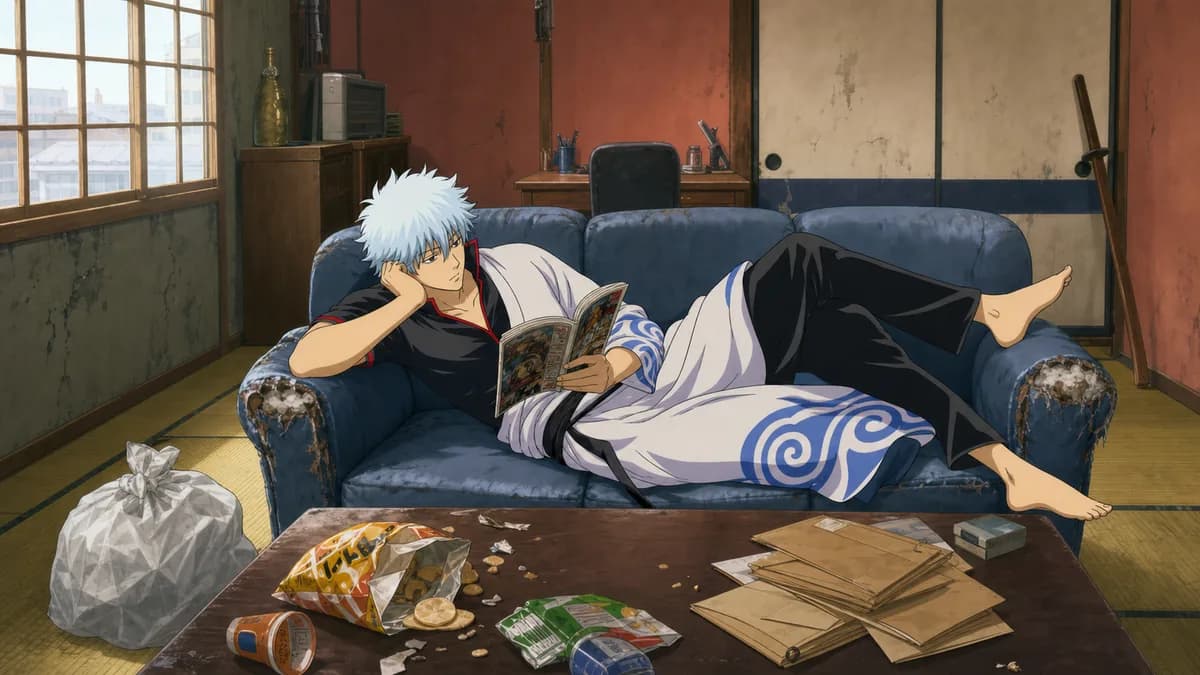
Gintama lives or dies on its ensemble, and its core trio is one of anime's great found families. Gintoki is the dead-eyed, sugar-addicted center, a lazy slob who'll pawn his principles for a parfait right up until someone he loves is threatened and he becomes the most dangerous man in the room. Shinpachi Shimura is the long-suffering straight man whose exasperated tsukkomi retorts hold every joke together; the fandom's affectionate 'he's just the glasses' gag says everything about how the show teases its own cast. Kagura, the alien girl with monstrous strength and a bottomless stomach, completes the household, with the enormous dog Sadaharu as its fourth member. Around them orbits a sprawling supporting cast: the Shinsengumi police, rival swordsmen, old war comrades, and a soft-spoken teacher whose shadow falls across Gintoki's entire story. The remarkable part is how many of these one-off gag characters Sorachi later reloads as full dramatic leads. In this world, nobody stays a punchline forever.
Animation & Sound
Sunrise treats Gintama as a comedy first, and that choice shapes the whole look. Day to day the animation is clean and functional rather than lavish, because the budget clearly lives in the character acting: rubber-faced reactions, immaculate comic timing, and sudden art-style shifts that sell gags flatter dialogue never could. When a serious arc arrives, the studio visibly changes gears. The swordplay tightens, the direction sharpens under early-series director Shinji Takamatsu and those who followed, and the fights carry real weight. The audio is where it truly shines. Tomokazu Sugita's Gintoki is a career-defining performance, dry and unhinged and able to flip on a dime from screaming idiot to quiet steel, and the cast matches his rapid-fire delivery, which is the engine of the humor. The rotating roster of opening and ending themes leans hard into Japanese rock and pop, doubling as a running showcase, and a few of those tracks became fan anthems on their own.
Themes & What Sets It Apart
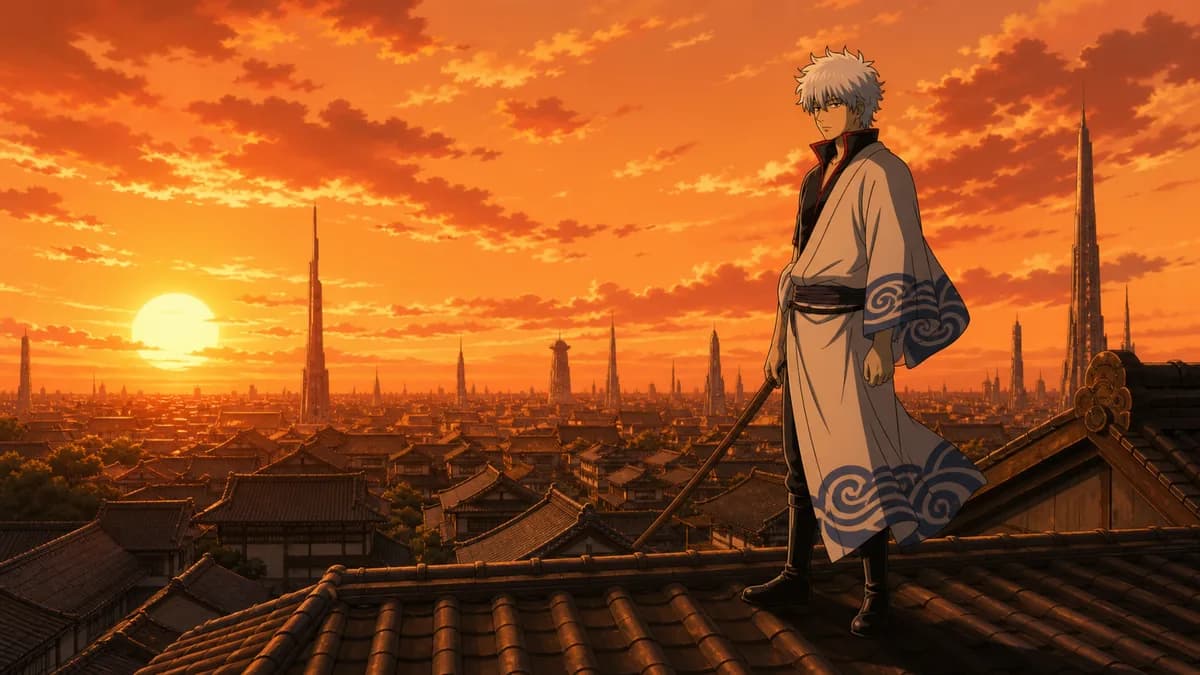
What sets Gintama apart is that it speaks a language most anime avoid: it knows it's an anime, and it will not let you forget it. Characters break the fourth wall constantly, complaining about the animation budget, needling the manga's editor, mangling rival series' names to dodge lawsuits, fretting about cancellation. It's a parody engine, riffing on shonen cliches, Japanese pop culture, and the moment's headlines at reckless speed. Yet none of that meta mischief is the real theme. Beneath the noise, Gintama is earnestly about the samurai spirit surviving in a world that has outlawed it: loyalty, resolve, and protecting the people beside you even when the rulebook says not to bother. Sorachi keeps quietly insisting these ridiculous freelancers still live by something. The genius is the bait. The jokes lower your guard so completely that when the show finally speaks from the heart, you have no defenses left. Almost nobody else pulls that off.
Strengths & Shortcomings
Let's be honest about the cost of admission, because it's real. Gintama is a long-running series, and committing to it is a genuine investment rather than a weekend binge, and the show does itself no favors early. The opening stretch is front-loaded with scattershot, episodic gag chapters, and plenty of newcomers bounce off before the story hands them a reason to stay. The humor is unapologetically crude and reference-dense, too; nosebleeds, toilet jokes, and parodies you may not catch are all part of the package. Filler-flavored detours come and go. And the tonal swings fans adore can read as pure whiplash to someone who wanted one steady thing. The flip side is that the payoff is enormous: stick with it and the gags become shorthand, the throwaway characters become people you'd take a bullet for, and the dramatic arcs hit like little else because you've lived alongside this cast so long. High ceiling, high barrier, and both are equally true.
The Verdict
Gintama is not for everyone, and it never pretended to be. It's crude, sprawling, and slow to show its hand, and it asks more patience than almost anything else you'll pick up. But for viewers who meet it halfway, it becomes something rare: a comfort-watch and an emotional heavyweight at once, a comedy you'll quote for years and a drama that can wreck you in the same afternoon. Our score reflects exactly that, elite-tier anime carrying one honest asterisk about the commitment it demands. Don't start it expecting to fall in love by the first weekend. Start it the way fans do, trusting that the jokes are building toward something, because they are. Give Gintama the runway, and it will quietly turn into one of your favorites.
FAQ
Yes, with one honest caveat. Gintama is a big commitment and a slow starter, so it isn't an instant hit for everyone. But if you give it room to grow, it delivers one of the most rewarding blends of comedy, action, and genuine emotion in the medium. Fans who stick with it rarely regret the time, and most end up calling it a personal favorite.