Fullmetal Alchemist: Brotherhood Review: As Close to Perfect as Anime Gets
 By Mika Tanabe · Editor
Some anime you admire. Fullmetal Alchemist: Brotherhood is one you surrender to. Two boys break the one unbreakable rule of alchemy, that you cannot bring back the dead, and pay with an arm, a leg, and an entire body sealed inside a hollow suit of armor. From that single act of grief, Hiromu Arakawa's story spirals outward into conspiracy, genocide, and a nation's buried history, never once losing sight of the brothers at its heart. My thesis is simple: this is the most complete anime ever made, a series where worldbuilding, character, action, comedy, and theme lock together so tightly that pulling one thread would unravel the whole. It earns every ounce of its towering reputation.
Story & Premise
The premise is a gut-punch disguised as a fantasy hook. Edward and Alphonse Elric, alchemist prodigies, try to resurrect their dead mother and learn the hardest way that alchemy's Law of Equivalent Exchange takes as much as it gives. Ed loses limbs; Al loses his entire body, his soul bound to a suit of armor. Their hunt for the Philosopher's Stone, a relic that supposedly cheats that law, becomes the engine that drives everything. What starts as a road trip to reclaim their bodies steadily peels back into something enormous: a military dictatorship, a buried genocide, and a conspiracy that reaches the founding of their country, Amestris. The genius is structural. Every early beat that feels like a monster-of-the-week detour is quietly planting a seed that pays off later. Arakawa's plotting is ruthlessly efficient; clues, characters, and throwaway lines return with devastating purpose. By the climax, you realize there was never any filler. It was all one design, hiding in plain sight.
Characters
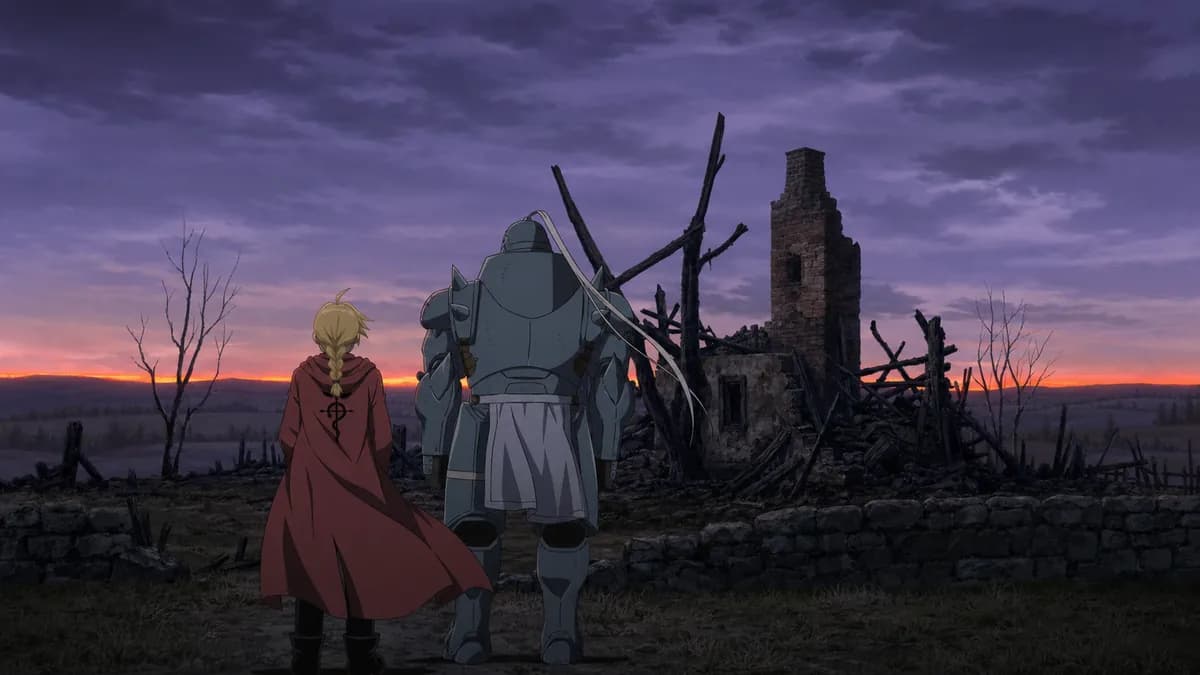
This is where Brotherhood separates itself from nearly every shounen peer: it has no disposable characters. Ed is a brilliant, hot-tempered teenager whose arrogance masks bottomless guilt; Al, trapped in cold steel, is somehow the warmest presence on screen. Around them orbits one of anime's great ensembles. Colonel Roy Mustang and the fiercely loyal Lieutenant Riza Hawkeye carry a slow-burn arc about power and accountability. Maes Hughes, I will not spoil it, but that thread genuinely broke me. Scar, introduced as a vengeful killer, becomes one of the show's most morally complex figures. Even the villains, the seven homunculi named for the deadly sins, are written with real interiority rather than cardboard menace. What impresses me most is restraint: nobody arrives fully formed. Ed's worldview shifts through what he witnesses; hardened soldiers reckon with atrocities they committed. The cast feels less like a roster and more like a living country. You finish caring deeply about people you were sure, early on, were minor.
Animation & Sound
Studio Bones handles the animation, and it shows in the fight choreography. Alchemy is rendered as a martial art, a clap of the hands and a surge of blue light reshaping the battlefield in real time. The action has genuine weight and spatial clarity; you always know where combatants are and what a transmutation costs. It is not the flashiest production ever made, and a few mid-run stretches dip in fidelity, but the direction never loses the thread. Akira Senju's orchestral score is the secret weapon, swinging from martial brass to aching strings without whiplash. The openings are a highlight; yui's 'Again' still gives me chills on the drop. I also have to praise the English dub, one of the best ever recorded, so subtitle purists and dub fans can both watch in good conscience. Sound design sells the body horror too, the creak of Al's armor, the hiss of automail, grounding the fantasy in something unnervingly physical rather than weightless.
Themes & What Sets It Apart
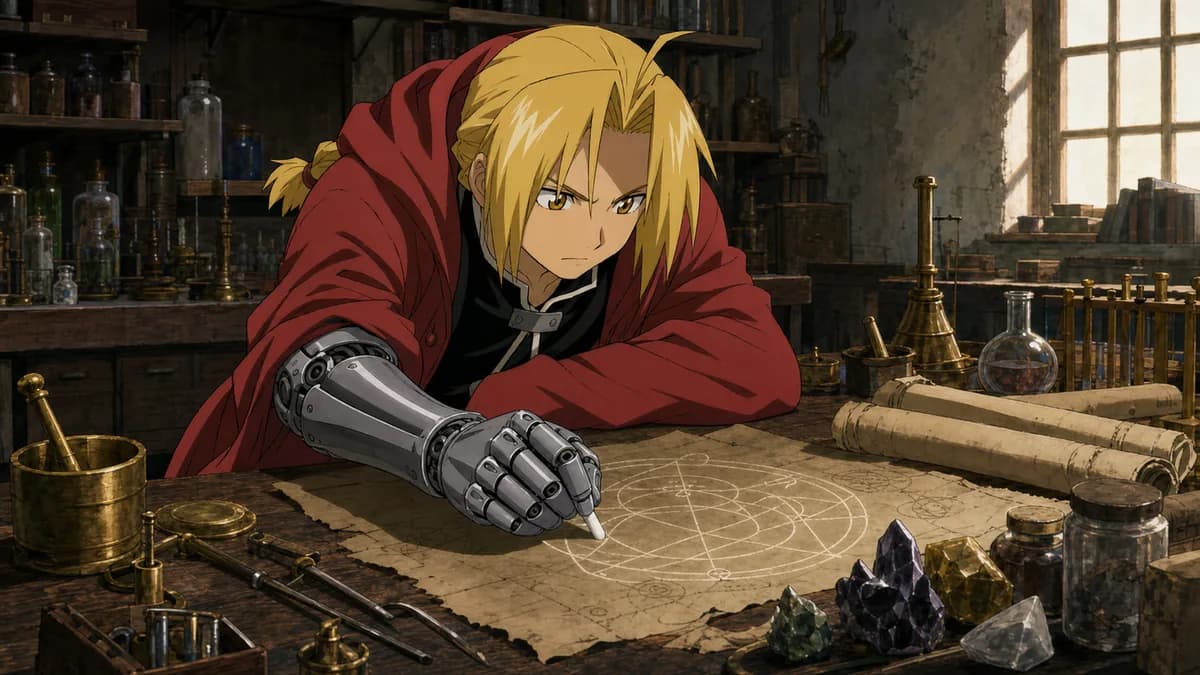
Equivalent Exchange is not just a magic system; it is the show's entire moral philosophy. To gain, you must lose; there are no shortcuts, in alchemy or in grief. Brotherhood interrogates the arrogance of playing god, the seduction of easy answers, and what people owe each other after unforgivable acts. Its treatment of the Ishvalan genocide is startlingly mature for a shounen title, refusing to let sympathetic characters off the hook for wartime atrocities. Yet it never curdles into nihilism. Against all that darkness, Arakawa keeps insisting on a stubborn humanism: people are worth saving, connection is the point, and no single person outweighs the world. What sets it apart is completeness. Plenty of anime start strong and collapse; Brotherhood's greatest trick is that it actually sticks the landing, tying every thread into a finale that feels earned rather than convenient. It is at once a rip-roaring adventure and a real meditation on mortality and forgiveness, holding both registers without ever dropping one.
Strengths & Shortcomings
The strengths are obvious and overwhelming: airtight plotting, an ensemble with zero dead weight, tonal range from slapstick to devastation, and a finale that pays off dozens of hours of setup. But a premium review owes you the flaws. The opening stretch is genuinely rushed; because the manga was nearly complete, Bones sprints through the brothers' early adventures, assuming you will keep up, and newcomers can feel whiplashed before the story finds its rhythm. The chibi comedy, charming as it is, occasionally punctures scenes that were building real dread. A couple of late-game resolutions lean on convenient power-ups, and the ultimate antagonist's motivation, deliberately abstract, lands as more thematic than viscerally personal, which blunts the final confrontation slightly. None of these are dealbreakers; they are the difference between a 96 and a perfect score. If your taste skews toward slow, ambiguous character studies, Brotherhood's shounen DNA, loud and earnest and occasionally tidy, may read as too neat. For nearly everyone else, the flaws are dust on a masterpiece.
The Verdict
Fullmetal Alchemist: Brotherhood is the anime I hand to anyone who claims the medium cannot do it all, action, comedy, tragedy, philosophy, and a plot that actually resolves, inside one coherent work. It is not literally flawless; the hurried opening and the occasional tonal jolt keep it a hair below perfect, which is exactly why the score lands at 96 rather than 100. But those are quibbles about a series that gets more right, more consistently, than almost anything else in the form. It rewards a first watch and deepens on a rewatch, when every foreshadowed line clicks into place. If you have never seen it, envy is the correct emotion to feel toward you, because you get to experience it fresh. Start it, give it a handful of hours to breathe, and let it earn every bit of the hype.
FAQ
Absolutely. It is routinely ranked among the greatest anime ever made, and it earns that status by balancing thrilling action with genuine emotional and moral weight. If you watch a single long-running series this year, make it this one.