Fire Force Review: David Production's Gorgeous, Tonally Reckless Inferno
 By Mika Tanabe · Editor
Fire Force wins you over through movement before anything else. David Production throws flame across the screen with such control that it can make you forgive, at least for a while, how often the writing wrecks its own mood. The story takes place in a Tokyo where ordinary citizens can erupt into living infernos. Shinra Kusakabe joins the firefighters assigned to deal with them, using the flames that burst from his feet while a demonic-looking grin betrays his nerves. Company 8 lays the combusting victims to rest and investigates what caused their transformation. Its work soon leads to a conspiracy tied to the tragedy that shaped Shinra's life. The show lives at two very different extremes. Its action can be astonishing, while its gags can make a serious scene collapse on contact. How well Fire Force works for you will depend on how much inconsistency that visual excitement can cover. For plenty of fans, the answer is quite a lot.
A Firefighting Story with a Conspiracy Inside It
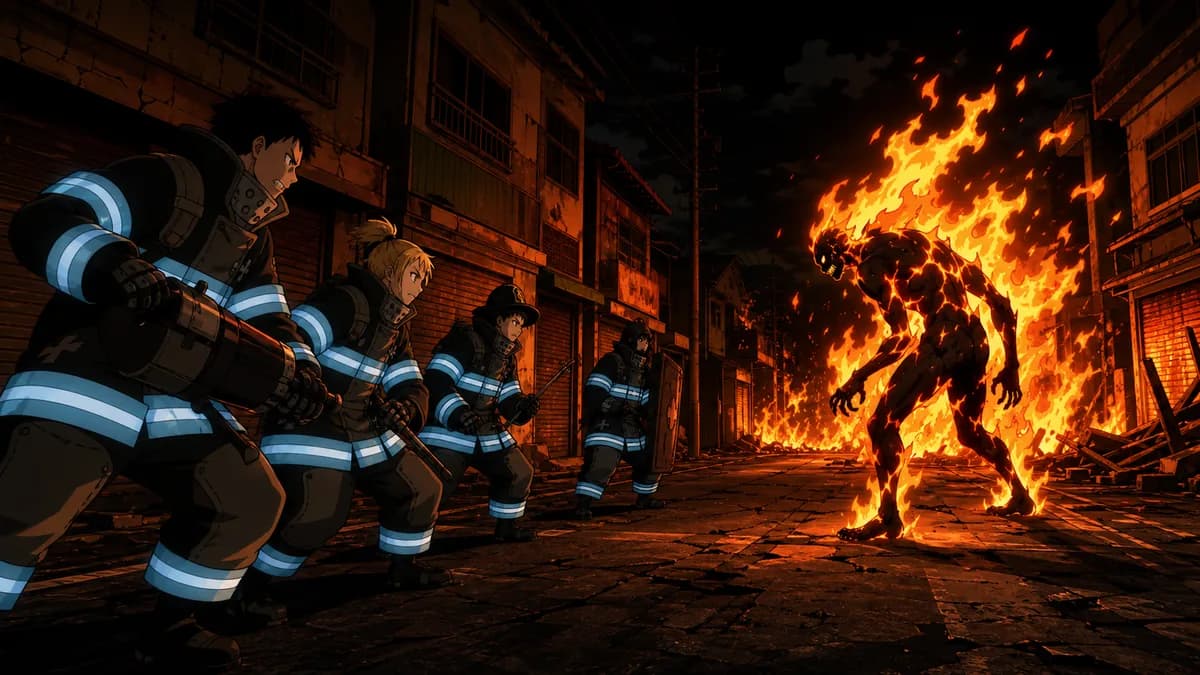
The premise immediately gives Fire Force an identity of its own. In Year 198 of the Solar Era, ordinary people spontaneously ignite and become rampaging beings known as 'Infernals.' Specialized fire brigades are responsible for putting those victims to rest. Later generations affected by the phenomenon retain their human form and gain the ability to wield flame, so those pyrokinetics fill the ranks of the Special Fire Force companies. Shinra joins Company 8, a scrappy unit that approaches every combustion as a rescue and a mystery. Its members never forget that each Infernal used to be somebody's family. That detail gives the job a sadness that a straightforward monster hunt would lack. At first, the series uses a monster-of-the-week structure built around emergency calls and investigations. Gradually, those cases expose a much larger plot. Someone is deliberately creating Infernals. The church responsible for blessing the dead may be corrupt, and the fire that killed Shinra's mother and brother years earlier was not an accident. Turning isolated incidents into a conspiracy is the story's sharpest decision because it gives all the spectacle a personal cost. The pacing does stumble. Certain investigations wander longer than they need to, while a few revelations turn up earlier than expected. Even so, Shinra's grief and his choice to turn it into duty keep the first season moving whenever an individual episode loses its footing. The central mystery also gives Company 8 a reason to look beyond each new blaze and question the institutions that tell them what their work means.
Shinra and Company 8
Shinra Kusakabe holds the series together. As a child, he was bullied because stress triggers a nervous grin that other people read as something sinister. He has built his idea of heroism around proving that he is a hero, not the 'devil' everyone assumes they see. There is real hurt beneath that smile, and Fire Force handles it well whenever it gives him room to be vulnerable. His desire to save people is not a vague shonen ambition. It grows directly out of his family's death. Company 8 surrounds him with a likable group whose personalities are easy to tell apart. Arthur Boyle calls himself the 'Knight King,' and his power literally grows with the strength of his chuunibyou conviction. Maki Oze is a soldier, far tougher than the jokes at her expense suggest. Hinawa is the unit's stoic gunman. Captain Oubi has no powers, yet his moral authority makes the rest of the company follow him. Iris, the nun who prays for the victims Company 8 puts to rest, keeps the spiritual meaning of their work present. Tamaki Kotatsu is where the character writing falls short. She is a capable fire-soldier, but the series repeatedly turns her into the target of its 'lucky lecher' punchline. The ensemble has plenty of charm, and each member arrives with a clear place in the team. The problem is distribution. Some characters receive thoughtful material, while promising arcs for others are set aside whenever a flashier fighter demands attention.
Animation That Makes the Flames Feel Physical
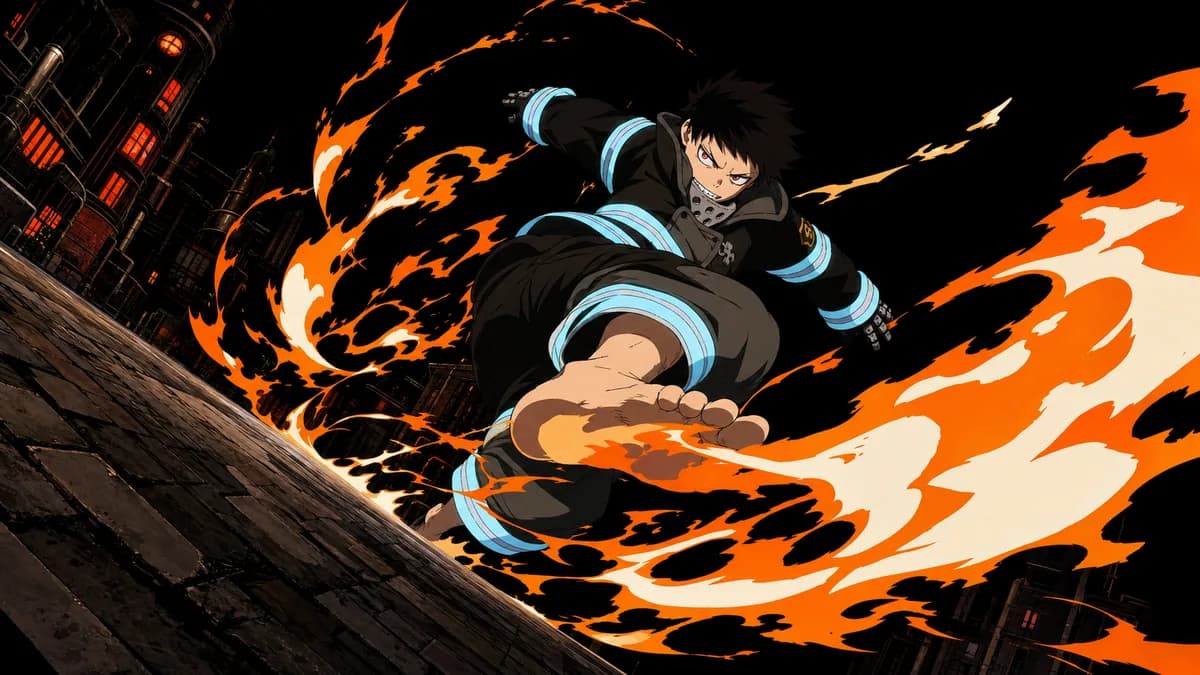
This is the part of Fire Force that fully earns the show's reputation. David Production, the studio behind JoJo's Bizarre Adventure, treats every burst of fire as part of the choreography. Flames carry weight and direction. Shinra's ignition-powered dashes carve scorched afterimages through a scene, and the camera races through combat with a fluidity that most action shonen never reach. Brightness alone is not what makes the attacks convincing. The heat and pressure come through as well, so a kick or explosion feels dangerous before it lands. Stylish framing and bold silhouettes bring Atsushi Ohkubo's designs into motion without sanding away their eccentricity. Speech-bubble text and flourishes shaped like manga panels preserve some of the original page energy on screen. Among mainstream action series from its era, Fire Force is one of the best looking, and its strongest fights are genuinely breathtaking. The sound work meets the animation at the same level. Fire has crisp, tactile foley, and the propulsive score knows when to drive a battle forward. The series also has a pair of memorable opening themes, including the earworm 'Inferno,' which fans still choose to play on its own. There is an unfortunate downside to giving every scene this much polish. The production applies the same visual attention to the leering comedy, so crude jokes can receive the sort of elaborate staging that only makes their intrusion harder to ignore. When the show concentrates on action, though, it plays like a showcase for what David Production can do.
Atsushi Ohkubo's Familiar Ideas in a New Setting
Fire Force clearly comes from Atsushi Ohkubo, the creator of Soul Eater. His preferences are visible in the gothic-cool character designs and in the collision between grim mythology and cartoon slapstick. The story shares his fascination with cults, souls, and institutions that conceal what they really are. Those elements make the series feel related to his earlier work without requiring any knowledge of it. Many shonen series use their setting mainly to arrange the next fight. Ohkubo instead develops a full cosmology around this one. The Solar Era has its own faith, an 'Evangelist' works from the shadows, and the metaphysics behind fire become stranger and more ambitious as the plot expands. Even the job of firefighting carries a meaning that separates Fire Force from its peers. Defeating monsters is only part of Company 8's work. Its members conduct a funeral rite for people who combusted, praying over them before they burn out. That rite asks the audience to remember that every Infernal belonged to somebody's family. Bringing reverence into the battles gives the series a texture that a conventional supernatural action show would not have. It also prepares ideas about grief, faith, and what humanity is willing to sacrifice. Those ideas continue to pay off beyond the first season. The imagination behind all of this is never in doubt. Viewers split over whether the comedy and dramatic timing can support that ambition without weakening it.
Big Strengths, Frustrating Habits
The flaws deserve direct attention because they are the reason many viewers abandon a show they might otherwise love. Fire Force suffers from severe tonal whiplash. A genuinely heartbreaking death can give way to broad comedy within seconds, with no space for the emotion to settle. That abrupt shift makes the drama feel disposable even when the preceding scene was carefully handled. The greater problem is the fanservice. Tamaki's recurring 'lucky lecher' gag engineers accidents in which she is stripped or groped during battles, then treats the result as a joke. The criticism is fair. Tamaki is competent and brave when the writing allows her to act, which makes her repeated reduction to this routine especially irritating. It is Fire Force at its most juvenile, and it can sabotage scenes that should belong to her as a fighter. Iris receives similar treatment, though less often. Some viewers will be able to brush these moments aside, but nobody should dismiss them as an imaginary complaint. They are a legitimate reason to hesitate before recommending the series. The other side is easy to see: exceptional action, a strong lead character, an inventive world, excellent music, and a conspiracy that becomes more rewarding with patience. Fire Force commits hard to both its best qualities and its worst instincts. Your response will depend less on whether its strengths appeal to you than on whether you can tolerate the habits that keep interrupting them.
The Verdict
Fire Force is a good series burdened by loud problems that it could easily have avoided. Viewers who can accept the sudden tonal changes and sit through Tamaki's recurring gag will find one of the most visually exciting action shonen of its generation. Shinra gives that spectacle an emotional anchor because his smile conceals pain that the story gradually brings into focus. Anyone who draws a hard line at juvenile fanservice is likely to find the series exhausting, and this is exactly the sort of show that will test that limit. Our score is 82. The recommendation is clear, but self-inflicted mistakes keep Fire Force from greatness, not any shortage of talent or imagination. Its highest peaks and deepest frustrations can appear in the same episode. David Production's remarkable fire effects provide the immediate attraction, while the growing conspiracy supplies the reason to keep watching. Go in knowing that the worst habits appear heavily near the front of the story. They become easier to forgive once the mystery takes hold, though they never stop being weaknesses that the show created for itself.
FAQ
Yes, with one clear warning. The beautifully animated action, likable cast, and slowly developing conspiracy make it easy to recommend. Its comedy and fanservice are much less reliable, so expect some scenes to land badly. If stylish supernatural shonen is what you want, the spectacle alone makes Fire Force worth trying.