Dr. Stone Review: Anime's Most Exhilarating Chemistry Lesson
 By Mika Tanabe · Editor
Most shonen heroes get a sword, a Quirk, or a monster in a ball. Senku Ishigami gets a periodic table. A blinding flash turns all of humanity to stone, and the modern world slowly gives way to jungle. When Senku wakes millennia later, he sets himself an absurdly ambitious job: rebuild civilization's entire technological ladder by hand, starting with fire and working toward antibiotics and electricity. TMS Entertainment's adaptation of Riichiro Inagaki and Boichi's manga is loud and funny, with no embarrassment about its love of knowledge. This survival adventure treats a successful batch of sulfa drugs with the same excitement another series might reserve for beating a final boss. The unlikely trick works. Dr. Stone can make chemistry feel like a cliffhanger, and that remains its finest achievement.
Story and Premise
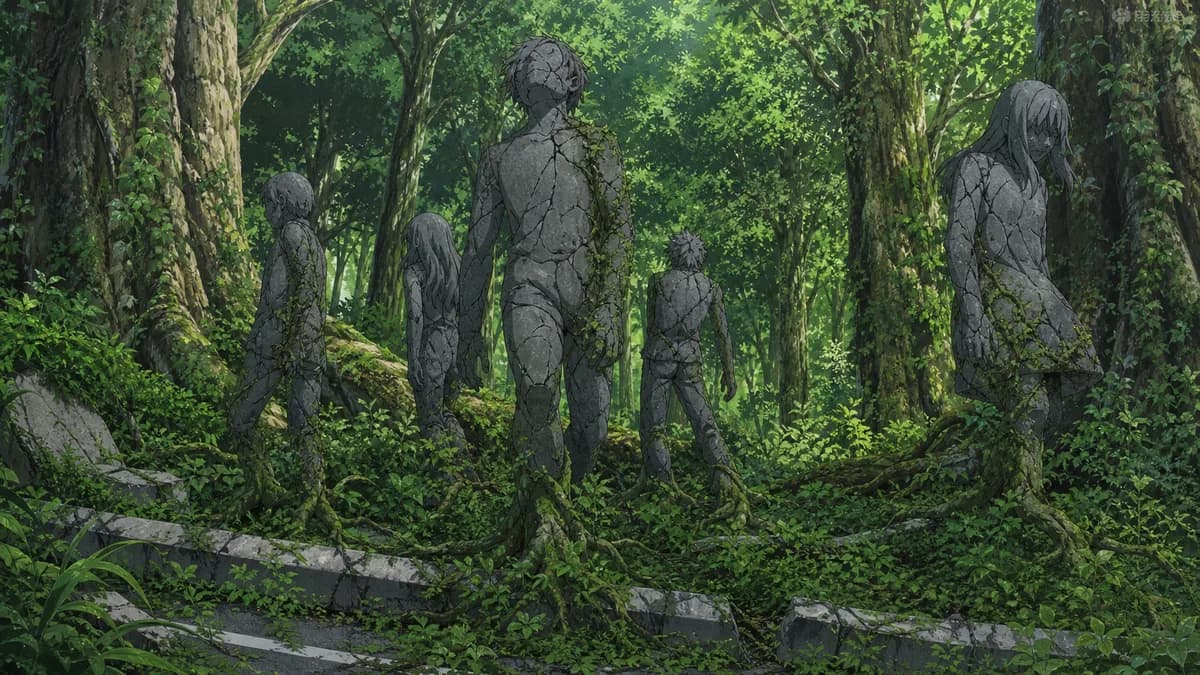
The opening idea grabs you immediately. Green light washes across Earth and petrifies every human on the planet, catching people wherever they happen to be. Ages pass. Nature swallows the ruins, and Senku Ishigami finally breaks free into a silent, overgrown world. He has no supplies or allies at first, only his intellect and the scientific knowledge he taught himself. Simple survival does not satisfy him. He intends to restart civilization in full, climbing the technology tree one rung at a time, from a crude lightbulb through iron and medicine. Dr. Stone finds its spark by treating the apocalypse as a chance to build. Senku does not pick through the corpse of the old world for whatever still works. He grows its capabilities again. Glass, gunpowder, and a working phone each become a quest with practical obstacles and serious consequences. Trouble arrives quickly when a revived rival proposes a completely different future. His new world would value strength and a clean slate rather than inherited knowledge. Their disagreement gives the plot its backbone: should the people who wake again preserve humanity's science, or try to begin in innocence? Without that conflict, the material might have become a relentlessly cheerful instruction guide. Instead, every invention also says something about the society Senku wants to restore.
Characters
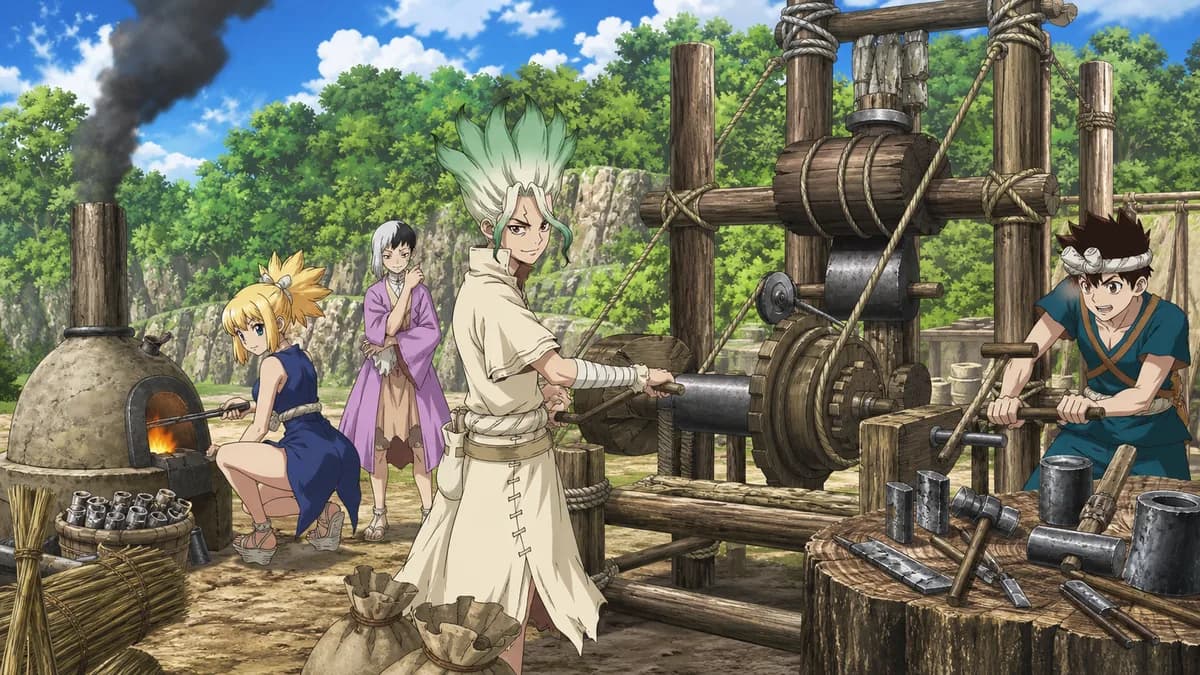
Senku Ishigami makes the entire premise come alive. Shonen leads rarely win through preparation instead of willpower, but this spiky-haired science obsessive plans, experiments, and cackles his way forward. His grinning catchphrase effectively means 'this is exhilarating.' He is arrogant without being cruel, ten-billion-percent confident and unexpectedly generous. The series also understands that intelligence cannot do every job. Senku needs other people's hands and the abilities he lacks. That dependence shapes the supporting cast. Taiju supplies raw muscle along with bottomless loyalty, while Yuzuriha acts as the group's steady heart. Chrome is a self-taught 'sorcerer' born in the stone world, and his delight in discovery makes him both Senku's apprentice and his reflection. Kohaku contributes her sword arm and sharp tongue. Kaseki is the master craftsman. Suika begins as a small, observant outsider and repeatedly finds ways to help. Tsukasa Shishiou stands against them, and raw strength accounts for only part of his menace. His philosophy is coherent enough to be almost sympathetic, which makes the conflict far better than a simple contest against a brute. The character writing tends to serve the plan before it explores anyone in depth. Most people have a clear job and remain strongly associated with it. Even so, the ensemble has real warmth. Their willingness to pool their abilities gives the found-family side of the show its pulse.
Animation and Sound
Dr. Stone looks handsome and energetic, even if it never reaches for nonstop visual spectacle. TMS Entertainment concentrates on the qualities that fit this story. Character movement is expressive and elastic, while the nature backgrounds give the reclaimed world a lush sense of life. A bright, clean palette keeps even an explanation of sulfuric acid visually active. Boichi's distinctive original designs survive the move into animation. The sharp angles and unruly hair remain, along with the exaggerated intensity. The direction is especially good at comedy. It can jump from honest wonder to rubber-faced slapstick without making either mood feel out of place. The limitations become visible during some quiet or crowded scenes, where the available budget is easier to spot. This is not a sakuga showcase, and it never presents itself as one. Jin Aketagawa's sound design carries plenty of weight. A reaction's crackle has enough texture to sell the experiment, and a fragile plan sounds as tense as it should. The score moves between triumphant electric guitar and genuinely stirring builds. Its opening themes have the propulsive energy the series needs, and they are very hard to skip. None of these elements overwhelms the material. Together, they make every small piece of progress feel physically convincing. The process stays easy to follow and exciting.
Themes and Its Distinctive Appeal
Dr. Stone stands apart because understanding the physical world functions as its greatest power. The series is openly and infectiously pro-science. It loves human ingenuity and respects the accumulated knowledge separating a caveman from a spacefaring species. It also teaches real ideas with an earnestness that very few shonen attempt. Much of the chemistry follows recognizable processes that a viewer can look up afterward. The route from wood tar to a sulfa drug has a basis in reality, as do the smelting of iron and the wiring of an electromagnet. Better still, the show enjoys laying out the intermediate work rather than cutting straight to the finished tool. Those recipes support an adventure instead of replacing one. Beneath them sits a serious disagreement about civilization. The story considers which knowledge deserves preservation and who should inherit the future. It also weighs progress as a gift against its use as a weapon. Its answer repeatedly favors cooperation over the fantasy of a lone hero. Senku may know the formula, but knowledge alone cannot mine materials and shape every component. It cannot convince a community to participate, either. Nobody rebuilds the world alone. Every success depends on people teaching one another and contributing a skill to the next stage. The scientific care and optimism give the series its own identity, while the shonen excitement keeps the lessons moving. No close peer has the same mixture.
Strengths and Shortcomings
For all its intelligence, Dr. Stone uses familiar shonen shortcuts without trying to hide them. Its science is sound in principle and heavily dramatized in execution. Timelines shrink, and montages cover feats that verge on impossible. Senku's small crew also finishes in days what required armies of specialists and centuries in our civilization. Viewers who demand strict realism may wince when the details get waved aside. The series sometimes treats science as a convenient answer to any problem, which can drain tension from a difficult situation. Its writing also stays broad. Villains tend toward simplicity, and supporting characters often function as parts of Senku's plan. The moral lessons can become loud as well. Pacing creates another clear weakness. This run works as an extended origin story, so it begins with a slower stretch filled with explanation and takes a detour midway through the story before its momentum fully settles. The ending openly prepares the next stage instead of completing a self-contained arc. These flaws never sink the series. The compression is part of what allows technical processes to become brisk entertainment, and the show's sincerity makes its rough edges easy to forgive. Watch it for the adventure and the pleasure of seeing an idea become a working object. It was never meant to pass as a peer-reviewed paper.
The Verdict
Dr. Stone earns its 86 because it is among the most joyful and quietly nourishing shonen in years. It makes curiosity the hero's superpower and commits to that idea with a grin. The science bends whenever the plot needs speed, and its characters are drawn in broad strokes. This opening run also behaves like a launchpad instead of a complete story. Still, few series show this much sincere pleasure in figuring out how something works. It teaches the viewer some real chemistry and somehow makes a lightbulb worthy of cheers. By the end, the next experiment feels genuinely inviting. Anyone looking for a survival epic powered by intelligence and a generous sense of wonder should begin here. Families can share it, too. Keep watching afterward, because the larger story is only beginning to warm up.
FAQ
Absolutely. It has one of the freshest shonen concepts in years: a survival adventure in which the hero rebuilds civilization through chemistry instead of winning with his fists. The result is smart and funny, and the experiments generate genuine excitement. Treating science as a superpower separates it from the rest of the genre. Its broad writing and dramatized experiments are noticeable, but easy to forgive once the inventions start landing. Viewers after an optimistic adventure with a working brain should consider it close to essential.