
Demon Slayer Review: The Anime That Set a New Standard for Action
 By Mika Tanabe · Editor
Demon Slayer hits with the force of a great action series and the ache of a much sadder story. Its setup sounds almost old-fashioned on paper. A gentle boy returns home to find his family slaughtered by a demon, while his only surviving sister has been cursed and is becoming a monster herself. He picks up a sword in the hope of putting things right. Plenty of shonen series have started with comparable ingredients, but few have been presented with this degree of care. ufotable's work made casual viewers notice frame rates and sent longtime fans into arguments about sakuga at parties. The narrative may be familiar, yet the execution is so accomplished that predictability rarely dulls the experience. Demon Slayer raised expectations for how anime action could look and, just as importantly, how much feeling a fight could carry.
A Familiar Quest with Real Feeling
The opening gets to the tragedy quickly. The hero returns home and discovers that a demon has killed his household. His sister is the sole survivor, but she has already started transforming into the same kind of creature that destroyed their family. He refuses to kill her. Instead, he promises to find a cure and track down the monster responsible. Doing either requires him to join a secret order of swordsmen fighting a hidden war against demons. The structure is a classic revenge-and-redemption journey, and the early episodes stick closely to the usual shonen route. He meets a mentor, endures punishing training, faces a graduation exam, and then travels into encounters with ever more dangerous enemies. The difference lies in the story's emotional tone. Grief hangs over nearly everything, but the series does not turn that grief into cheap edginess. The hero is moved by love and duty rather than a hunger for blood. His decency follows him into every battle, even when the enemy offers him no reason to be gentle. The Taisho-era Japanese setting also gives the journey a distinct look and mood. Lantern-lit villages give way to misty mountains, and early trains appear along the road. That period texture makes the world feel particular in a way many fantasy shonen settings do not.
A Hero Defined by Kindness
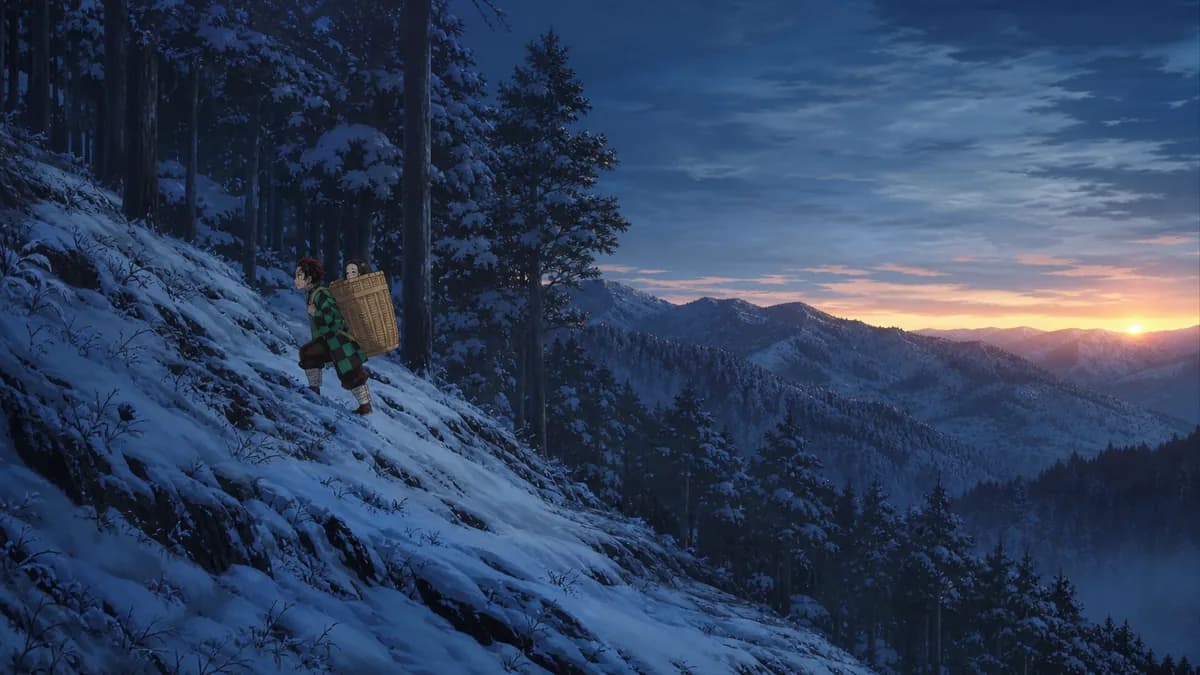
Tanjiro drives the series, and his temperament makes him unusual among shonen leads. He is consistently kind and emotionally perceptive, even allowing himself to mourn demons after he has been forced to kill them. A character written this way could easily become sugary, but Tanjiro's compassion feels earned. He can be naive without being foolish, and his stubborn streak has enough force to keep kindness from looking like passivity. Nezuko, the sister he will not abandon, is less fully served in this part of the story. She spends much of the run wearing a muzzle and saying very little. Her instinct to protect Tanjiro comes through clearly, but she functions more as an icon than a complete character early on and receives less inner life than she deserves. Much of the comedy and warmth comes from the supporting cast. Zenitsu is a whining coward who turns into a lightning-fast prodigy whenever he loses consciousness. Viewers who enjoy the bit may find him hilarious, while anyone with less patience for it may find him exhausting. Inosuke is a feral brawler in a boar mask, driven by unfiltered chaotic id. Giyuu Tomioka brings a quiet severity to the group, and Shinobu Kochou pairs a cheerful manner with an unnerving edge. Their personalities register immediately, as do their sharply readable silhouettes, so the expanding roster rarely becomes hard to follow.
Animation and Sound at Full Force
The praise for Demon Slayer's presentation is fully deserved. ufotable took a manga with an ordinary visual appearance and made the adaptation feel like a showcase for the possibilities of modern television animation. Hand-drawn character acting blends with digital effects and mobile camera work until the separate techniques become difficult to pick apart. The result gives each major clash the brightness and scale of a carefully staged fireworks display. Water Breathing attacks spread across the screen as rolling painterly waves. Lightning arrives in flashes that can last a single frame, and the virtual camera moves through combat with a sense of weight that many studios struggle to create. By the late part of the run, certain episodes reach such a fluid and kinetic level that they genuinely reset expectations for the medium. The audio meets the same standard. Yuki Kajiura's score knows when to bring in mournful strings and when to drive a scene with pounding percussion. The vocal cast handles the large emotions convincingly without pushing them into melodrama. Even the grotesque body-horror of the demons' transformations is given tactile, attentive detail. Demon Slayer is sometimes far more beautiful than its underlying material would seem to demand. That imbalance can expose the simplicity of the writing, but it also shows how much direction, motion, sound, and timing can add to a straightforward scene.

Compassion in the Middle of Violence
Beneath the visual spectacle, Demon Slayer is concerned with compassion in circumstances that seem designed to destroy it. The series' harshest device is also its most humane. Almost every demon Tanjiro kills receives a brief memory near death, revealing something of the frightened or grieving person it once was. Tanjiro cannot spare creatures that will continue killing people, but he can recognize what has been lost inside them. He grants them a measure of mercy as he strikes, asking the audience to feel sorrow at the same time as the violence. That sadness gives the fights meaning beyond the choreography and reaches for a heavier emotional register than the genre usually attempts. The show is also distinguished by abrupt changes in tone. Broad slapstick can sit beside warm domestic moments, then give way to genuinely upsetting horror within the same episode. The transitions sound unwieldy, and a few of them are, but most land because the characters' feelings remain clear. Its largest distinction is cultural rather than thematic. Demon Slayer showed that a mid-tier shonen premise could become a global phenomenon when paired with a top-tier production. The success pushed the expected standard for televised action upward, and the effects were felt across the industry.
Where the Series Excels and Where It Stumbles
The production cannot completely hide Demon Slayer's main weakness: the writing follows a well-worn shonen skeleton. The hero trains, meets a monster-of-the-week, fights, and moves on to a stronger threat. Anyone familiar with a few series of this kind will be able to predict many of the coming beats. Most villains have thin motivations until their deathbed flashbacks supply a burst of sympathy, and the middle portion can droop into episodic filler before the finale explodes into life. The comedy creates another divide. Zenitsu's shrieking breakdowns wear out their welcome for many viewers, and his creepy obsession with Nezuko can sour scenes that are supposed to be funny. Sudden comic detours also sometimes weaken emotional moments that needed more room to settle. Nezuko remains underwritten here, closer to a mascot than a person despite how important she is to Tanjiro and to the plot. It is fair to argue that the animation is carrying source material that would appear ordinary with a less gifted studio behind it. Still, the craft is exceptional and the emotions are sincere. Above all, the series is remarkably easy to keep watching. It offers the familiar satisfaction of comfort food made with the precision of a Michelin kitchen. The recipe may hold few surprises, but the quality of the result is rare.
The Verdict
Demon Slayer earns its 85 because it is among the most immediately enjoyable action anime ever produced, even if its script seldom surprises. Viewers who value originality in storytelling above every other quality may resist the scale of its acclaim. This is not the deepest shonen ever written, and the series does not pretend otherwise. Its achievement is the way it can make a fight leave your jaw hanging while the emotion brings tears to your eyes in the same minute. Very few shows manage that combination as well. I recommend it to people who insist they dislike anime, and it wins them over more often than not. The plot has familiar bones, but ufotable gives them extraordinary form and the characters supply a sincere heart. That balance places it in the low-to-mid eighties for me. It has flaws, so I would not call it a perfect masterpiece. I would call it a landmark action series that anime fans owe it to themselves to experience.
FAQ
Yes. The plot covers familiar shonen territory, but the animation and fight choreography give it exceptional force, while the emotional writing keeps the action from feeling empty. Anyone with even a passing interest in action anime should try it.