Attack on Titan Review: A Modern Landmark Built on Pure Dread
 By Mika Tanabe · Editor
Some shows ask you to care about their world; Attack on Titan grabs you by the collar in its opening minutes and makes caring feel like survival. Within its first act it commits an act of narrative cruelty so total that the rest of the series plays like one long exhale you never quite get to take. This is anime as pressure cooker: the last of humanity penned behind enormous walls, faceless giants roaming outside them, and a cast of teenagers handed blades and told to hold the line. My headline thesis is simple. This is a modern landmark that turns raw dread into pure propulsion, and even where it stumbles, nothing else on the shelf feels quite like standing on that wall.
Story & Premise
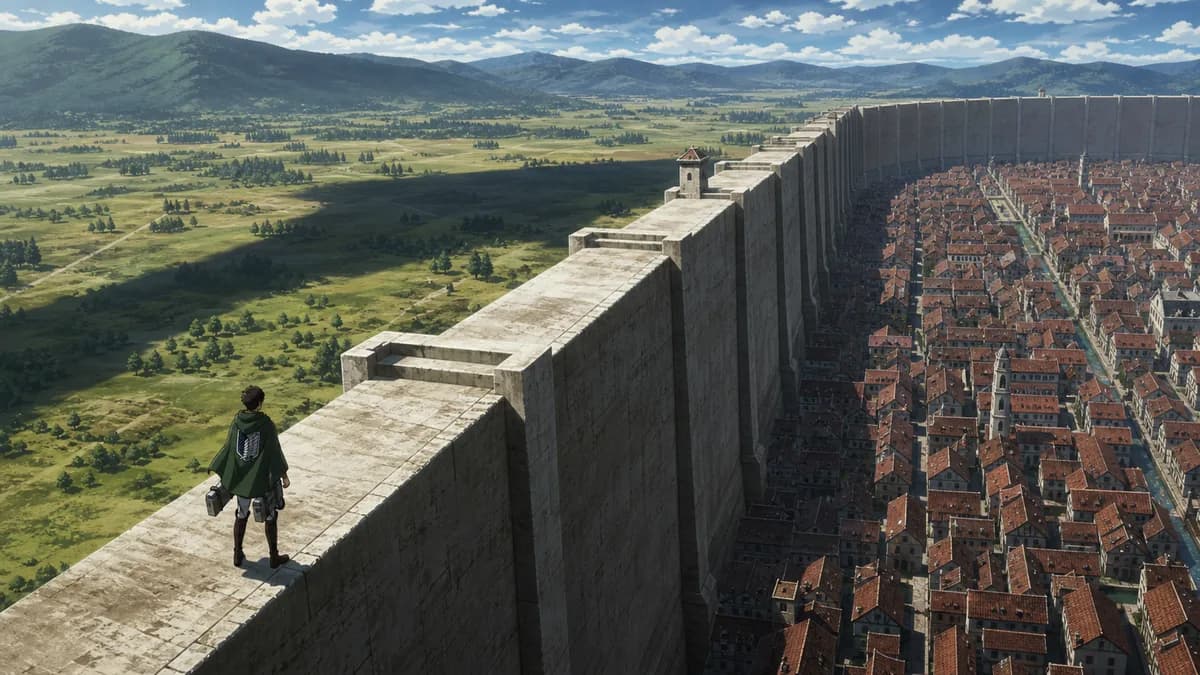
For more than a century, the last of humanity has lived inside three concentric rings of colossal stone, treating the walls less like architecture than scripture, proof that the man-eating Titans beyond them can be held off forever. The premise's genius is how fast it detonates that comfort. A single catastrophic morning turns the safest district into an abattoir, and young Eren Yeager watches the life he assumed was permanent get chewed away in front of him. What follows fuses several genres without diluting any of them: the fantasy of a walled, quasi-medieval world, the drama of grief hardening into obsession, the action of soldiers slingshotting through ruined streets on gas-powered gear, and a real mystery about where the Titans came from and why. Crucially, the show treats its setup as a question rather than a backdrop. Every answer it hands you pries open two darker doors, and that engine of dread plus curiosity is what keeps the walls from ever feeling safe again.
Characters
The central trio is a study in contrast that mostly works. Eren is pure furnace, a boy who converts trauma into a vow of extermination, and early on that single-mindedness can tip into shouting sameness. What rescues him is the pair orbiting his fire: Mikasa, the quietly devastating fighter whose stoicism hides bottomless protectiveness, and Armin, the timid tactician who keeps insisting that brains matter more than bravado. Around them, the series stacks one of the strongest ensembles in the genre. Hange Zoe's manic scientific glee, Sasha Blouse's food-obsessed comic relief, and the flinty resolve of veterans like Petra Ral give the Survey Corps texture far beyond cannon fodder, even as the show stays ruthless about reminding you they are, in fact, mortal. Even antagonistic figures such as Annie Leonhart are drawn with unsettling interiority rather than cartoon menace. The cast's real achievement is making you dread the roll call, because Attack on Titan will spend a beloved character without hesitation to make a point land.
Animation & Sound
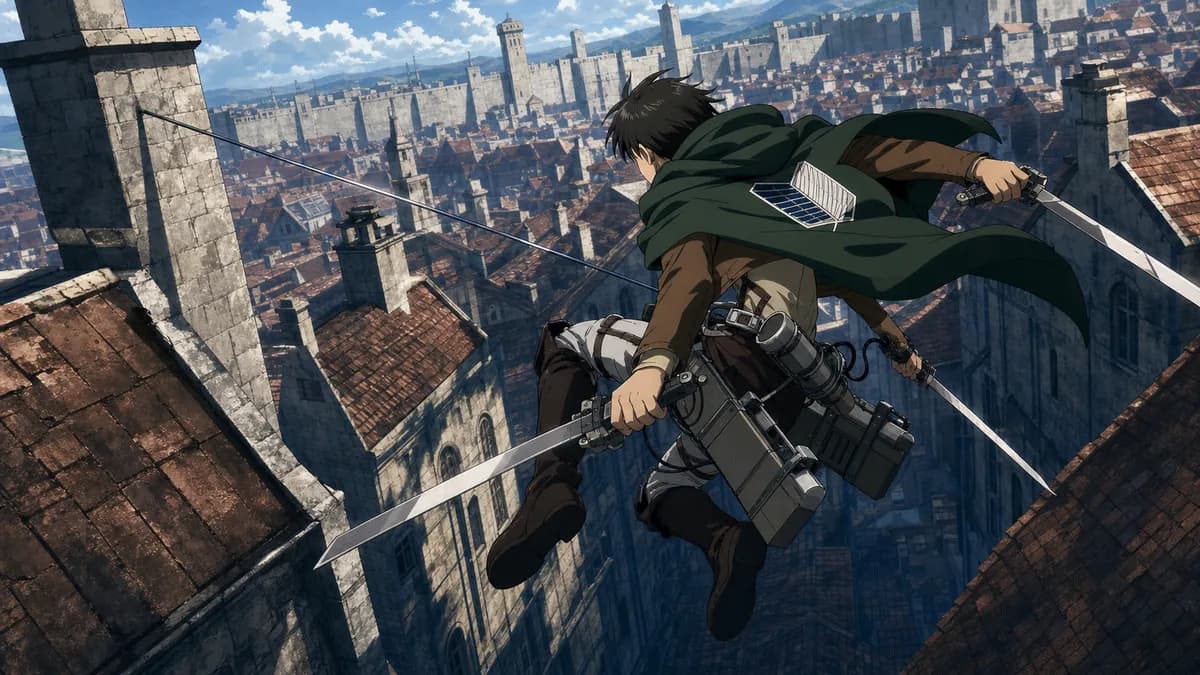
Animated by WIT Studio under the Production I.G umbrella, this is the show that made a generation obsess over vertical maneuvering. Director Tetsurou Araki stages the omni-directional mobility gear like aerial ballet with a body count, soldiers whipping between rooftops and Titan napes in long, vertiginous takes that still rank among the most kinetic action ever storyboarded for television. The Titans themselves are rendered with a deliberate wrongness: uncanny grins, lurching gaits, and an occasional shift into a thicker, almost woodcut line that makes them feel like nightmares intruding on daylight. Sound is where it truly separates from the pack. The score swings from mournful strings to full operatic bombast, layering choral chants and blaring brass over the biggest set pieces until the dread turns physical. Add bone-crunching foley and those infamous Titan roars, and the audiovisual package lands like a war film. It is loud, it is gorgeous, and it is completely uninterested in ever letting you relax.
Themes & What Sets It Apart
Strip away the giants and Attack on Titan is really about the terrible arithmetic of survival, what a species will sacrifice, and become, in order to keep existing. Its recurring obsession is freedom: the ache to see the ocean, the outside world, anything past the stone horizon, set against the grim truth that the walls keeping everyone alive are also a cage. That tension is what gives the carnage meaning. Every charge outside the gates is framed as a choice between safety and dignity, and the series never once lets a heroic sacrifice feel clean or cost-free. What sets it apart is its flat refusal to flatter the audience. There are no plot-armored protagonists here, no comforting promise that courage guarantees survival; bravery and brutal death share the same frame. It is a coming-of-age story in which growing up means learning how indifferent the world truly is. That moral seriousness, welded to blockbuster spectacle, is exactly why it burst out of the anime bubble and into the mainstream conversation.
Strengths & Shortcomings
The strengths are obvious and enormous: a hook that never loosens, worldbuilding that doubles as an unfolding mystery, top-tier action, and the nerve to make death genuinely matter. But a premium review owes you the flaws, and this first stretch has them. The pacing is uneven; long passages of ground-level survival horror can stall into extended interior monologues, characters narrating tactics mid-battle while the momentum quietly drains. There is a noticeable reliance on recap and reused footage that pads certain stretches and can test a binge-watcher's patience. Eren himself is a shakier lead early on than his reputation suggests, running on a single note of rage until the plot forces more range out of him. And the relentless bleakness, while very much the point, is legitimately exhausting; this is not a show that offers many places to breathe. Most of all, it ends mid-story, a deliberate, tantalizing cliffhanger that resolves almost nothing and demands you commit to what comes next. Brilliant, but not remotely a stand-alone.
The Verdict
Attack on Titan earns its status as a modern landmark. The score of 91 reflects near-elite work: a masterclass in tension, spectacle, and worldbuilding that genuinely expanded what mainstream audiences believed anime could do. The points I am holding back are honest ones. The uneven pacing, the padding, and a first run built to end on a cliffhanger rather than a resolution keep it just shy of the untouchable tier. But those are the quibbles of a great work, not the excuses of a flawed one. If you can stomach the cruelty and the dread, this is essential, genre-defining viewing, the rare phenomenon that turns out to be exactly as good as everyone promised. Start here, brace yourself, and know that the wall only climbs higher from here. It is worth every step.
FAQ
Absolutely. It is one of the defining anime of its era: relentlessly tense, gorgeously animated, and emotionally uncompromising. If you only ever sample a handful of modern anime, this one belongs on the list.