Studio Pierrot: The Home of the Shonen Titans
 By Mika Tanabe · Editor
Say "Studio Pierrot" in any comment thread and someone will type "filler" before the sentence finishes. It is the laziest received opinion in anime fandom, and it gets the studio backwards. Pierrot's specialty was never the single show-stopping cut. It was endurance: keeping a weekly series on-model, legible and emotionally alive across a run measured in years, while the manga it adapted was still being drawn. That is a genuinely hard craft, and almost nobody else was willing to attempt it at that scale. Bleach is the clearest case study, and its long-delayed return is the control experiment that settles the argument. The filler everyone mocks is not evidence of incompetence. It is the invoice for a model that built the audience modern anime now sells to.
The Studio That Plays the Long Game
Most studios make a show. Pierrot kept them running. Bleach, adapted from Tite Kubo's Weekly Shonen Jump manga about a high schooler who can see ghosts and ends up shouldering a borrowed shinigami's job, is one column of a portfolio that also carried Naruto into Naruto Shippuden and onward into Boruto: Naruto Next Generations, with Yu Yu Hakusho a generation earlier and Black Clover more recently. Read that list as a business rather than a fandom argument and something obvious surfaces: this is the house that accepted the assignments other studios treat as a career hazard. A weekly slot chasing an unfinished manga is a grinder. Schedules do not flex. Designers do not rest. The team animating this week's fight is already booked for the next one. Pierrot did not merely survive that pressure; it built institutional muscle for it, on several flagship series at once. Whatever you make of the results, the operational feat is real, and the studios currently praised for immaculate single-cour productions have never attempted anything close to it.
Legibility Is the Craft Nobody Scores
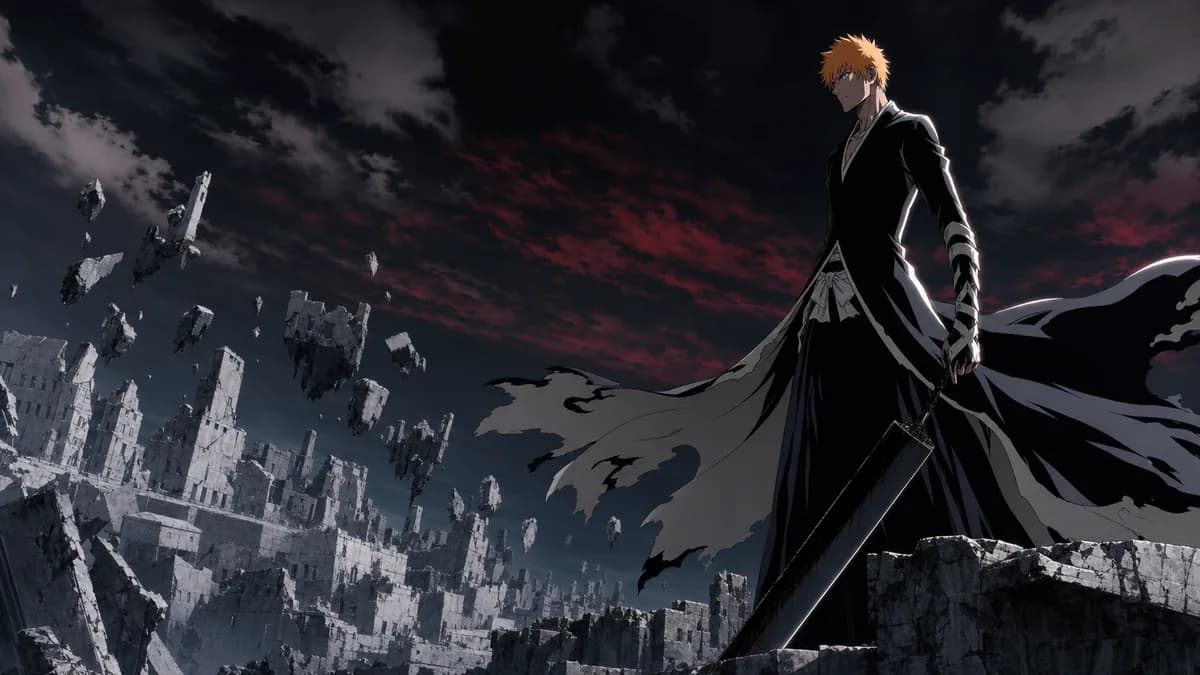
Watch what a long-running shonen actually demands, and it is not sakuga. It is legibility. A fight has to read at a glance: who stands where, whose blade is where, what just changed. Kubo's designs are engineered for exactly that, all silhouette and negative space, faces that survive a lean production week because the shapes carry the weight. Pierrot leaned all the way in. Bleach's visual signature is stillness and composition, a held frame, a slow pan across a coat, a palette that drops to flat white and blood red at precisely the right beat. Then Shirou Sagisu's score arrives and buys something no cut count can. Those horns and choirs make a standoff between two shinigami feel world-historical on resources that should not permit it. That is craft; it simply is not the kind that trends as a fifteen-second clip. It is the difference between animation as spectacle and animation as storytelling, and this studio has always been fluent in the second language.
The Case Against Pierrot, Taken Seriously
The indictment deserves a real hearing, because on the facts it is correct. Bleach's run is padded with arcs that exist because the adaptation caught its source and had nowhere left to go. Momentum dies in them. A newcomer arrives at a story with genuine peaks and is immediately handed a spreadsheet of what to skip, which is an absurd thing to ask of anyone starting a series. Some mid-run stretches look visibly under-resourced. All true. Here is why none of it sinks the studio: the alternative on offer was never a tight, seasonal Bleach. In a weekly slot beside an unfinished manga, the options are pad or stop, and stopping means the show never reaches the scale it reached. Notice, too, what the complaint quietly concedes. Nobody writes a skip guide for a series that vanished after one cour. Filler is a symptom exclusive to shows that lived long enough to matter, which is this entire argument compressed into a single word.
The Range the Meme Erases
Reduce Pierrot to shonen and you delete most of the shelf. The Twelve Kingdoms is dense political fantasy far more interested in how a realm is governed than in who can hit hardest. Yona of the Dawn is a patient exile story about a sheltered princess growing a spine. Great Teacher Onizuka is a delinquent comedy that keeps smuggling in real pathos. Tokyo Ghoul went for body horror and identity panic. Akudama Drive is a neon-soaked original with no manga to serve at all, which is the house proving it can simply invent something. And Yu Yu Hakusho laid down the template half of modern shonen still runs on: the tournament structure, the rival who becomes indispensable, the tonal drop into something darker than the opening promised. That is not a one-note factory. That is a working studio with a wide register, judged in perpetuity by the single title that accumulated the most hours to complain about.
Thousand-Year Blood War Settled the Argument
Then came the return. Bleach: Thousand-Year Blood War took the same property and the same house and changed exactly one variable: the production model. A finished manga to adapt. A cour structure instead of an endless slot. Time to board, time to paint. What arrived is the best-looking work anyone at that studio has put on screen, with inky compositions, ruthless pacing, and Sagisu's music finally mixed like it belongs in a feature. If the problem had been talent, that could not have happened; nobody acquires a visual identity that confident in one production. The problem was a constraint, and removing it revealed a very high ceiling. There is a debt here that rarely gets acknowledged, too. The audience that turns today's prestige hits into global events was assembled slowly, by shows that were simply there every week for years. Streaming inherited that habit, and it is why a catalog like Disney Plus or Hulu still wants Bleach on it.
FAQ
No, it is optimized for a different problem. Years-long weekly production rewards clean design, readable staging and consistency over show-off cuts, and when the studio gets a normal seasonal schedule, as with Bleach: Thousand-Year Blood War, its ceiling is as high as anyone's.