Production I.G: Anime's Quiet Powerhouse
 By Mika Tanabe · Editor
Some studios are visible from orbit. You know their palettes, their house faces and the exact way they light a room. Production I.G works differently. Its fingerprints appear on an implausible share of the medium's landmarks, yet plenty of viewers never register the name. People often explain that anonymity as weak marketing or simple modesty. Neither answer fits. Production I.G stays hard to see because its specialty depends on disappearing into the work. Instead of imposing a style, the studio studies the subject in front of it and serves that subject with unusual care. This is how one production house can own cyberpunk and volleyball at the same time. It also explains why its older work refuses to age and why the studio will probably never trend like its flashier peers. That bargain deserves a close look.
The Studio With No Obvious Face
Name a studio and an image usually follows. ufotable means fire rendered like stained glass. Kyoto Animation brings to mind afternoon light passing through a classroom window. MAPPA suggests a fight staged like a short film with its own director. Try the same exercise with Production I.G and nothing obvious arrives. There is no standard palette, no familiar set of house faces and no signature effect that identifies the studio from a single screenshot. That blank does not reveal a gap in your knowledge. It may be the most accurate thing you can know about I.G. Ghost in the Shell, Haikyu!! and Kaiju No. 8 came from the same production house, but they share almost nothing else. Ghost in the Shell is grey, wet and philosophical. Haikyu!! is bright, loud and constructed from sneaker squeaks. Kaiju No. 8 plays as a monster blockbuster while keeping genuine body horror beneath the spectacle. Any studio capable of making all three has declined, by definition, to settle on one face. I.G is often described as self-effacing because of that choice. Strategy is the better explanation. The approach lets the material determine the result, though the studio gives up something real in exchange for that freedom: viewers have a harder time forming an instant image of the company itself. Its work becomes famous while the maker remains oddly indistinct.
Observation Comes Before Style
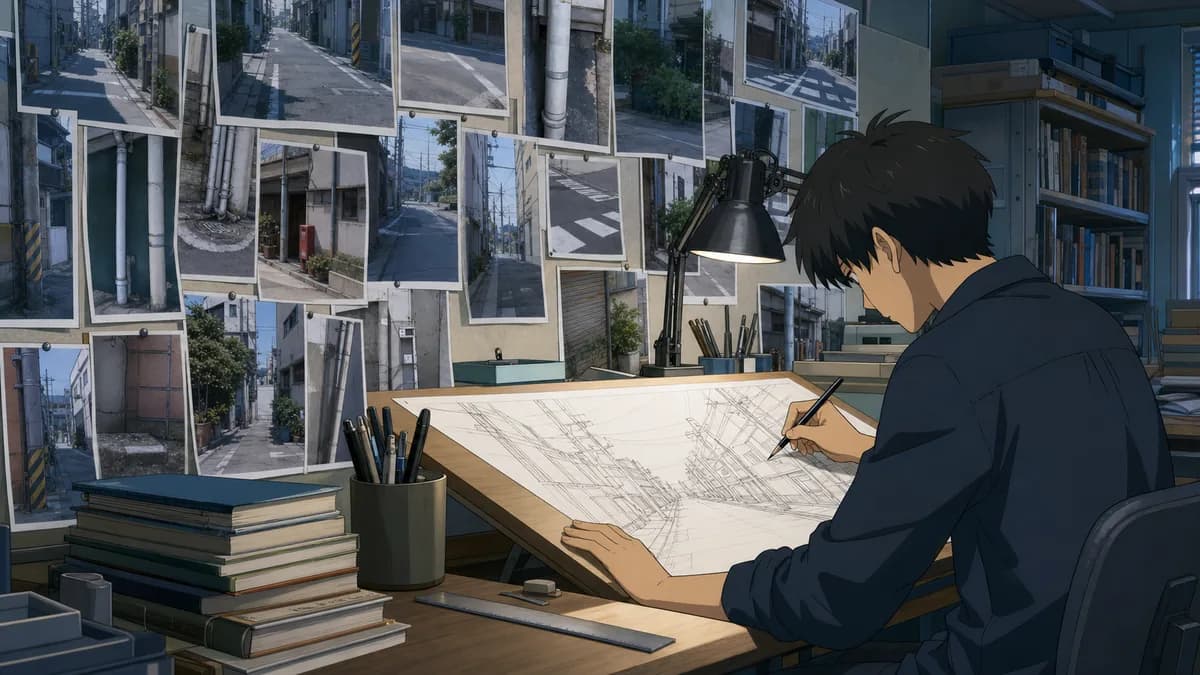
If I.G has a signature, it lies in the method rather than the finished look. The studio works out how a subject actually functions, then animates what it has observed. Ghost in the Shell's city convinces because the cabling, crowds and machinery look as if somebody studied them before anyone started drawing. A filter could supply atmosphere, but it could not provide that sense of physical knowledge. Haikyu!! became the most beloved volleyball series ever made largely because the viewer can always track the ball, understand where each player stands in relation to the net and see why an apparently casual receive is actually desperate. The space stays readable, and that readability creates the drama. Run with the Wind brings the same rigour to running form. Distance running sounds like one of the least cinematic subjects available until a runner's stride begins to degrade across a leg. You can see exactly what the effort costs him because the movement has been watched closely enough to tell the story. Welcome to the Ballroom finds its drama in posture and frame. Across all of these productions, animation behaves like reporting. It pays attention before it embellishes. Visual fashions age quickly, while an accurately observed movement or environment keeps making sense. That is why so much of the I.G back catalogue still holds up while flashier contemporaries can look trapped in the moment that produced them. The shows do not depend on a fashionable studio effect for their force. Their authority comes from knowing what they are looking at.
Psycho-Pass Shows the Method Clearly
Psycho-Pass offers the cleanest single example of the studio's working method. It is an original work, with no manga underneath it, no built-in audience and nothing pre-existing to serve faithfully. That choice already says something, since the safe modern business is to adapt material that has proved itself. The staff makes the case even more clearly. Original character design went to Akira Amano, the manga artist behind Katekyo Hitman Reborn! That sensibility has no obvious place in a bleak cyberpunk procedural, which is precisely why the decision works. The faces remain handsome and readable in shonen terms even as the surrounding world rots. Sayo Yamamoto storyboarded and directed the opening, then later went on to direct Yuri!!! on Ice. Makoto Fukami carried the scripts through nearly the entire run. Naoyuki Onda anchored chief animation direction during the back half. This was not a standard house style pressed onto whatever material happened to arrive. The team was built to answer one particular problem: how can algorithmic justice be made to feel physical? Across the two-cour run, Akane Tsunemori, Shinya Kougami and Shougo Makishima operate less like conventional characters than three competing arguments over the meaning of justice. Their conflict makes the show's ideas tangible and gives them consequences. Every major staffing choice supports that task from a different angle. Psycho-Pass looks like itself because I.G assembled people suited to its central question, not because the studio required the series to resemble the last thing it made.
Range Is How the Business Works
Most studios build a reputation by repeating one strength until nobody handles it better, then guarding that territory. I.G made the opposite bet and has collected on it for decades. Cyberpunk belongs to the studio several times over. Ghost in the Shell established that claim internationally. Ghost in the Shell: Stand Alone Complex showed that film-grade craft could last across a television series. Psycho-Pass then carried the lineage into a procedural built around policing intent before a crime occurs. Sports also belongs to I.G again and again through Haikyu!!, Kuroko's Basketball, Run with the Wind and Welcome to the Ballroom. Each title asks for a different kind of motion and a different way of making bodies readable, yet all of them benefit from the same habit of close observation. The range keeps widening outside those two areas. Jin-Roh is a genuine art film with a body count. Heavenly Delusion is a post-apocalyptic mystery with some of the finest background art in recent memory. Uzumaki is horror. Kaiju No. 8 is unapologetic blockbuster shonen. Very few production houses can point to defining works in four genres at once. I.G can do it because the studio never created a fixed appearance that needed to be protected. A signature style helps inside one genre and becomes a liability in the next. Method can move from a cyberpunk city to a volleyball court because it begins by asking what the new subject needs. Aesthetic habits do not travel with the same ease. I.G's lack of a recognisable surface is therefore tied directly to its extraordinary range, not evidence that the studio lacks an identity.
The Best Objection: Quiet Studios Get Overlooked
There is a strong objection to this argument. WIT Studio was founded by Production I.G producers under the same parent company. It received one enormous property in Attack on Titan and became a household name almost immediately. WIT followed that success with Vinland Saga, Ranking of Kings, Great Pretender, Vivy: Fluorite Eye's Song and a hand in Spy x Family. An offshoot from I.G's own corporate family outran it in public recognition on its first swing. That result raises a fair challenge to any grand claim about the power of I.G's approach. Anonymity carries real costs. When viewers cannot picture a studio, it builds little fan loyalty around the company name. It receives no automatic benefit of the doubt when a season wobbles, and its name carries less weight when a hot manga goes to auction. A studio without a set style is not protected from failure either. Guilty Crown is a gorgeous I.G production built around a script that never quite closes its hand. The objection gets the question of fame right, but it mistakes fame for the measure of craft. Public recognition tends to follow properties. I.G has built its model around a different kind of success: the ability to be hired again in any genre for an indefinite period. That power accumulates slowly and attracts less attention than a huge breakout title. It is also much harder to lose. WIT's rapid visibility shows what I.G surrendered by keeping its identity flexible. It does not prove that flexibility was a mistake. It shows the exact price of the choice.
Follow the Credits Instead of the Logo
The useful result of all this is a better way to decide what to watch. A studio logo provides a coarse signal. The individual names inside the credits provide a much finer one. Sometimes a stretch of a series suddenly becomes braver. The camera drops lower, the timing tightens, or a quiet scene gets room that the plot did not strictly require. Those changes usually come from one storyboard artist or episode director receiving genuine authorship, and that person's name scrolls by a few minutes later. Production I.G rewards viewers who notice those names because its lack of a uniform house style leaves individual authorship visible. There is no dominant visual formula smoothing every contribution into the same shape. What you are seeing is often the particular judgement of the people assigned to that episode or sequence. Start with whichever part of the studio's range suits your taste. Choose Psycho-Pass to see I.G at its most argumentative. It streams legally on Crunchyroll, Hulu, Netflix and Tubi, and there is a sequel series waiting if the world catches hold of you. Pick Haikyu!! if delight sounds better than unease. Go to Ghost in the Shell for the landmark that made the rest of the world take the medium seriously. These are three completely different experiences from one production house. Their differences reveal the studio better than a shared surface ever could. Once that habit of reading credits takes hold, I.G stops looking anonymous. Its identity appears in how carefully each production understands its own subject.
FAQ
Its reputation rests at two opposite ends of the spectrum. The Ghost in the Shell films and series made Production I.G a global name in cyberpunk, while Haikyu!! is widely treated as the high-water mark of sports anime. Psycho-Pass, Heavenly Delusion and Kaiju No. 8 extend the same range through the studio's more recent slate.