How Anime Tackles Grief and Loss
 By Mika Tanabe · Editor
Most media treats a death as a plot event: it happens, someone cries, the story moves on. Anime's best grief stories do something stranger and more useful. They treat grief as a problem of language. The question isn't whether it hurts, it's that the hurt refuses to fit into words, and the show gets built around that failure. Violet Evergarden is the purest version: a former soldier takes a job putting other people's feelings into letters while remaining unable to name her own. That is not a premise about mourning. It's a premise about the distance between what you feel and what you can say, and I'd argue that distance, not the death itself, is what this medium has spent decades getting right.
Grief as a Translation Problem
Violet Evergarden hands its protagonist a job that is really a thesis. As an Auto Memories Doll, a ghostwriter for hire, she sits across from strangers, listens to whatever they can manage to say, and returns it as a letter they can actually send. The work is emotional translation and she is very good at it. She is also, for most of the series, incapable of performing it on herself: the last words a person she loved gave her are the one text she cannot decode. Reiko Yoshida's series composition presses on that irony on purpose. Every commission is a rehearsal for a translation Violet can't yet do. And notice how few of those commissions are actually about death. Some clients are in love, some are estranged, some are simply out of time. The show's claim is that they all run on the same engine: a feeling that outgrew the vocabulary available to hold it.
The Episodic Form Does the Heavy Lifting
Here is the structural advantage anime has and rarely gets credit for. A film has to pick one grief and drive it. Grave of the Fireflies chooses a single unbearable trajectory and refuses to soften it, which is exactly why it works and exactly why most people watch it once. A serialized, episodic show can do something a film can't, which is survey. Violet Evergarden runs a tight single cour and spends most of it as an anthology: a new client, a new house, a new shape of loss, resolved and released. Nothing escalates. Things rhyme. That structure quietly makes the point that grief isn't one emotion with one arc but a category of experiences that only look alike from the outside. Meanwhile the protagonist's own arc advances by inches, which is the honest rate. A show that fixed her in one dramatic breakthrough would have been lying about how this actually goes.
Animation Has to Choose to Draw the Empty Chair
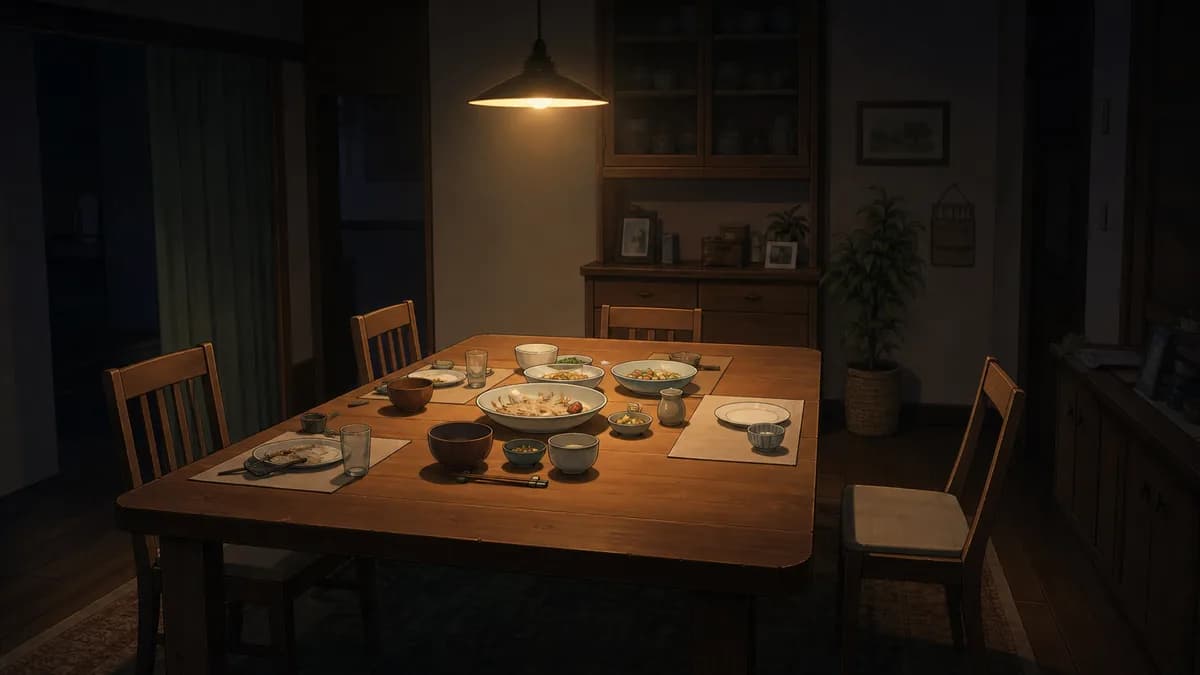
Live action photographs a room and the absence comes free: the missing person is simply not in the shot. Animation has no free absence. Every object in a frame was drawn on purpose, so an empty chair, an unopened drawer, a place setting nobody uses is an authored decision, and audiences feel that authorship even without naming it. Kyoto Animation built this show's entire grammar around it. The series watches hands more than faces. Fingers on typewriter keys, a grip that hesitates, the small physical business people do instead of saying the thing. Naoko Yamada took storyboard duty on one of its most-quoted stretches and Yasuhiro Takemoto directed and boarded others; between them the show learned to hold a cut a beat past comfort. Youta Tsuruoka's sound direction finishes the job with room tone, the clack of keys, the silence where a reply should be. A Silent Voice trades in the same currency: point the camera at the object, not the crying face.
The Strongest Objection: Isn't This Just Engineered Crying?
The fair criticism goes like this. "Sad anime" is a product category with a known parts list: the childhood friend, the flashback timed to the reveal, the piano cue that arrives four seconds early, the diagnosis. Anohana and Your Lie in April both get accused of pulling those levers, and the accusation isn't stupid. Both are engineered. Both know precisely where you will start crying and build toward it. I don't think the charge lands, though, because it tests the wrong thing. All drama is engineered; what matters is what the engineering is for. So use a sharper filter: does the show stay past the death? A story that climaxes at the funeral used a death as a payoff. A story that opens long after one, the way Anohana does with a loss nobody has managed to move past, is genuinely about grief. Violet Evergarden begins after the war is already over. The loss is historical before the first letter gets written. That's the tell.
Recovery Is Social Infrastructure, Not Willpower
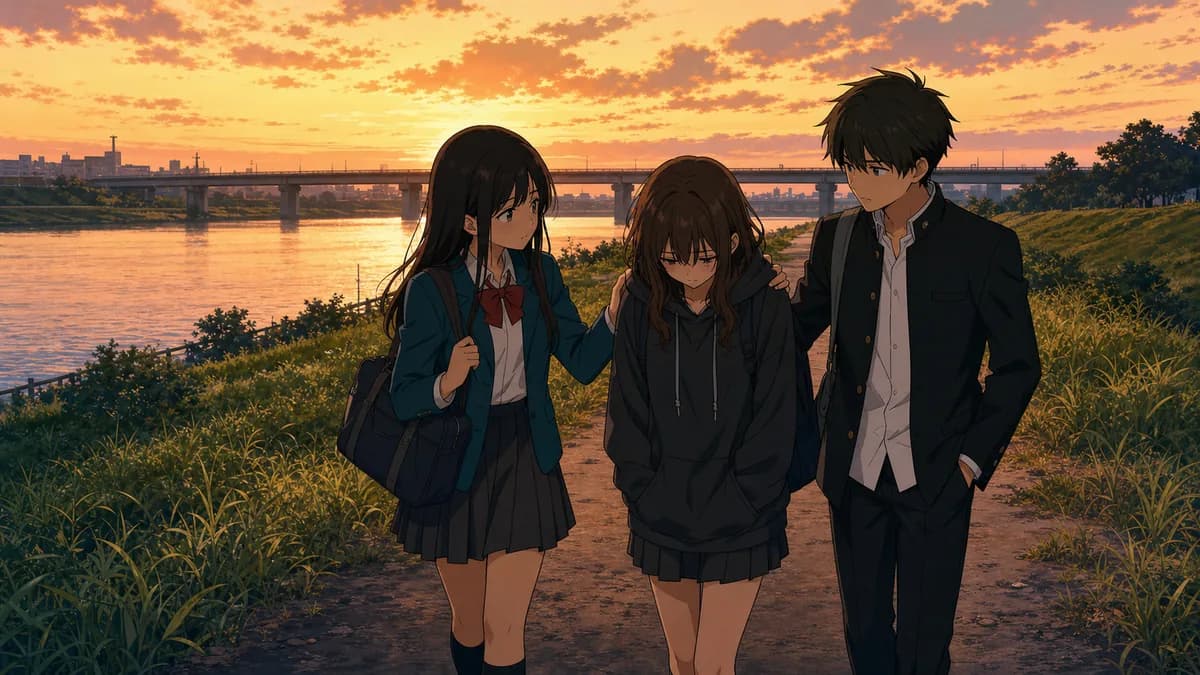
Anglophone prestige drama loves the solitary mourner, alone in a house, processing. Anime almost never stages it that way. It puts grief inside a workplace or a found family and lets the ensemble do the work. Violet's rehabilitation happens at the CH Postal Service among Claudia Hodgins, Cattleya Baudelaire, Benedict Blue and colleagues who largely don't lecture her. They just keep handing her assignments and keeping her in the room. March Comes in Like a Lion is the most explicit version, where a depressed teenager gets fed by neighbors until eating turns back into living. Anohana can't resolve at all until the whole group is physically present. The shared argument across these shows is that recovery is infrastructure: somebody has to keep showing up with dinner, with work, with a reason to leave the apartment. That's a different and, I'd say, truer model than the one where the bereaved is expected to repair themselves in private.
The Real Subject Is Time, Not Closure
The last thing this medium gets right is duration. Grief in these stories doesn't resolve, it changes scale. Frieren: Beyond Journey's End is the purest statement of it, a mage who outlives her companions and only afterward, slowly, begins to grasp the size of what she had. The critical shorthand people reach for is mono no aware, the ache built into the fact that things pass, and it fits, though it undersells the practical version: these shows are interested in what the fifth year feels like, not the first week. Violet Evergarden never pretends to erase what happened to its protagonist, and it's telling that the story kept going afterward into a side story and a feature film rather than sealing itself with one final image. That's the form being honest. There is no last page for this. The letters just keep going out, and somebody keeps writing them.
FAQ
Violet Evergarden is the cleanest entry point, because it's episodic and you can sample a couple of self-contained stories before committing to the whole thing. It streams on Netflix. If you want something rawer and more character-driven, Anohana arrives at a similar place by a very different road.