Steins;Gate Review: Anime's Best Time-Travel Story
 By Mika Tanabe · Editor
Some anime seize your attention in the cold open. Steins;Gate is happy to wander for a while. Rintarou Okabe, a self-appointed mad scientist, delivers grand speeches about secret organizations as his friends microwave bananas in their cramped Akihabara lab. It can be hard to see what everyone loves about the show during those early episodes. Then one discovery changes its entire shape. The loose hangout comedy becomes a tightly wound tragedy about altering the past and paying for it afterward. White Fox adapted the visual novel by 5pb. and Nitroplus with unusual confidence, allowing the quiet setup to do its job before the consequences arrive. That patience makes the later pain land harder than a barrage of spectacle ever could. Give it the time it asks for. El Psy Kongroo.
The Story and Its Rules
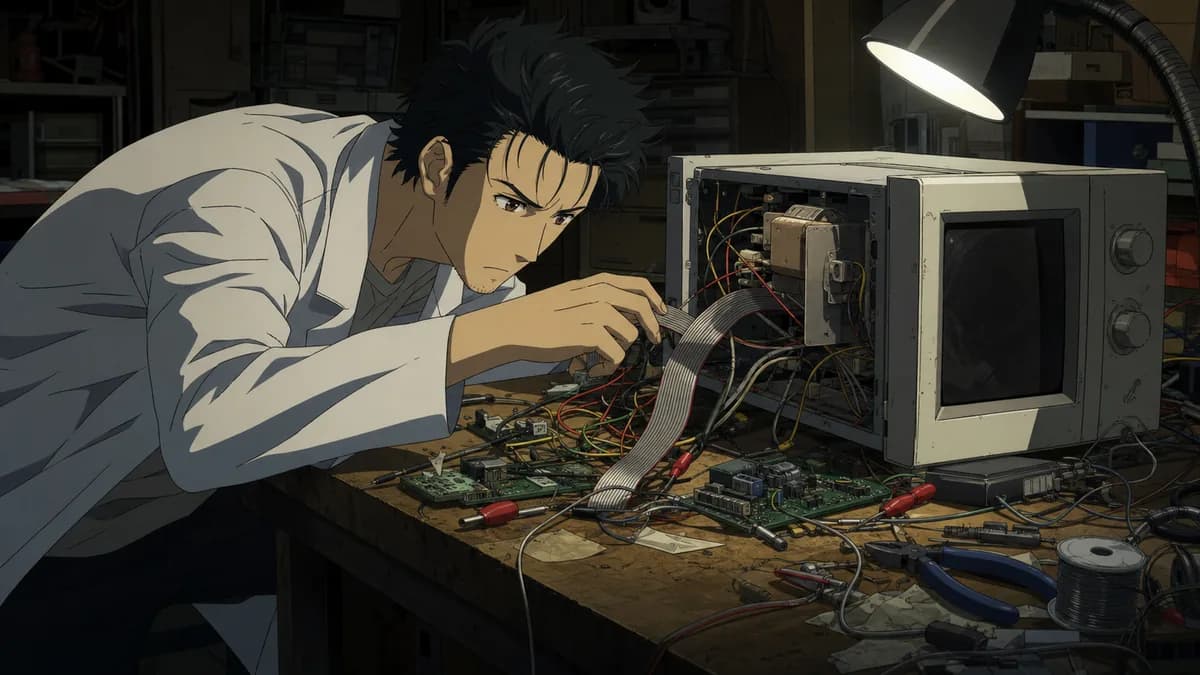
The story opens with a broken pocket watch and a text message received before it was sent. Okabe and the other members of the Future Gadget Laboratory, including hacker Daru and cheerful Mayuri, learn that their improvised Phone Microwave can send messages into the past. Each one nudges history by a few minutes. Their first reaction is playful, with ideas such as undoing a bad grade. The mood darkens when they understand that somebody else wants this ability and begin to consider what a shadowy organization might do with control over time. On paper, the premise sounds familiar. The writing makes it feel anything but ordinary. Small details that look disposable during the opening stretch return much later with brutal consequences. Watching the series again can feel like reading the same book after finally understanding how cruel it was all along. The time-travel rules also hold firm. Every message sent backward has a price, and each apparent repair damages something else. The script never grants the cast an easy exception. Once the real stakes become clear, each new attempt to put history right closes another route of escape. What looked like a comic experiment has become a trap built by the characters themselves.
Okabe, Kurisu, and the Lab Members
Steins;Gate depends on Rintarou Okabe working as a character, and the writing pulls off a difficult trick with him. He first appears as an unbearable chuunibyou who cackles, swishes his cape, and answers a phone that never rang. In those performances he calls himself 'Hououin Kyouma.' It is easy to expect that persona to become exhausting. Instead, the series gradually exposes the frightened and intensely loyal young man behind the act. His change across the story belongs among anime's finest character arcs because the bravado never disappears without explanation. It buckles under pressure. Kurisu Makise is equally well served. She initially reads as a prickly genius neuroscientist, but the show gives her far greater depth than that description suggests. Her exchanges with Okabe are sharp and funny, while the connection between them develops at a pace that makes every later moment convincing. Mayuri provides the innocent warmth that keeps the lab together and becomes the story's emotional anchor. Daru brings the science fiction back down to earth through his grubby manner and startling competence. Suzuha, Luka, Faris, and Moeka also receive moments that reveal inner lives of their own, rather than existing as devices for the plot. By the second half, the lab members feel like a found family. The audience's affection for them is what gives the coming suffering its force.
Direction, Animation, and Sound
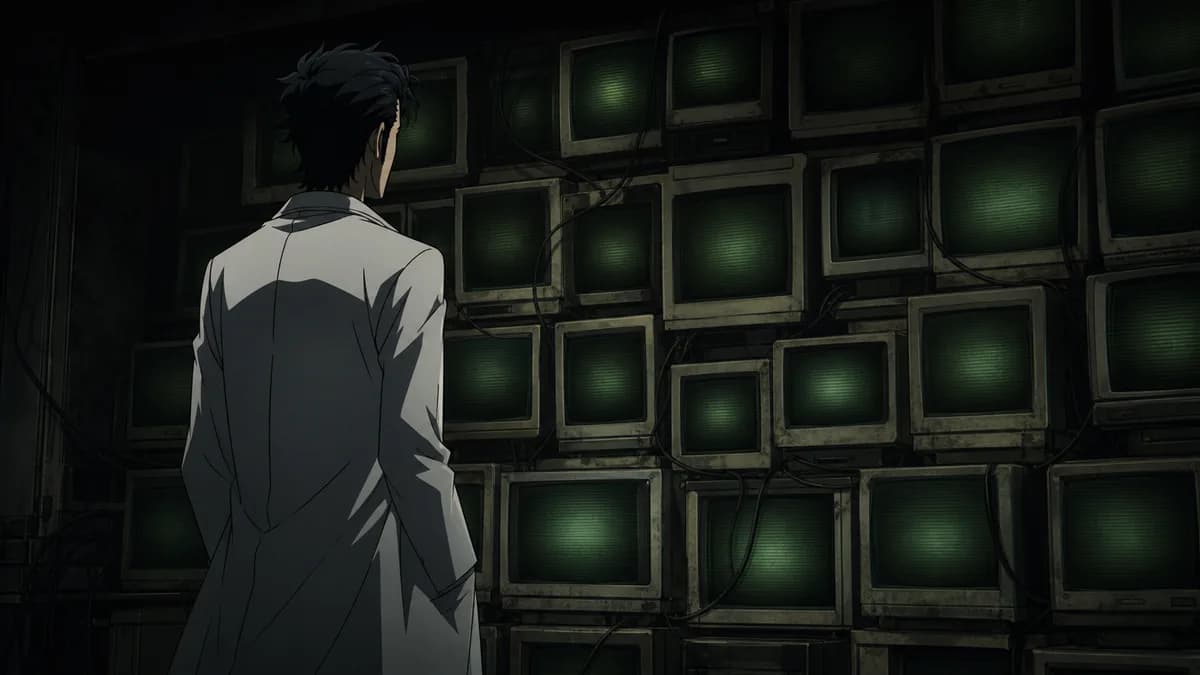
White Fox keeps the production deliberately restrained. Director Hiroshi Hamasaki avoids building the series around flashy set pieces. He uses a pale, slightly unhealthy color palette that turns a hot Akihabara summer into something oppressive and dreamlike, which suits a story about a man coming apart. The character animation saves movement where it can, yet faces and gestures remain expressive. Carefully recreated Akihabara streets give the setting physical weight, as do the tube monitors and the crowded mess inside the lab. This technology looks used instead of displayed. Hamasaki often holds on silence or a static composition long enough for discomfort to settle into the scene. When the plot tightens, the direction changes pace with it. Sound does even more of the work. Kanako Itou's opening theme, 'Hacking to the Gate,' ranks among the great anime openings because it catches both the dread in the story and its gathering momentum. Takeshi Abo's synthesizer heavy score slips anxiety into scenes that seem calm on the surface. Individual noises matter too. A keyboard clacks in an otherwise still room. A CRT hums. A cheap phone buzzes, and an everyday object suddenly feels dangerous. The combined effect is quiet and exact. Steins;Gate knows that tension often grows faster when the production resists the urge to shout.
Why Its Time Travel Feels Different
Many anime play with time travel, but very few approach it with the same discipline or emotional honesty. Steins;Gate is interested in obsession and grief, especially the damage done when someone refuses to accept a loss and the universe continues to reject every correction. Its system of 'world lines' does real dramatic work instead of decorating the story with clever terminology. The framework repeatedly puts Okabe in situations where saving one life may cost another, and it offers no clean answer that lets him escape responsibility. Weaker science fiction can use a trip through time as a reset button. This series treats every rewind as an experience that leaves a scar, even when other people no longer remember what happened. Some results cannot be optimized out of existence. It also asks what remains of a person after the willingness to do anything has worn away their judgment. Alongside those larger concerns, the series captures the abrasive, particular feel of otaku culture in its setting. Akihabara is tied to imageboards and to urban legends such as the John Titor myth, but the show depicts that culture from inside rather than staring at it as a curiosity. Its careful science-fiction construction matters because it traps characters the audience cares about. Human desperation gives those rules meaning, and the rules prevent that desperation from finding an easy exit.
Where It Struggles and Where It Excels
The price of entry is real. The first half moves slowly enough to become a slog for some viewers. Okabe's exaggerated mad scientist routine is meant to irritate, but intention does not automatically make it pleasant to watch. Daily life in the lab can drift, and several character detours in the middle resemble padding on a first viewing. Later developments justify most of that material, though the audience cannot know that while watching it unfold. The comedy is also strongly tied to its period. Imageboard jokes and broad otaku stereotypes appear often, while some awkward 'Engrish' has aged poorly. Once the main plot takes control, one or two members of the supporting cast receive less attention than they deserve. These problems do not ruin the series, and much of the slow material is doing necessary setup. Still, new viewers should know that Steins;Gate saves most of its reward for the back half. What follows the long buildup is exceptional. The tension rises with near perfect control, and the heartbreak never feels detached from earlier choices. Okabe and Kurisu make an unforgettable central pair. Most important, the finale resolves a difficult time-travel plot without wasting the emotional cost that came before it. Few stories in the genre manage an ending that satisfying. Patience is required, but the resulting catharsis earns it.
The Verdict
Steins;Gate is neither the fastest anime to win over an audience nor the flashiest one on the screen. Its measured approach is a large part of why the series stays in the mind after slicker productions have faded. The opening asks viewers to trust that its odd conversations and loose comic episodes have a purpose. During the back half, the show repays that trust through a remarkably precise time-travel thriller filled with genuine heartbreak. Okabe develops from a mortifying poser into a damaged, unwilling hero, and his journey stands as one of the medium's great character arcs. Because the series refuses to make changing history easy, every decision carries weight. There are flaws. The early stretch drags, while parts of the humor have soured with age. The destination still makes those slow steps worthwhile. If you intend to watch only one science-fiction anime, choose this one. Just reach the turn near the halfway point before making up your mind. El Psy Kongroo.
FAQ
Yes. It is widely considered one of the greatest anime ever made and remains near the top of all-time rankings by rating. Viewers do need to accept a deliberate buildup. The first half resembles an eccentric comedy, then the full and devastating shape of the plot comes into view. Stay with the complete story and it delivers one of the medium's most satisfying payoffs.