
Samurai Champloo Review: Lo-Fi Beats, Cold Steel, and a Road Trip Worth Taking
 By Mika Tanabe · Editor
Samurai Champloo cares less about chasing its plot than catching a particular feeling. In Shinichiro Watanabe's follow-up to Cowboy Bebop, the dust of Edo-period Japan settles over a scratched-vinyl beat while three badly matched travelers keep stumbling into trouble. Mugen fights as if a breakdancer has decided that self-preservation is optional. Jin's blade moves with the strict timing of a metronome. Fuu is the waitress who talks both men into joining her search, then somehow keeps their brittle agreement from falling apart. The mix of hip-hop and topknots sounds absurd on paper, as does the combination of DJ scratches and drawn steel. On screen, it walks in with complete confidence. The series uses the shape of an action show to build a mood, and cool matters far more to it than the next cliffhanger. Viewers after a tightly serialized run may find its pace frustrating. Anyone ready to sit with its style should pull up a cushion.
The Road and the Search
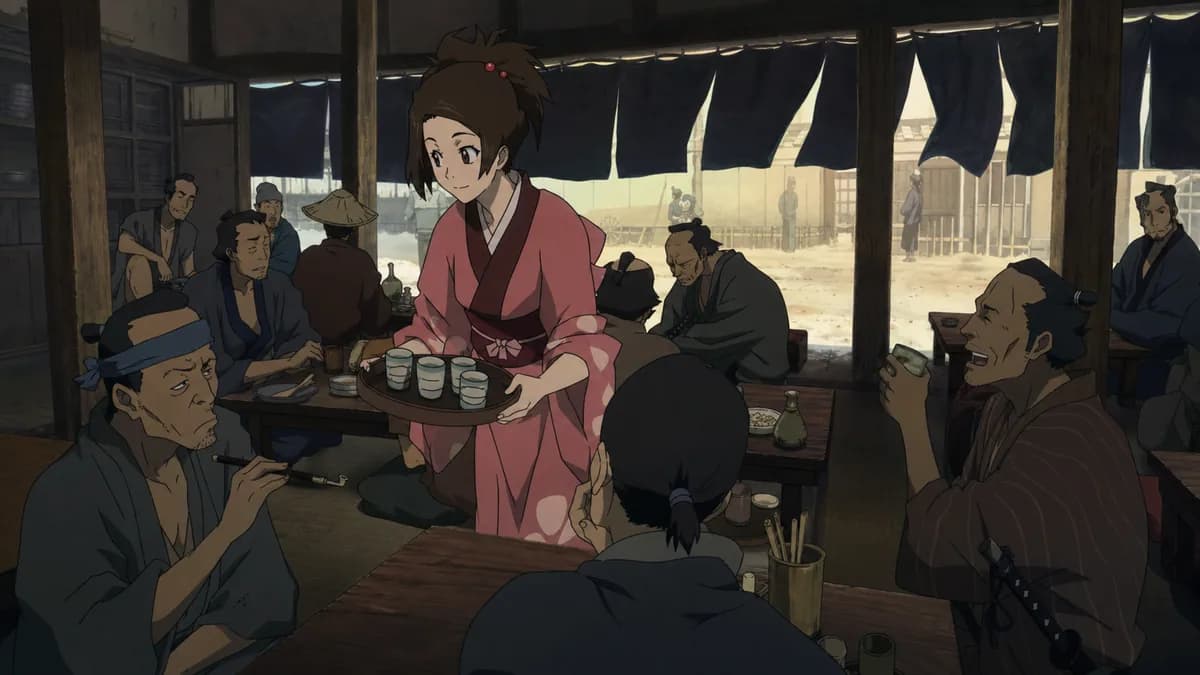
The premise wastes no time. Fuu is a teahouse waitress whose nerve regularly outruns her judgment. After she saves two condemned swordsmen from the executioner, she immediately calls in the favor: they must help her find 'the samurai who smells of sunflowers.' Mugen is a feral vagrant from the southern islands, while Jin is a disgraced ronin trying to stay ahead of his own history. Neither man has any interest in Fuu's request. A coin toss and an uneasy truce put the three of them on the same road anyway. The search gives the series a direction, but rarely dictates its next stop. Champloo only pulls on the sunflower-samurai thread when it feels the time is right. Most episodes take the form of picaresque detours involving corrupt magistrates, rival dojos, smugglers, a baseball game against Americans, or a graffiti contest. These diversions are the substance of the trip, not obstacles between the audience and the real story. Plot functions as a road with plenty of exits, and the series takes nearly every one. It trusts that spending time with this company will matter more than reaching the next marked destination. The central mystery does receive a strong payoff when the story finally returns to it. Getting there calls for patience, though. Samurai Champloo is made for viewers who enjoy the trip even when the map stays folded away.
Three Travelers Who Should Not Get Along
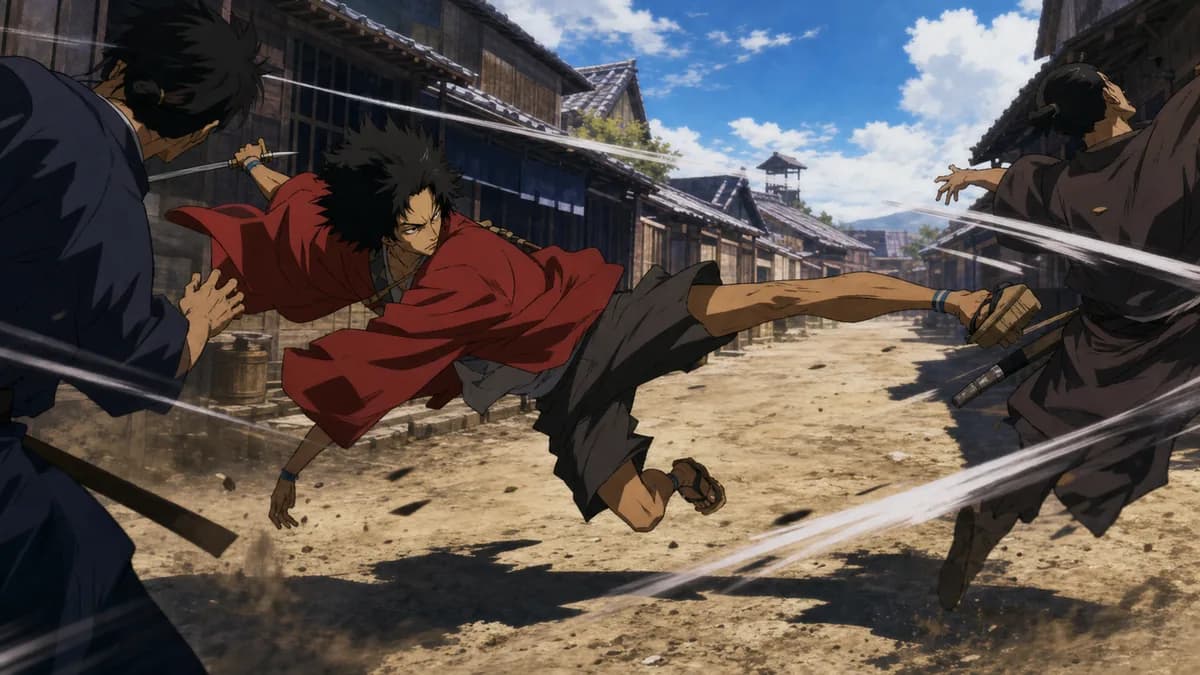
Everything depends on the chemistry among the three leads. Watanabe makes them opposites, then lets the friction do the work. Mugen is chaos with a sword: a tanned, tattooed brawler whose technique draws from breakdance and street fighting. His attacks come from odd angles, and his reckless spins look improvised because they often are. He is crude and selfish, with an unpredictability that makes him hard to look away from. He also refuses to mature according to anybody else's timetable. Jin reflects Mugen in reverse. The bespectacled ronin belongs to the classical school. He is quiet and principled, and his stillness can turn lethal without warning. Both men recognize a rival worth killing. Their repeated decision to postpone that fight produces some of the funniest scenes and some of the tightest tension in the show. Fuu stands between them, and the series knows she is sharper than the familiar 'girl who needs saving' role suggests. Her stubborn will keeps two solitary men circling the same purpose. Her search also gives their aimless travel a backbone. None of the three explains every feeling or delivers a tidy account of the past. Backstory arrives in small, controlled portions. A flinch can tell us as much as a speech, and a raised eyebrow often does the rest. By the end, following these three into another mess feels like the easiest decision in the world.
A Soundtrack That Shapes Every Cut
The sound is what turned Samurai Champloo into a legend. The late Nujabes, working alongside Fat Jon, Tsutchie, and Force of Nature, scored the series with warm, crackling lo-fi hip-hop. Dusty boom-bap loops and jazz samples play against the feudal setting, with turntable scratches breaking into the action. Nujabes' music for the show helped establish an entire aesthetic. There is a direct line from these needle-drops to the later 'lo-fi beats to study to' era. The opening song, 'Battlecry,' still lands with the force of a manifesto. The score does not sit quietly behind the images. Transitions hit like record scratches, and the rhythm determines how scenes are edited. Manglobe's animation follows the same pulse. Sword fights are fluid and expressive, and every good strike has weight. The comedy gets a looser sense of timing, while the grimy palette makes the world look occupied rather than polished for display. The production is not flawless. A handful of episodes in the middle reveal tighter budgets through stiffer movement and recycled cuts. The best duels compensate for those dips. Several were storyboarded by future luminaries, and they remain gorgeously kinetic. Image and sound follow the same groove so closely that watching on mute removes half of the show's personality.
Why the Historical Mash-Up Works
Samurai Champloo's boldest choice is its deliberate anachronism. 'Champuru' is an Okinawan word for a stir-fry of leftovers, an apt name for a show that happily mixes periods and styles. Tokugawa-period Japan appears through a modern hip-hop lens. Beatboxing monks and graffiti taggers can share the screen with DJ-scratch edits, yet real historical texture remains visible beneath those inventions. The collision is funny and stylish, but it also has something specific to say. Watanabe filters feudal Japan through a musical culture shaped by outsiders, improvisation, and the practice of sampling old work to create something new. That approach draws a quiet connection between two cultures formed among marginalized people. Beneath all the swagger, this is a story about drifters with no secure place in their society. Mugen is an islander treated as subhuman. Jin is a masterless samurai, and Fuu is an orphaned girl. Each is trying to outrun the restrictions of a rigid social order. The series also brushes against difficult history, including the persecution of hidden Christians, the shogunate's paranoia, and the fate of the Ainu and Ryukyuan peoples. It makes room for those subjects without turning its episodes into lectures. Plenty of anime display their influences loudly. Few combine them this freely and still find a personal idea underneath. The period play is part of the fun, but the hurt carried by these characters is sincere. That tension separates Champloo from the many shows that copied its surface.
Where the Loose Structure Helps and Hurts
The episodic format is both Samurai Champloo's great advantage and its most obvious weakness. When an episode works, the freedom lets it reach astonishing heights. The two-part finale and the Ainu episode stand among the strongest material, along with several excellent standalone stories. In those stretches, the series joins its style to real feeling and sharp action without straining for effect. An anthology structure also allows quality to shift from week to week. Some detours feel like filler, particularly a zombie caper and a shroom-fueled misadventure. They pause the forward motion in favor of gags that do not always land. The mystery of the sunflower samurai stays intentionally slight through much of the run. It can disappear for so long that a first-time viewer may forget it is supposed to be the destination. Character development moves in bursts instead of following a steady climb, which will test anyone waiting for regular serialized payoff. Even weaker installments remain easy to watch because the soundtrack carries them and the trio's chemistry rarely fails. The show also plays better in small portions. A couple of episodes at a time gives each stop room to settle, while a fast binge can make the thin central thread and uneven patches easier to notice. Approached as a serialized epic, it falls short of its apparent destination. Taken as a soulful travelogue with a singular hip-hop pulse, its flaws recede. Knowing which experience the series offers makes a real difference.
The Verdict
Samurai Champloo has no interest in becoming the tightest anime you have ever watched. It invites you to live inside its mood for a couple of dozen half-hours. Feudal Japan becomes the setting for a hip-hop fever dream, carried by a soundtrack that changed the culture and by three people who linger in the memory. Watanabe made a series about wandering and asks the audience to wander at the same unhurried pace. The main plot is thin, and the story often strolls when it could move. Its best episodes are all-timers, however, and the show carries itself with a confidence that few series find. It earns a 91 from us. The rough patches are real, but so are its effortless cool and quiet emotional pull. It also sounds and looks like nothing but itself. Viewers who put music, mood, and character ahead of airtight plotting should consider it essential. It remains one of the most rewatchable anime ever made. Press play, settle into the rhythm, and let the road take its time.
FAQ
Absolutely. It is a modern classic and among the most stylish anime ever made. Its appeal rests on the mood and music, along with characters who stay with you long after the trip ends. Viewers who care less about a tightly arranged mystery will get the most from it. Expect a wandering journey instead of constant, edge-of-your-seat stakes, and the series pays back that patience generously.