The Promised Neverland Review: A Near-Perfect Thriller
 By Mika Tanabe · Editor
Some anime begin with a premise so neatly poisonous that everything afterward depends on whether the story can hold its nerve. The Promised Neverland does. Studio CloverWorks adapts the hit Weekly Shonen Jump manga as a claustrophobic thriller about three clever children living at Grace Field House, a bright orphanage where a loving woman called Mom cares for them and dozens of younger siblings. Then two of the children discover what lies beyond the gate. In an instant, the warm nursery becomes a prison. This review covers the first season only, and judged on those terms, the show comes remarkably close to flawless. It is a lean, controlled game of wits that belongs among the best psychological anime of its era. The divisive second season complicates the series' reputation, but it does not undo how well this opening chapter works.
Story and Premise
The story is built around one devastating reversal. Grace Field House first appears to be the safest place these children could have found, a home where well-fed and well-loved orphans spend their days together. Then the horror beneath that comfort comes into view. The early scenes are deliberately idyllic because the truth needs that warmth to land properly. I will keep the exact nature of the reveal vague, since encountering it cold is half the experience, but its effect is immediate. What looked like a cozy slice-of-life story turns into a countdown. From then on, the children have to plan an escape from an adult who is smarter than they are, physically stronger, and able to watch them almost constantly. They also have to do it without letting her know they have learned the truth. That turns the season into a tense exchange of plans and counterplans in which every ordinary interaction can expose somebody. The show remains almost entirely in one location across a single taut cour, yet it keeps finding fresh sources of pressure inside the same house and grounds. A glance lasts a little too long. An expression cracks at the wrong moment. A number refuses to add up. Small details carry the force that action scenes would supply in another series. This is horror driven by information. Learning the truth is dangerous, but concealing the fact that you know it can be even worse. Everyone in the house is watching for a mistake, and the children cannot afford one.
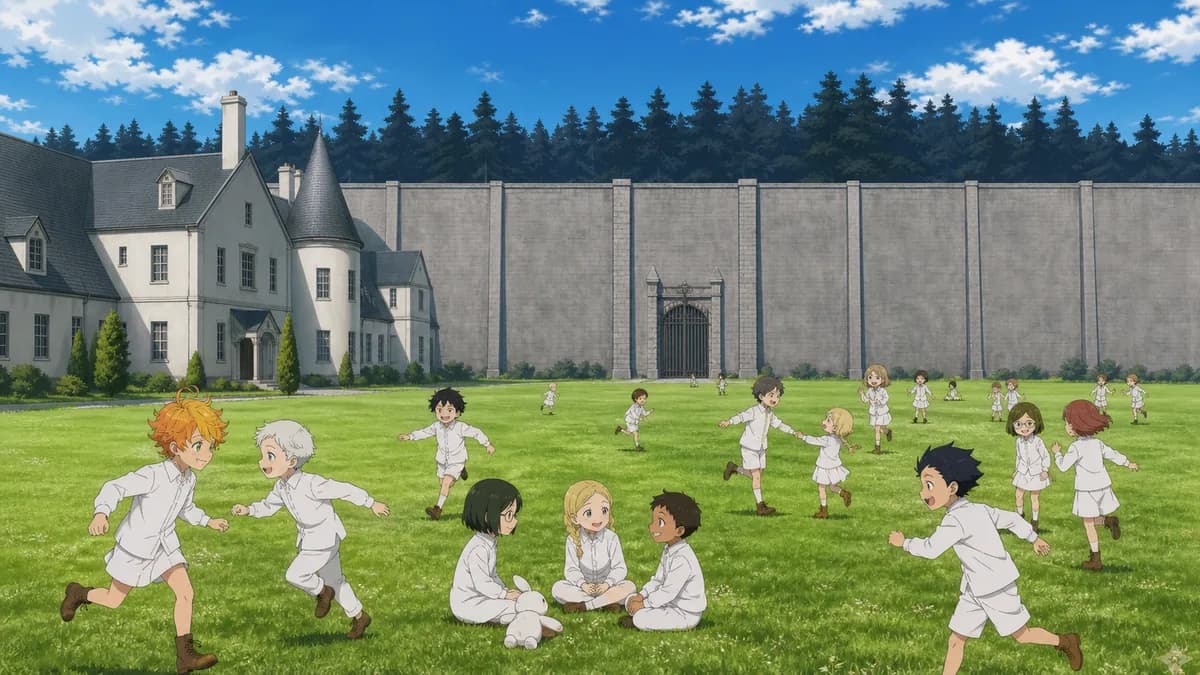
The Children and Their Captors
The whole season depends on three children and the woman determined to stay ahead of them. Emma supplies its emotional center. She is an optimist, and her defining trait is a refusal to abandon even one sibling. Her stubbornness can be maddening, especially when a cleaner plan is available, but it gives every escape calculation a moral cost. Norman is the gentle strategist, able to think several moves ahead without losing his compassion. Ray is the caustic realist. He has already made colder calculations about survival than either of his friends, so even agreement between the three can feel unstable. Their loyalties, disagreements, and private decisions give the puzzle an emotional pulse. Isabella is the season's greatest achievement. The caretaker the children know as Mom is one of anime's finest antagonists because the contradiction inside her never feels false: her affection is genuine, while her cruelty is part of her job. Whenever she shares a scene with the children, the surface conversation is only half of what is happening. A kind word can also be a warning, and a smile can mean that she already knows too much. Krone enters as a wild, unstable factor who disrupts the balance between both sides. The younger orphans matter just as much to the tension. They are not pieces to be shifted around a board; they are children who trust the people caring for them. The series keeps that fact in view, which stops its elaborate mind games from becoming an empty intellectual exercise.
Direction, Animation, and Sound
Director Mamoru Kanbe knows that a thriller like this depends on where the camera sits and what it refuses to show. CloverWorks gives him everything needed to make an ordinary house feel hostile. The camera prowls around Grace Field as if it were another predator. Low angles make familiar rooms look threatening, while oppressive negative space leaves the children seeming exposed even when no adult is visible. Sudden changes in light can turn a family dinner into an interrogation before anyone raises a voice. Faces do much of the hardest work. A child's smile slipping by a tiny degree creates more menace than a loud monster reveal, and the animation is controlled enough to make those minute changes readable. The show trusts the audience to notice them. When the demons appear, the noticeable CG gives them a visual wrongness that separates them from the human world. It can stand out, but in most scenes that alien quality helps rather than hurts. UVERworld's driving opening theme provides a sharp jolt at the start of each episode. The sound design is even more important to the mood. Quiet stretches tick with anticipation, and the score begins to swell just before a plan is put to the test. The production pushes its dread close to the limit without falling back on cheap shocks. Its best scares come from understanding what a look or pause might mean and waiting to see who else has understood it.

Ideas Behind the Escape
Beneath the escape plot is a story about children discovering that the loving system responsible for raising them has always planned to consume them. They choose to resist with the only weapon available to them: their minds. The series belongs to the tradition of anime thrillers powered by intelligence rather than physical force. Viewers who enjoy the cat-and-mouse brinkmanship of Death Note will recognize the appeal, though The Promised Neverland uses that tension differently. Here, warmth and innocence are constantly at risk, so every clever move carries an ache that a colder battle of geniuses would not have. This also makes the show unusual within shonen. Nobody settles a confrontation with a punch. Winning means preparing a convincing plan, reading the opponent correctly, and keeping an unbroken poker face when fear threatens to expose everything. The horror cuts deepest when it focuses on betrayed trust. The creatures with teeth beyond the wall are frightening, but the more intimate monster is the person who tucked these children into bed at night. Parental love has been turned into a cage, and the children have to question every comforting memory without discarding their care for one another. That idea gives the season psychological weight that many survival stories never attempt. The escape matters because it offers freedom, but it also forces the children to decide what their family means once the home holding that family has been revealed as a trap.
What Works and What Falters
Viewed as a self-contained season, The Promised Neverland has enormous strengths. Its structure is extremely tight, Isabella is a genuinely great villain, and the tension almost never loses momentum. The central reveal remains one of anime's best hooks because the season understands how completely it changes every detail that came before it. The finale also sticks the landing, paying off the careful planning without draining the characters' choices of feeling. The flaws inside the season are relatively small. A few of the children's schemes need the adults to react a beat more slowly than their established intelligence would suggest. A couple of gambits also rely on an antagonist choosing a convenient moment to explain too much. Those lapses are noticeable because the surrounding mind games are so disciplined, but they never break the story. The unavoidable warning concerns what comes after season one. The continuation adapts the source material loosely and rushes through huge portions of the manga's story. It disappointed a large share of the fanbase. As a result, this near-perfect season points toward a follow-up that many viewers actively regret watching. Anyone judging the first season by itself will still find an exceptional thriller with a satisfying arc. Anyone planning to continue should know that the animated version soon becomes much rougher. That later disappointment affects the series' legacy, though the quality of these opening episodes remains plain.
The Verdict
Taken on its own, the first season of The Promised Neverland is a near-perfect thriller. It is a tightly controlled, dread-soaked chess match led by one of anime's best antagonists, and it carries out its premise with almost no wasted material. The score is 8.8. The few deductions come from occasional moments when the mind games depend on a convenient lapse, along with the hard-to-ignore knowledge that the animated continuation fails to honor the strength of this beginning. My advice is straightforward: watch this season and allow its ending to stand. If you need to learn what happens next, treat the manga as the real continuation. The first season still ranks among the most gripping single cours the psychological-thriller genre has produced. It is an easy recommendation for anyone who enjoys a show capable of staying several moves ahead of its audience without forgetting why its characters matter.
FAQ
Yes, emphatically, if you are watching the first season. It is one of anime's tightest psychological thrillers, though it works best when treated as the main event instead of the beginning of a consistently great series.