Millennium Actress Review: Satoshi Kon's Most Romantic Film Is a Chase Through Movie History
 By Mika Tanabe · Editor
Some films tell a story. Millennium Actress runs through one. Satoshi Kon's second feature takes the simplest of hooks, a documentary crew coaxing a reclusive former star out of decades of silence, and detonates it into a headlong dash across memory, performance, and the whole history of Japanese film. As aging actress Chiyoko Fujiwara recounts her life, the interviewers, and we, are pulled bodily into her recollections and the roles she played, until you can no longer tell the woman from the parts she performed. It is formally daring and emotionally direct at once, a combination almost no one else pulls off. Warmer than his thrillers and endlessly rewatchable, this is Kon working in a rare, openhearted key.
Story & Premise
The premise is deceptively small. Ginei Studios is being torn down, and documentarian Genya Tachibana finally secures an interview with its lost legend, Chiyoko Fujiwara, who walked away from stardom at her peak and vanished into seclusion. He arrives bearing a gift: an old key she lost long ago. That key unlocks everything. As a girl, Chiyoko once sheltered a wounded painter, a political dissident fleeing the authorities, who left the key in her keeping and a promise she would return it. She never saw him again. So she became an actress, chasing rumors of him from set to set, across feudal epics, wartime melodramas, Meiji-era romances, and even a rocket launch toward the stars. What makes it sing is how Kon refuses to keep memory and movie apart. Her real life and her many screen roles bleed together until the search itself becomes indistinguishable from the fiction, and Genya and his skeptical cameraman Kyoji are swept along inside it. It is one continuous, accelerating chase that never once loses its footing.
Characters
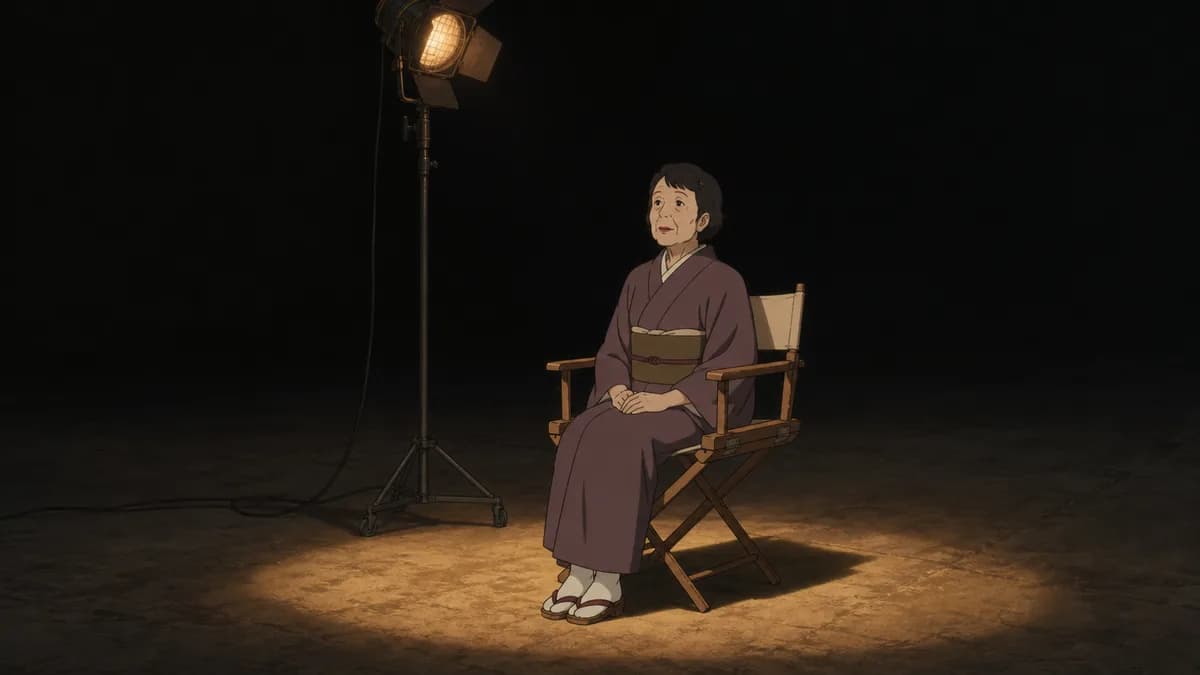
Chiyoko is one of anime's great romantic heroines, and Kon builds her with real care. We watch her span an entire lifetime, from wide-eyed teenager to weary old woman, and the film lets a single youthful vow define all of it without ever mocking her for it. Her devotion is the beating heart of the picture. The framing device is quietly brilliant too: Genya Tachibana, the documentarian, is no neutral observer. He adores Chiyoko, carries his own buried history with her, and keeps materializing inside her memories as a loyal retainer, a rescuer, a bystander, forever helping her along. His cameraman Kyoji supplies the wry skepticism, grumbling at the impossible logic even as he is dragged into it. Around them orbit sharper figures: the scarred secret-policeman who haunts Chiyoko's every era like a recurring nightmare, and the aging rival actress Eiko Shimao, who knows more about the man Chiyoko chases than she lets on. Nobody here is filler; even the pursued man, glimpsed only in fragments, registers as a genuine absence rather than a plot token.
Animation & Sound
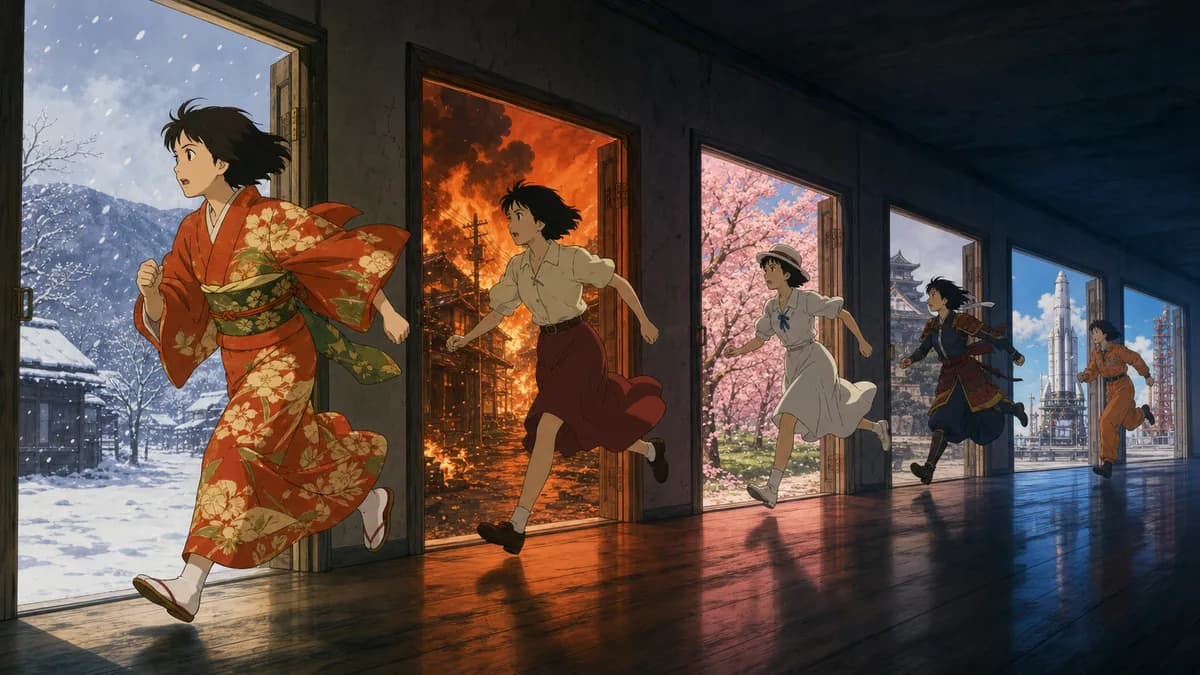
This is where Kon announces himself as a master of the cut. Millennium Actress is built almost entirely on his signature match-cut editing, transitions that hurl Chiyoko out of one time and place and land her mid-stride in another, a sliding door in a feudal castle opening onto a wartime street, a stumble in one memory becoming a stumble in a different film entirely. Memory, history, and cinema fold into a single unbroken motion, and Madhouse's animation makes those impossible seams feel not just smooth but inevitable. For a story that is fundamentally about running, the whole film runs, gathering speed until the edits themselves become the emotion. Then there is Susumu Hirasawa's score, the not-so-secret weapon. His soaring, electronic-choral theme swells beneath the climactic sprint through the eras and turns technical bravura into pure, chest-swelling catharsis. Sound and image are locked so tightly that by the finale you are not watching a chase so much as being swept inside one. It is dazzling craftsmanship, start to finish.
Themes & What Sets It Apart
Most love stories are about union. Millennium Actress is about pursuit, and it makes the radical case that the chasing matters more than the catching. Chiyoko spends a lifetime running toward a man she barely knew, and the film's devastating final turn suggests she may have understood that all along, that the longing itself was the point, the engine that kept her alive and moving. It is a bracingly grown-up idea about love and desire, delivered without a shred of cynicism. Layered over it is Kon's deeper obsession: the porous border between reality and fiction, memory and performance. Chiyoko's life survives only as the films she made and the story she tells, which makes this, quietly, a meditation on cinema as a machine for immortality, a way to outrun time itself. It doubles as a heartfelt tour through the eras of Japanese film, feudal, wartime, modern, science-fiction. What sets it apart is that all this formal ambition never turns cold; it is an experimental film with the pulse of a genuine romance.
Strengths & Shortcomings
Let's be honest about the trade-offs. The very thing that makes Millennium Actress dazzling, its refusal to separate reality from fantasy, is also what will lose some viewers. If you want a story that tells you plainly what is 'really' happening, the film's constant slippage between memory, movie, and present can feel disorienting or even frustrating; it withholds the clean answers a more conventional drama would hand over. A little grounding in classic Japanese cinema deepens things too, and viewers without it may miss some of the affectionate genre pastiche. At a lean under-ninety-minute runtime it also moves fast, sometimes so fast that its emotional beats arrive before you have braced for them, and the man Chiyoko chases stays deliberately thin, more symbol than person. But these are the costs of its ambition, not failures of it. The craft is flawless, the structure is airtight, and the ending delivers one of the most quietly overwhelming gut-punches in animation. Meet it on its own dreamlike terms and it rewards you completely, and repeatedly.
The Verdict
Millennium Actress is Satoshi Kon at his most openhearted, and for many fans it is his best film precisely because it trades his usual dread for devotion. It is a technical marvel, a history of Japanese cinema, and a genuine tearjerker folded into one seamless, sprinting whole, and it manages all of that without ever feeling like homework. Yes, it asks you to surrender to its logic rather than decode it, and a first watch can leave you slightly dizzy. Give it that surrender. Let the match-cuts carry you and let Hirasawa's score do its work, and by the closing line, one of the most beautiful in the medium, you will understand why the people who love this film love it so fiercely. It is the perfect gateway to Kon and a high-water mark for the anime film as art. Essential, and endlessly rewatchable.
FAQ
Absolutely. It is widely regarded as one of the finest anime films ever made and one of Satoshi Kon's crowning achievements, a rare movie that is formally experimental and deeply emotional at the same time. If you have any love for cinema, or have ever held onto a feeling far longer than made sense, it will land hard. Its lean runtime means it never overstays its welcome, and its dreamlike structure makes it enormously rewatchable, revealing new match-cuts and connections every time. This is essential viewing.