
Hyouka Review Reveals Kyoto Animation's Quiet Perfection
 By Mika Tanabe · Editor
Some anime chase spectacle. Hyouka does the opposite: it slows down, leans close, and finds wonder in a locked clubroom, an old anthology, and a question nobody else thought to ask. Adapted by Kyoto Animation from Honobu Yonezawa's Classic Literature Club novels, it follows Houtarou Oreki, a boy whose entire philosophy is to expend as little effort as humanly possible, as he is roped into a school club and, against his will, into solving the small puzzles of ordinary life. There are no villains, no stakes larger than a misremembered promise or a missing manuscript. And yet it is riveting. This is a mystery series about curiosity itself, dressed in some of the loveliest animation you will ever see. Patient viewers are richly rewarded.
Story & Premise
Oreki lives by a motto: if he doesn't have to do something, he won't, and if he must, he'll make it quick. He divides the world into people who burn bright, rose-colored lives and gray ones like his own, and he is perfectly content gray. Then his sister strong-arms him into reviving the near-defunct Classic Literature Club, where he meets Eru Chitanda, a girl so relentlessly inquisitive that her wide-eyed 'I'm curious!' becomes a force he cannot refuse. What follows isn't a case-of-the-week thriller so much as a series of small, human riddles: why a teacher poses an odd question, what a decades-old anthology's title really means, who rewrote the ending of a class film. The central thread, a 45-year-old secret buried in the club's own history, gives the story its spine, but the pleasure is in the texture. Hyouka argues that everyday life is quietly full of mysteries, if only someone bothers to look. Oreki, reluctantly, becomes that someone.
Characters
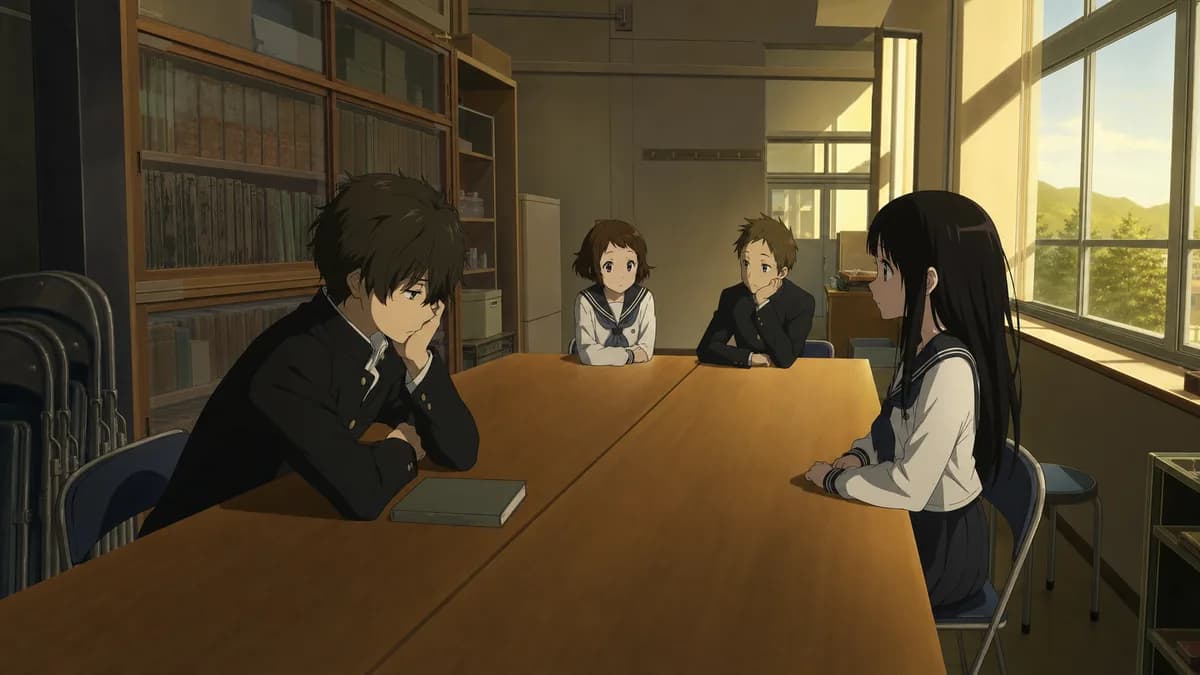
The show lives or dies on its central pair, and it thrives. Oreki is a wonderful anti-protagonist: lazy by creed, not by ability, hiding a genuinely sharp deductive mind behind a shrug. His arc is subtle, a boy who insists he wants nothing slowly discovering that he wants to be the kind of person Chitanda already assumes he is. Chitanda herself could have been a plot device, the curious girl who sets each mystery in motion, but the writing gives her real depth: an heir to a prominent rural family, poised and gracious, carrying quiet expectations that surface in the show's most affecting turns. Their chemistry is electric precisely because it is restrained; a held glance carries more charge than a confession. Around them, Satoshi Fukube, the self-described 'database' who gathers facts but refuses to draw conclusions, and Mayaka Ibara add warmth, rivalry, and their own aching almost-romance. Four teenagers, rendered with startling emotional precision. You come to love every one of them.
Animation & Sound
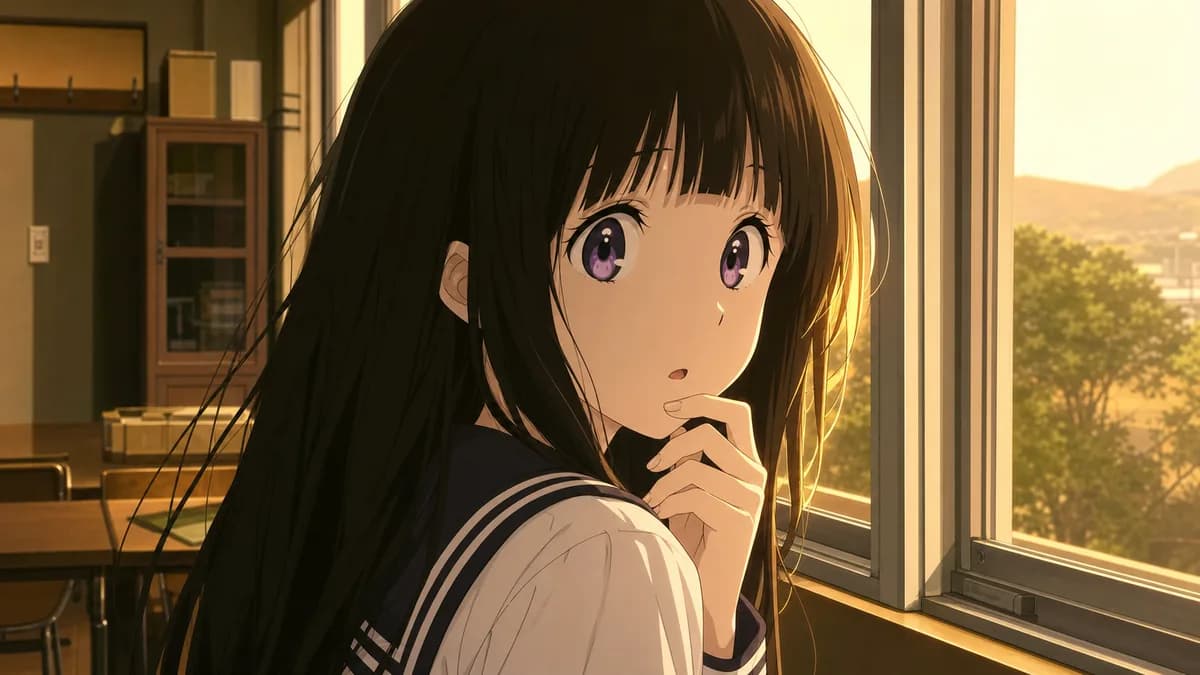
This is Kyoto Animation at the height of its powers, and it shows in every frame. Hyouka is arguably the studio's most visually ambitious work, a show where a boy simply thinking is staged like a fever dream, where sunlight through a classroom window is animated with the reverence most series reserve for battles. Chitanda's enormous eyes, so often turned into memes, are actually a deliberate visual language: the camera treats her curiosity as something almost overwhelming, blooming across the screen in petals and light. The direction, led by Yasuhiro Takemoto, turns mundane spaces, libraries, festival stalls, a sunlit riverbank, into places of genuine beauty, drawn from a lovingly rendered rural town. Kouhei Tanaka's score is gentle and unobtrusive, swelling only when the emotion earns it, and the opening and closing themes are lovely. It is the rare series where you could pause on almost any moment and hang it on a wall. The craft alone justifies the watch.
Themes & What Sets It Apart
What elevates Hyouka above a merely pretty slice-of-life is its real subject: it is a coming-of-age story disguised as a detective show. The mysteries are never truly about the mysteries. They are about Oreki learning that effort, the very thing he has spent his life avoiding, is how you become someone, and about the melancholy of ordinary talent brushing up against the extraordinary. There is a recurring, wistful ache to it, a sense that youth is fleeting, that potential unused is potential lost, that the rose-colored life Oreki disdains might be the only one worth living. Few shows treat teenage introspection with this much respect. It also quietly interrogates class and expectation through Chitanda's inheritance, and the weight of legacy through the club's buried past. Where most mystery anime chase shock, Hyouka chases feeling, the small revelation that recolors how you see a friend, a family, yourself. That reorientation from puzzle-solving to self-discovery is exactly what sets it apart, and why it lingers.
Strengths & Shortcomings
Let's be honest about who this is for. Hyouka is slow, deliberately and sometimes frustratingly so. The stakes are microscopic: no lives hang in the balance, and the 'crimes' are things like a mislabeled anthology or a misunderstanding at a festival. Viewers who need momentum, tension, or a body count will bounce off it hard, and even admirers will admit the middle stretch meanders before the standout Kanya Festival arc pulls things taut. The deductions, while elegant, are occasionally so understated that the payoff feels smaller than the buildup. And the central romance is a glacier, beautiful, but you will wait a long time for very little overt movement. These are real limitations, not nitpicks. Yet they are inseparable from what makes the show special: it earns its quiet by refusing to inflate itself. If you meet it on its own terms, as a mood, a texture, a character study, the shortcomings dissolve. If you don't, it will bore you. Know yourself before you start.
The Verdict
Hyouka is not for everyone, and it never tries to be; that is the source of both its flaws and its greatness. If you want plot-driven mystery with real danger, look elsewhere. But if you are willing to slow down, it offers something rare: a gorgeous, tender, quietly profound portrait of adolescence, curiosity, and the small effort it takes to care about anything at all. Kyoto Animation pours its full craft into a story that, on paper, is about almost nothing, and makes it unforgettable. Oreki and Chitanda are among the most quietly resonant duos the medium has, and the show's core argument, that ordinary life brims with mystery for anyone curious enough to look, earns its emotional weight completely. It is a slow burn that rewards patience with beauty. A near-masterpiece, held back only by its own gentle pace. Curious? You should be.