Hinamatsuri Review: The Funniest Anime You Probably Skipped
 By Mika Tanabe · Editor
Hinamatsuri is the comedy nobody warns you about, and that's the problem, because it deserves the reputation it never got. On paper it's a one-joke premise: a mid-level Tokyo yakuza opens a mysterious pod in his apartment, and out steps Hina, a flat-voiced psychic girl who could level a city block but would rather watch TV. What that logline hides is a show with astonishing range, pivoting from screwball slapstick to genuine, lump-in-the-throat pathos without ever tripping over itself. feel.'s adaptation of Masao Ootake's manga is a masterclass in comic timing wrapped in a gag-comedy costume over a stealth character drama. My thesis: this is one of the sharpest comedies of its era, and that so many fans passed it over is a small tragedy.
Story & Premise
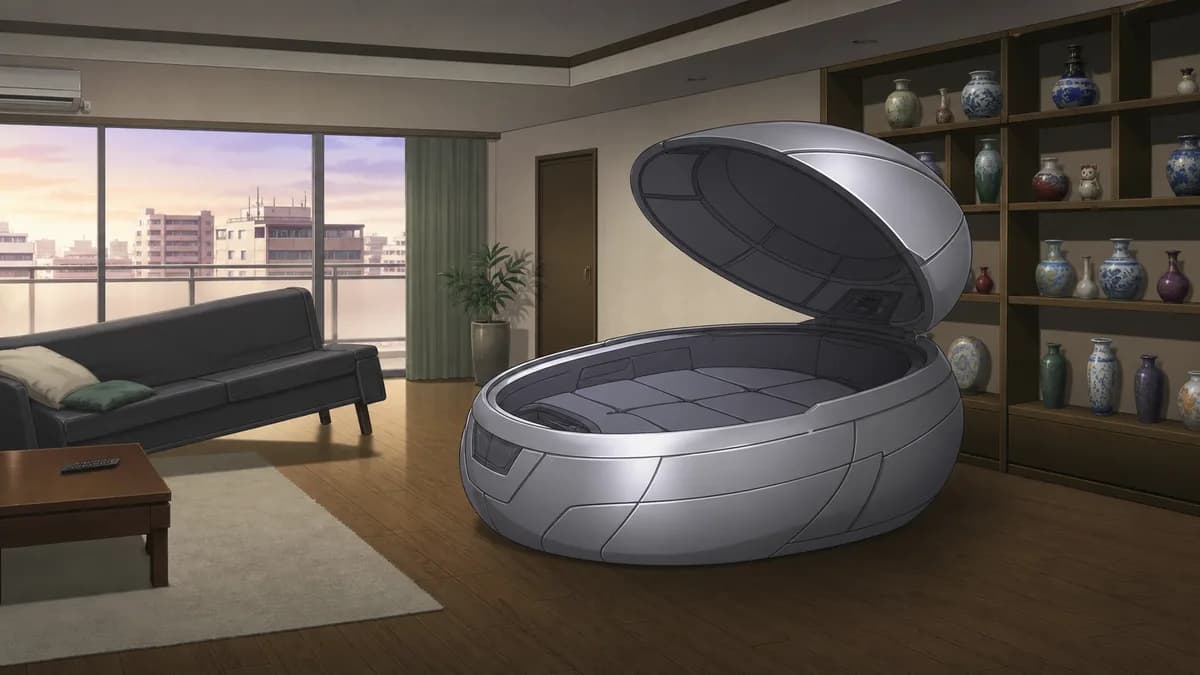
The setup is deceptively simple. Yoshifumi Nitta is a young, upwardly mobile yakuza with a soft spot for absurdly expensive pottery, and his tidy bachelor life is detonated when a capsule crashes into his living room and disgorges Hina, a psychic girl of unknown origin with telekinetic powers she'll unleash whether he likes it or not. She threatens him; he caves; and the two become uneasy housemates, with Nitta cast as reluctant guardian to a child who treats destruction as a shrug. From that single absurd engine the series fans outward into a loose, episodic structure that keeps introducing new orbits: a second psychic girl who loses everything, a middle-schooler press-ganged into adult responsibility, a whole community of the down-and-out. It plays less like a plot than a widening ensemble, each thread mining a different flavor of comedy from ordinary Tokyo life bent slightly out of shape. What's remarkable is how quickly it stops being about the superpowers at all. The powers are the hook; the people are the point.
Characters
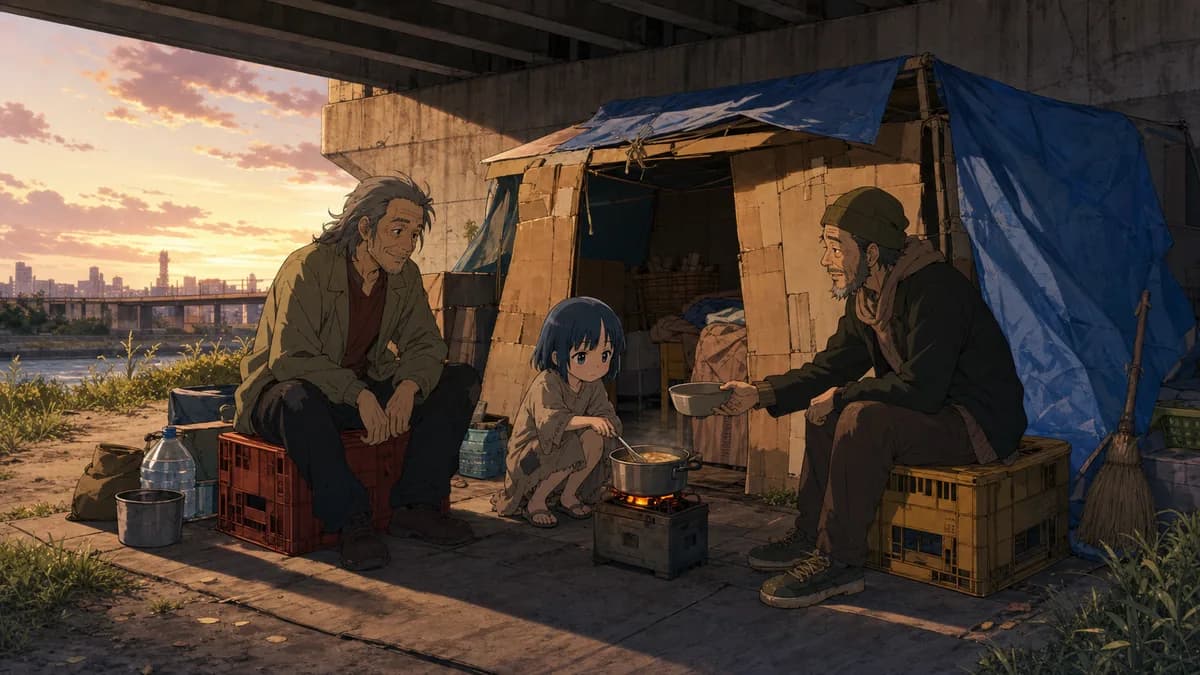
Nitta is a perfect straight man, forever exasperated, secretly decent, endlessly calculating the yen-value of whatever Hina just smashed, and Hina's flat, unbothered deadpan is the deadweight his frustration bounces off. But the show's not-so-secret weapon is Anzu. She arrives as a rival psychic sent to drag Hina home, loses everything, and lands among a community of homeless men who quietly take her in. What follows is one of the most affecting arcs in modern comedy: a spoiled kid learning kindness, gratitude, and the brutal arithmetic of poverty, played with a sincerity that sneaks straight past your defenses. Hitomi Mishima is the other standout, a hyper-responsible middle-schooler who physically cannot say no, roped into bartending and spiraling into a double life as a legendary mixologist. Around them, Nitta's exasperated colleagues, his sharp-tongued sister Mika, and a rogues' gallery of rival psychics keep the ensemble humming. It's a cast where even the throwaway players land a punchline, and two or three land an actual soul.
Animation & Sound
Comedy anime lives or dies on timing, and Hinamatsuri's is close to flawless. Director Kei Oikawa understands that the funniest thing on screen is often a held reaction shot: a beat of dead silence before Nitta's face collapses, a smash cut that lands a gag like the button on a stand-up bit. feel. isn't a powerhouse studio, and the show is honest about its budget; this is clean, functional TV animation, not a sakuga reel. But Kanetoshi Kamimoto's expressive character designs and Tetsuya Takeuchi's key animation know exactly when to warp a face into rubber-limbed hysterics and when to hold dead still, and the editing rhythm does the rest. The real flex is elasticity, the way the art pivots from a composed emotional beat to grotesque comic exaggeration inside a single scene. Yasuhiro Misawa's score is playful and unobtrusive, content to set a stage rather than steal it, and the peppy opening sells the show's deceptively light surface. It's craft in pure service of the joke, and the jokes almost always land.
Themes & What Sets It Apart
Plenty of comedies do deadpan; almost none do it with this much heart. What sets Hinamatsuri apart is the whiplash, its willingness to spend one segment on pure surreal nonsense and the next on a homeless girl's hard-won dignity, and to treat both with equal craft. Underneath the absurdism runs a persistent theme of makeshift family: nobody here chose the people they end up caring for, and the show keeps quietly arguing that responsibility, freely taken up, is its own kind of love. Nitta never asked to be a father figure; Anzu's adoptive community never asked for her; Hitomi certainly never volunteered for adulthood. That found-family warmth, smuggled in under the gags, is what lifts it above the gag-a-minute pack. It shares DNA with the deadpan-superpower comedy of Mob Psycho 100 and the fish-out-of-water yakuza laughs of The Way of the Househusband, but its particular alchemy, nonsense and tenderness in the same breath, is entirely its own. Few shows make you laugh this hard and then ambush you.
Strengths & Shortcomings
Time for honesty, because the flaws are real. The episodic structure that gives the show its range also makes it tonally uneven: the leaps from slapstick to sincere drama are usually a feature, but occasionally they whiplash, and a viewer who came purely for jokes may find the poignant Anzu material a strange gear-shift, while those who came for the feels sit impatiently through broader gags. The bigger issue is structural. This is a single-cour adaptation of a long-running manga, and it makes hard choices, reordering material and stitching on an anime-original ending that ties a bow the source never intended. It's a serviceable landing, but it stops short of the manga's strongest later material and, worst of all, it sidelines Anzu, the show's finest creation, through much of its back half to service the wrap-up. That there's been no continuation to fix this genuinely stings. Forgive an ending that settles rather than soars, though, and nearly everything before it is close to comedy perfection.
The Verdict
Hinamatsuri sits at that rare intersection where a comedy is genuinely, reliably funny and also has something to say, and it clears both bars with room to spare. An 8.3 reflects a show that is near-flawless scene to scene, with impeccable timing, a career-best supporting character in Anzu, and a heart that catches you completely off guard, held back from the top tier only by an adaptation that runs out of road. The anime-original ending is a compromise, and the decision to bench its best character down the stretch is a real loss. But none of that dims how much this thing delivers, laugh for laugh and, when it wants to, tear for tear. If you skipped it because the premise sounded slight, correct the mistake. It's the funniest anime you probably passed over, and quietly one of the warmest too.
FAQ
Absolutely. It's one of the most underrated comedies of its era, reliably hilarious, unexpectedly moving, and easy to marathon in a sitting or two. If you like deadpan humor with a genuine emotional payoff underneath it, this is close to essential viewing.