
Ghost in the Shell Review: A Cyberpunk Landmark That Thinks as Hard as It Hits
 By Mika Tanabe · Editor
Some sci-fi films show you the future; Ghost in the Shell makes you doubt the person watching it. Mamoru Oshii took Masamune Shirow's dense cyberpunk manga and pared it down into something colder, slower, and far stranger: a noir procedural that keeps pausing to stare into the void of what a self even is. Major Motoko Kusanagi hunts a ghost-hacking phantom through a rain-soaked megacity, but the real chase runs inward, toward the question of whether a mind housed in a manufactured body is still a person at all. As a 90s landmark it didn't just look like the future; it reshaped how sci-fi, animated and live-action alike, would imagine bodies, networks, and souls for decades afterward.
Story & Premise
Set in 2029, in a near-future where minds jack straight into a global network and most bodies carry some cybernetic upgrade, the film follows Major Motoko Kusanagi, a full-body cyborg and the sharpest operative of Section 9, a covert government unit that quietly cleans up the crimes the public never hears about. Their quarry is the Puppet Master, a phantom hacker who doesn't merely breach networks but breaks into human minds, rewriting memories and steering unwitting people like marionettes. The manhunt unfolds as slow-burn political noir: jurisdictional knife-fights between rival agencies, a diplomatic cover-up, a puppeteered host left mourning a past that was implanted rather than lived. But Oshii keeps deferring the thriller. He'll stop the case cold to let Kusanagi drift through the streets or sink into black water, brooding. The plot is genuinely tight, yet it withholds on purpose; the closer Section 9 edges toward cornering its target, the more the real question shifts from who the Puppet Master is to what it wants, and what that answer makes of the Major herself.
Characters
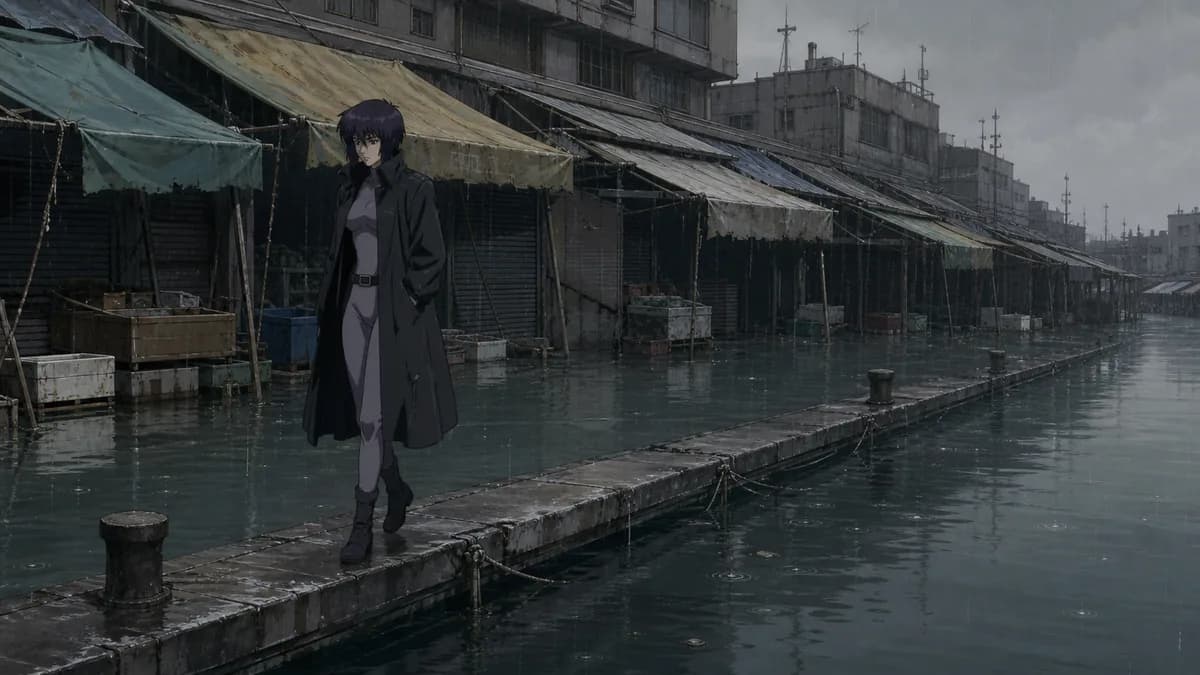
This is a lean ensemble, and it leans almost entirely on its lead. Major Kusanagi is one of the medium's great protagonists precisely because she's hard to read: outwardly a flawless, unflappable soldier, inwardly gnawed by the suspicion that the ghost animating her manufactured body might itself be a fiction, a program that only believes it's a person. She is cool, clinical, and quietly grieving something she can't name. Batou, her hulking partner with those unmistakable silver eyes, is the counterweight, gruff and fiercely loyal and visibly human in a way that anchors her drift; the unspoken care between them is the film's warmest thread. Togusa, the squad's newest recruit and its most organic member, serves as audience surrogate, still close enough to ordinary to ask the obvious questions. Chief Aramaki, all sharp angles and sharper politics, works the bureaucratic board. Looming over all of it is the Puppet Master. Nobody here gets a conventional character arc, but Kusanagi's inward crisis is magnetic enough that the deliberately thin characterization never reads as a shortfall.
Animation & Sound
Production I.G built a future you can feel the damp in. The city, a teeming, waterlogged Asian megacity of stacked signage and stagnant canals, is rendered with obsessive, painterly detail, and Oshii's camera lingers on it: gutters, reflections, shop mannequins, drifting boats. The craft blended traditional cel work with early digital compositing, and it has aged startlingly well; the Major's shimmering optical camouflage and the glowing cascades of network data still read as elegant rather than dated. But the film's secret weapon is Kenji Kawai's score. His main theme sounds like nothing else in the medium, an ancient-feeling choral chant, wedding-ritual vocals layered over sharp hand-clap percussion and a slow, mounting dread, half sacred rite and half warning. It transforms the movie's centerpiece, a near-wordless drift through the rain-soaked city, into something devotional. Sound and silence are wielded with the same discipline as the imagery; when the score finally swells, it doesn't hype the action so much as mourn it. Craft this deliberate, this unhurried, is genuinely rare.
Themes & What Sets It Apart
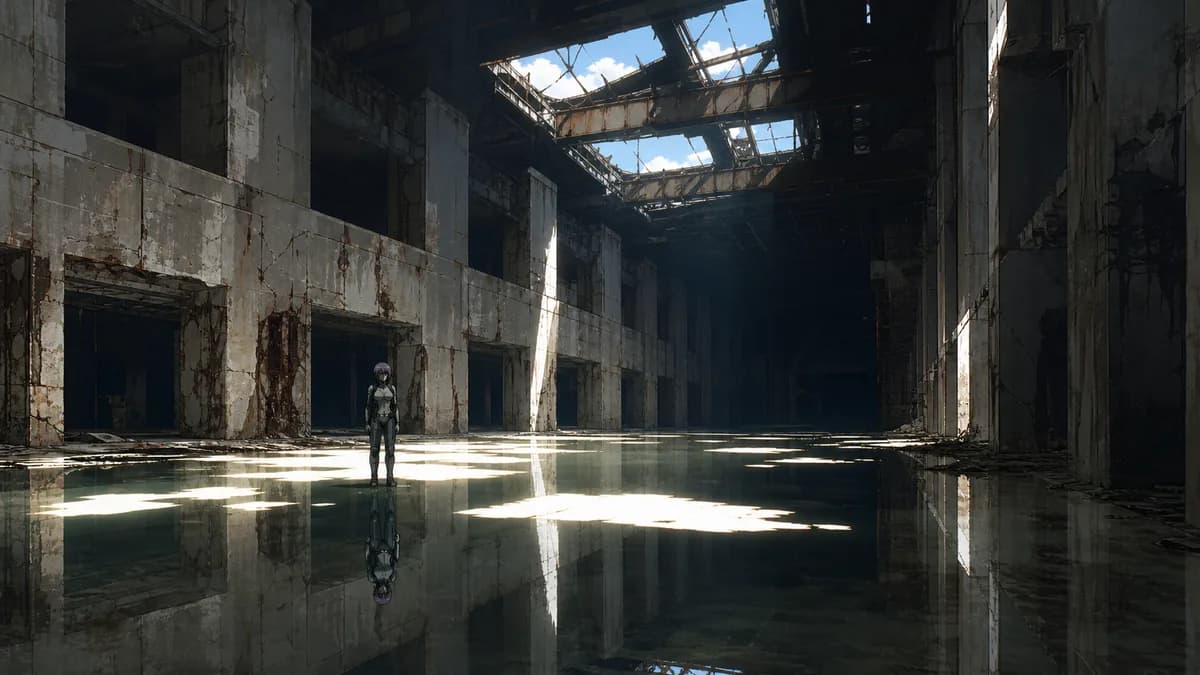
Strip away the gunfights and Ghost in the Shell is really a philosophy seminar with a body count. Its title is its thesis: the ghost is the ineffable spark of selfhood, the shell the replaceable body it rides in. If your limbs are manufactured, your eyes are hardware, and your memories can be rewritten by a good enough hacker, what exactly is left that counts as you? Kusanagi circles that question like a wound. The film pushes further than most sci-fi dares, asking not just whether a machine can wake into consciousness, but whether consciousness itself might want to evolve past the human entirely, to merge with the vast sea of the network and become something new. It treats those ideas with genuine seriousness rather than as set-dressing, and that's why its fingerprints are everywhere. A whole generation of cyberpunk, animated and live-action, borrowed its cascading code, its brooding cyborgs, and its unease about where the human ends and the machine begins. Few films have exported their questions so widely, or been imitated so openly by work that never matched their nerve.
Strengths & Shortcomings
Be honest about what this is. Ghost in the Shell is talky, cerebral, and deliberately cool to the touch. Long stretches are pure dialogue, characters debating consciousness and identity in dense, essayistic exchanges, and the film's most celebrated passages are near-wordless mood pieces where nothing overt happens for minutes at a time. If you come expecting the relentless kinetic assault the poster promises, you may find yourself checking the clock; the action is superb but rationed, and the plot is more scaffold than story. It also keeps you at arm's length on purpose. Its characters are studies more than warm companions, and the payoff is philosophical rather than visceral. None of this is a flaw so much as a filter: this is a mood and an argument as much as a thriller, and it rewards patience and full attention rather than a casual, half-watching evening. Meet it in the right frame of mind, big screen, no distractions, and its coldness reveals itself as a kind of ache. Meet it wrong and it can feel inert, even boring.
The Verdict
Ghost in the Shell earns its status as a 90s landmark and one of the most influential science-fiction films of any medium or nationality. It isn't the easiest watch, it's slow, heady, and emotionally reserved, and that restraint is exactly why it stops just short of a perfect score; its brilliance can feel a little airless, more admired than adored. But what it does, it does like almost nothing else: it fuses gorgeous, meticulous craft with real philosophical nerve and flatly refuses to talk down to you. Kenji Kawai's chant will haunt you, the rain will soak into you, and the Major's quiet crisis will trail you out of the room. Come to it as a curious viewer willing to think rather than just spectate, and you'll understand why creators keep bowing to it. A cerebral, beautiful, genuinely important film. Score: 94/100, a cyberpunk cornerstone.
FAQ
Yes, especially if you care about anime and science fiction as art forms. It's a cornerstone of cyberpunk and one of the most influential animated films ever made. Just know going in that it's a slow, cerebral mood piece as much as an action movie, so it rewards patience rather than casual viewing.