Erased Review: A Time-Travel Thriller That Cares About Its Characters
 By Mika Tanabe · Editor
Erased knows when to stay still. A-1 Pictures' adaptation of Kei Sanbe's manga begins with a supernatural device: an involuntary rewind sends its hero back through time whenever he needs to stop a death. The series uses that idea to examine loneliness and second chances. It also returns to the lasting pain of a childhood that went wrong. Satoru Fujinuma is a stalled manga artist whose life suddenly folds back on itself. He wakes up as a grade-schooler during a snowbound month, shortly before one of his classmates vanishes. From there, the mystery matters less as a guessing game than as a chance to see whom Satoru might save by paying attention this time. The result is gorgeous and tense, with an emotional weight that feels earned. Its ending remains the part that divides fans, but the rest of the journey gives them plenty to care about.
Story and Premise
Satoru calls his strange ability 'Revival.' It strikes without warning, throwing him a few minutes into the past and trapping him in a loop until he prevents an approaching disaster. He did not ask for the power, and it offers him almost no explanation. That makes each rewind an isolating experience rather than a gift. When catastrophe hits much closer to home than a stranger on a street corner, Satoru is framed as a murderer. In his panic, Revival sends him years into the past instead of minutes. He returns to his grade-school body in a snowbound northern town, where the loop begins to revolve around a quieter and colder horror. Kayo Hinazuki, a withdrawn classmate, is fated to disappear. Fixing his present now depends on seeing the child everyone else missed and revealing a predator who has been hiding in plain sight. Across its single cour, Erased moves between the dread of an adult murder mystery and the close social world of grade school. The tension between those perspectives keeps Revival from feeling like a disposable trick. Satoru may understand the danger as an adult, but he has to confront it with the limited reach of a child.

Characters
Satoru works as a lead because he starts out emotionally shut down. His adult narration keeps his own life at a distance, much as he keeps other people away. Once he is back in boyhood with an adult's store of regret, he has to learn how to reach toward someone instead. There is a quiet comic edge to watching a jaded twenty-nine-year-old operate through a grade-schooler's awkward courage, but the same contradiction supplies the story's emotional backbone. Kayo Hinazuki matters just as much. In a weaker version of this story, she would exist only as the missing girl who starts the plot. Erased gives her a wary personality of her own. She is a guarded, frostbitten child who has learned to protect herself from a home that was never safe. Her slow and suspicious thaw produces the show's strongest material. The friendship she and Satoru form over one bitter winter earns its emotional payoff because neither child trusts it too quickly. Sachiko, Satoru's warm single mother, steals nearly every scene she enters. His childhood friends also make the town feel inhabited rather than arranged around a mystery. The danger hurts because the people involved have recognizable habits and bonds. They never feel like pieces being shifted into place for the plot.
Animation and Sound
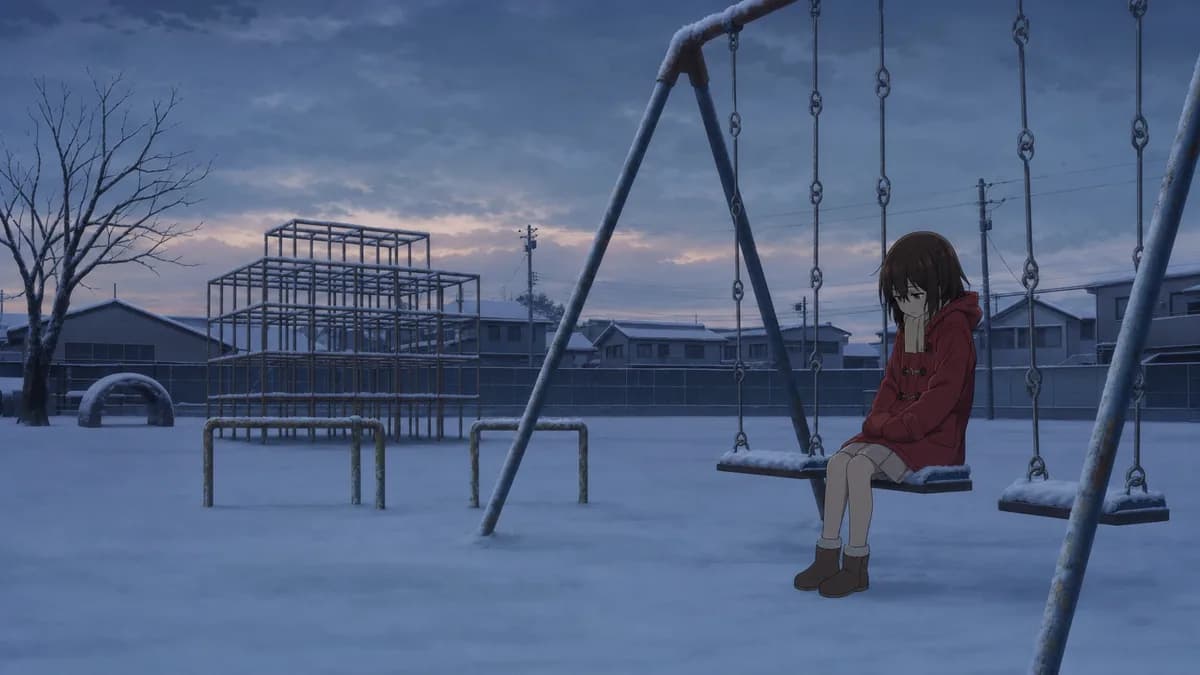
A-1 Pictures gives the story a cold, nostalgic palette that carries a large share of its feeling. The northern town is filled with grey slush and fogged breath under thin winter light. Against that chill, the modest warmth of a family diner or a school hallway registers as genuine shelter. Director Tomohiko Itou presents the Revival jumps through the show's now-famous visual signature, a red-bordered vignette that tightens around the image like a held breath. Elsewhere, he relies on patient compositions and silence instead of turning every tense moment into spectacle. The series is most confident when it allows stillness to hold. Its audio follows the same approach. Yuki Kajiura places fragile piano beneath the quieter scenes and brings in her trademark choral swells only after the tension has built enough to support them. ASIAN KUNG-FU GENERATION's opening, 'Re:Re:', is one of the rare OPs that fans continue to replay long after finishing the show. A carefully chosen needle-drop late in the series hits with startling force. None of these choices exist to show off. The music and direction serve the characters' feelings. Even the winter imagery reflects their personal fear.
Themes and What Makes It Different
Many anime use time travel to construct an elaborate puzzle. Erased treats the device as a moral problem instead. It cares less about the rules of the loop than about the people Satoru failed to see. Attention is the real subject. A lonely and mistreated child can sit in a full classroom every day while remaining invisible to nearly everyone around her. The series handles neglect and domestic abuse with unusual clarity. Kayo's home life is neither made lurid nor cleaned up for an easy resolution. Saving her depends on stubborn, ordinary kindness rather than a grand heroic performance. Satoru's supernatural gift matters far less than his repeated decision to arrive, stay close, and notice what others ignore. That conviction gives the thriller its distinctive warmth. Erased argues that connection is the useful defense against cruelty. A predator becomes harder to operate when a group of children chooses to watch out for one another. The suspense remains real, but it is never the show's only concern. Under the murder mystery sits a firm belief that care has practical force. That focus lifts Erased above the standard airport-thriller machinery its premise might initially suggest.
Where It Excels and Where It Stumbles
For most of its run, Erased is remarkably controlled. It is tender without losing tension, and each episode makes the next one difficult to resist. The problems arrive when the story has to land. A longer manga has been compressed into a single cour, so the final stretch suddenly begins to rush. The patient and grounded dread gives way to a conventional cat-and-mouse confrontation that some viewers find abrupt. The antagonist creates an even larger split. Fans still argue about the eventual unmasking. Some see it as a clever payoff that the show prepared carefully. Others find the villain's motive thin and cartoonish next to the painfully human characters surrounding it. A couple of late beats meant to seem clever also strain belief. Near the end, a time-skip ties off several emotional threads a little too neatly. Those weaknesses do not undo the series' best work. Its middle stretch contains some of the genre's most affecting scenes, and the relationships built there survive the hurried ending. Still, the finale keeps a near-masterpiece from becoming an outright one. The journey deserves your investment, even if the destination is best approached with looser expectations.
The Verdict
Erased is essential anime for viewers who want suspense anchored in people rather than machinery. It works as a thriller, but its lasting power comes from the care it gives Satoru and Kayo. Anyone looking for a beautiful and emotionally generous series should watch it, provided they can forgive a finale that reaches beyond what it can convincingly deliver. This is the kind of show that is easy to finish in one night and hard to shake for the following week. Revival supplies the initial pull. Kayo and Satoru give the story its staying power. At 88, it falls just short of my top tier. The divisive ending is a genuine flaw and should be acknowledged, yet the road toward it is so assured and quietly painful that I would still recommend the show to almost anyone. Bring tissues and avoid spoilers before you start.
FAQ
Absolutely. Erased is one of anime's most emotionally resonant thriller-dramas. The mystery holds your attention, while the gorgeous atmosphere gives the central friendship room to land with quiet force. Even viewers who dislike the divisive ending often agree that the rest of the series easily earns the time spent on it. It is close to essential if you enjoy character-driven suspense with real feeling behind it.