
Rascal Does Not Dream of Bunny Girl Senpai Review: Smarter Than Its Title
 By Mika Tanabe · Editor
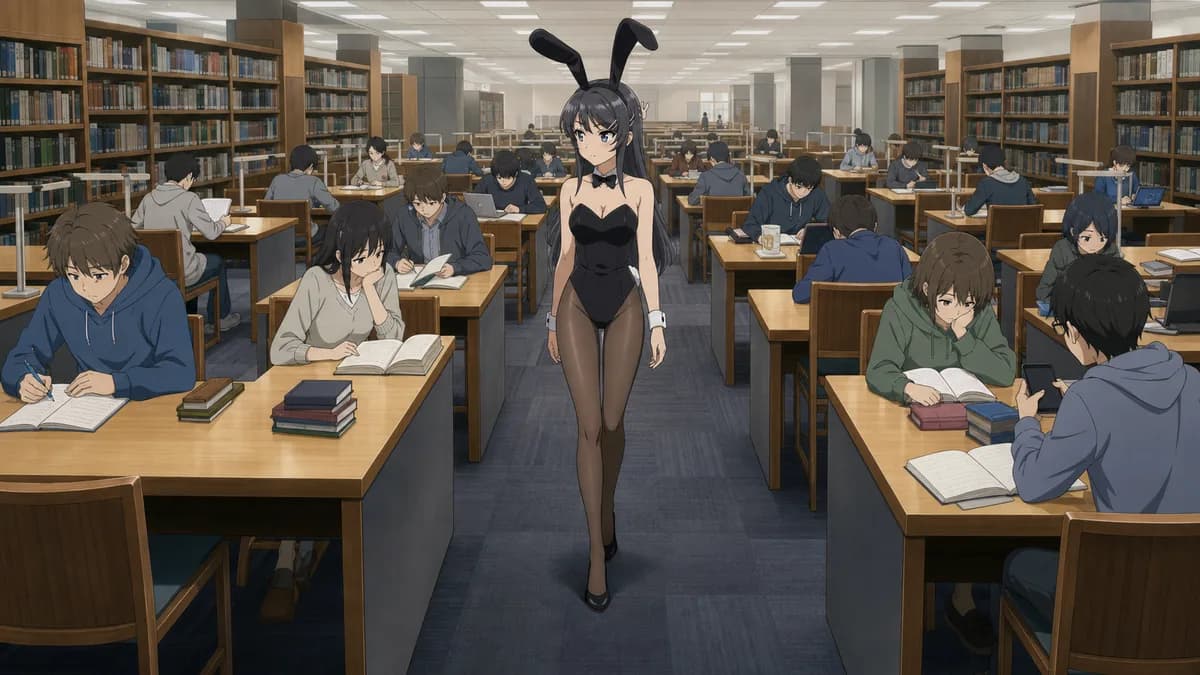
Let's get the obvious out of the way: yes, the title is ridiculous, and yes, the first thing you see is a girl in a bunny suit strolling through a library nobody else seems to notice. If that made you close the tab, you'd be missing one of the most quietly intelligent teen dramas anime has produced. Rascal Does Not Dream of Bunny Girl Senpai wears its silliness like a disguise. Underneath the fanservice packaging is a dialogue-driven story about invisible teenagers, sharp-tongued actresses, and the very real terror of not being seen. It's funnier, sadder, and far more thoughtful than its marketing lets on, a show that dares you to underestimate it, then quietly proves you wrong.
Story & Premise
The hook is a rumor. Around the seaside town of Fujisawa, high-schoolers whisper about 'Adolescence Syndrome', a half-urban-legend where the emotional pressure of being a teenager warps reality itself. Sakuta Azusagawa gets a front-row seat when he spots Mai Sakurajima, a famous actress on hiatus, strolling through the school library dressed as a bunny girl. The catch: almost no one else can see her. She is, quite literally, disappearing from the world as her retreat from public life turns into physical fact. From there the series runs as a loose anthology. Each arc introduces a different girl afflicted by her own manifestation of the syndrome, invisibility, a looping day, a body swap, a fractured identity, and Sakuta, blunt and unflappable, tries to talk her through it. The show dresses this in pop-science borrowed from quantum physics and Schrodinger's cat, but don't mistake the jargon for the substance. The real engine is emotional: every supernatural problem is a feeling nobody said out loud. It's a premise that should be gimmicky and somehow becomes genuinely moving.
Characters
Sakuta is the reason this works. The title's insult translates to something like 'pig bastard,' and he earns it, not by being cruel, but by being the rare anime lead who says exactly what he means. No blushing, no stammering, no convenient interruptions. When Mai tests him, he tests right back. Their banter is fast, dry, and adult in its rhythm, trading barbs that would make lesser couples combust. It's the sharpest dialogue in the genre this side of Monogatari. And crucially, they get together. Instead of stringing out a will-they-won't-they for years, the series lets Sakuta and Mai become a real couple early, then mines its drama from a relationship that actually functions. That confidence carries into the supporting cast: Rio Futaba, the science-club friend at war with her own self-image; Kaede, Sakuta's sister carrying a quiet trauma; plus Tomoe, Nodoka, and the elusive Shouko. The 'harem' the marketing hints at never really forms, Mai is unmistakably the lead, and everyone, Sakuta included, knows it.
Animation & Sound
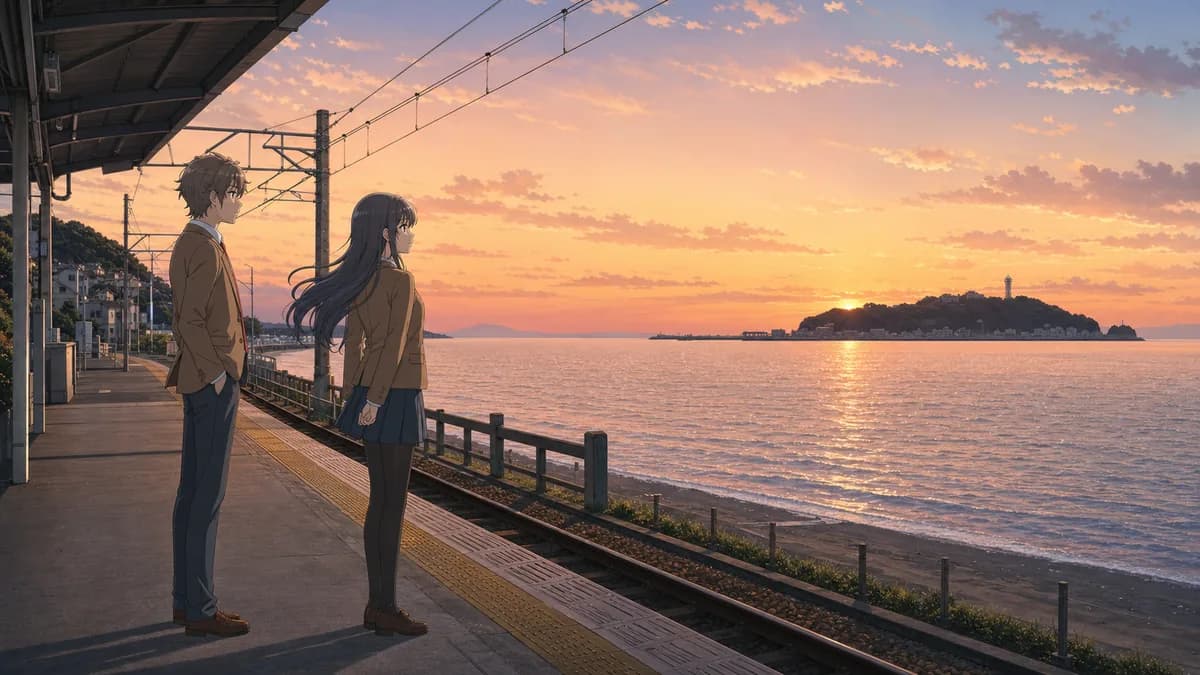
CloverWorks handles this as a grounded, naturalistic production, and that restraint is the right call. Because it's a dialogue-driven show, the animation serves conversation, micro-expressions, loaded pauses, the way a character looks away mid-sentence. Under director Souichi Masui, the real visual star is the setting: the sun-bleached coast around Fujisawa and Enoshima, all train crossings, seawalls, and shimmering water, rendered with enough love that the town feels like a character in its own right. The sound work earns equal marks. Kaito Ishikawa's deadpan delivery as Sakuta is pitch-perfect, and Asami Seto gives Mai a guarded warmth that sells the romance. The peggies' opening theme, 'Kimi no Sei,' is a genuine earworm, and the habit of swapping the ending song to match whichever heroine is in focus is a lovely touch. Yoshikazu Iwanami's piano-forward score knows when to stay out of the way, which, for a series built on talking, is most of the time. A solid English dub is on hand too, if subtitles aren't your speed.
Themes & What Sets It Apart
Here's what the title hides: 'Adolescence Syndrome' is one of the smartest metaphors in modern anime. Every supernatural affliction is a literalized teenage fear. Mai's invisibility is the dread of being ignored, of feeling like the world has stopped registering you exist. A looping day is the panic of a future you aren't ready to meet. A body swap is losing yourself inside someone else's expectations. A sister's amnesia is trauma so heavy the mind simply reroutes around it. The show never says the quiet part out loud, it just builds an entire supernatural grammar from feelings teenagers actually have and rarely confess. What sets it apart is empathy. Plenty of series would treat these anxieties as punchlines or plot fuel; this one treats them as real and gives them real weight. The obvious touchstone is Monogatari, the wordplay, the supernatural-as-psychology framing, but Bunny Girl Senpai is warmer and far more accessible, trading opacity for genuine payoff. It respects its teenagers instead of laughing at them.
Strengths & Shortcomings
The strengths are clear: crackling dialogue, a central romance that genuinely works, a vivid sense of place, and at least one arc, Kaede's, that lands like a gut punch. When this show is firing, little in its lane can touch it. But let's be honest about the flaws. The title and bunny-suit framing are a trojan horse that cuts both ways: the fanservice, flat-chest gags, and leering early beats undersell a thoughtful series and will make some viewers bounce before it earns their trust. Not every arc is equal, either, Tomoe's fake-dating detour is the slightest, most conventional stretch, and Nodoka's body-swap chapter is fine rather than essential. The pseudo-science holds up only if you don't poke it too hard; it's mood, not mechanism. Biggest of all, the season doesn't finish its own story. It builds toward an emotional climax and then hands the resolution to a sequel film, so the run feels deliberately incomplete on its own terms.
The Verdict
Rascal Does Not Dream of Bunny Girl Senpai is exactly what our subtitle promises: smarter than its title. It buries real emotional intelligence under a goofy, fanservice-flavored package, then quietly rewards anyone willing to look past the cover. The banter is the best in its genre, the central couple is that rare romance that functions instead of stalling, and the metaphor at its core gives every supernatural twist real stakes. It isn't flawless, a couple of arcs coast, the science is hand-wavy, and the season stops mid-story instead of ending, which is exactly why it lands at an 88 rather than higher. But if you like character-driven drama with a sharp tongue and a soft heart, this is close to essential viewing. Just know going in that the movie isn't optional; it's the second half of the very same story.
FAQ
Absolutely, if you value writing over spectacle. It's one of the best dialogue-driven romances in modern anime, anchored by a lead couple whose banter alone justifies the watch. Go in expecting conversation and character rather than action, and it's an easy recommendation, with the caveat that you'll want the sequel film to feel truly finished.