Berserk (1997) Review: Ambition, Betrayal, and Dark Fantasy's Cruelest Ending
 By Mika Tanabe · Editor
Some adaptations hide their age better than others. Berserk, the original television series drawn from Kentaro Miura's towering manga, has never needed to. Its roughness belongs to it. This 90s dark-fantasy landmark was the first anime to bring the Golden Age arc to the screen, and its raw edges still sharpen the tragedy. Guts is a mercenary who has never known tenderness. After Griffith draws him into the Band of the Hawk, he spends one bright, doomed stretch learning what it feels like to belong somewhere. The swordplay and battlefield glory gradually give way to a colder story about ambition, loyalty, and the terrible price of another man's dream. It is brutal, beautiful, and deliberately unfinished.
The Story and Its Setup
Most of the series plays out as one long flashback. A brief, blood-soaked look at Guts as the lone Black Swordsman sits at either end. The story then rewinds to a younger Guts, a hired blade with no purpose beyond survival. He crosses swords with Griffith and loses. Griffith commands the Band of the Hawk, a mercenary company fighting its way up through Midland's endless war, and he wants Guts with the possessiveness of a collector who has spotted a rare weapon. That defeat begins the Golden Age. The Hawks survive battles they have no business winning, storm the fortress of Doldrey, and climb from disposable sellswords to celebrated saviors of the kingdom. Griffith, however, wants something beyond military glory. He means to claim a throne of his own. Over time, Guts realizes that Griffith sees him as a tool for building that future, not a friend who stands beside him. Guts leaves because he wants to become his own man, and the delicate structure of Griffith's dream starts to break. The outline sounds like a war story, but the fighting is only the surface. Underneath it is a heartbreak unfolding in armor, moving steadily toward a reckoning that the viewer can sense without ever being ready for it.
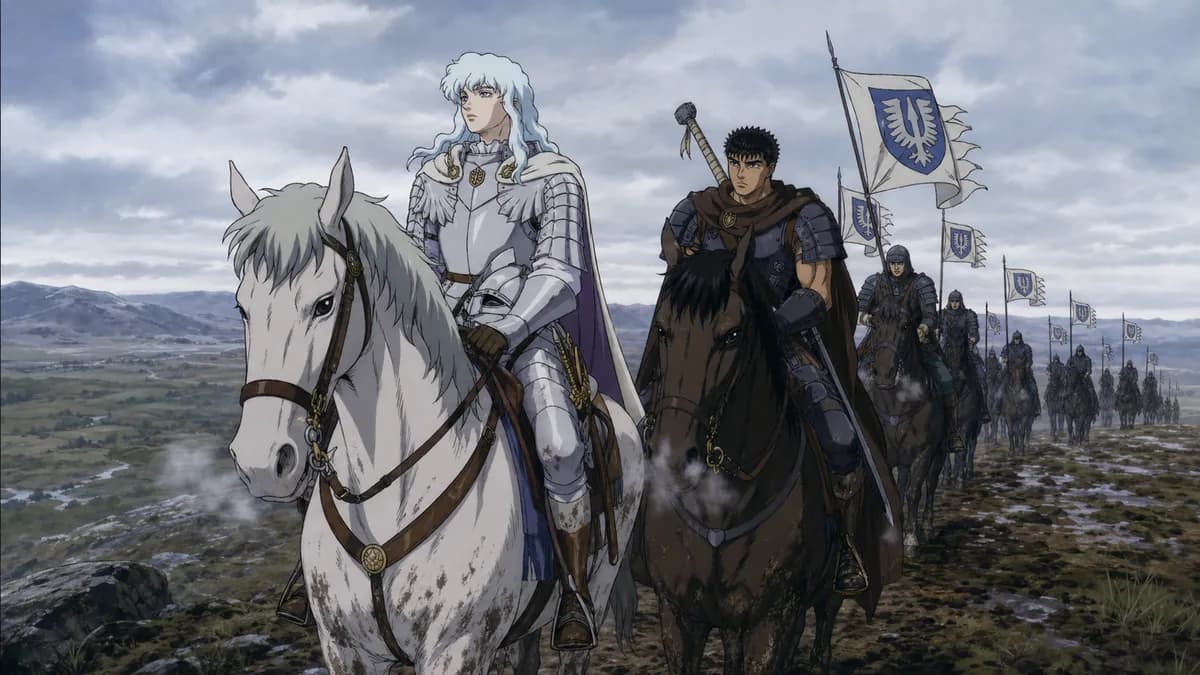
Guts, Griffith, Casca, and the Hawks
Berserk depends on its central trio, and each of them earns a permanent place in the memory. Guts looks like the obvious anti-hero: huge, scowling, and carrying a sword nearly as large as he is. Beneath all that force, he is quietly starving for the sense of belonging he would never admit he wants. Griffith reflects him and eventually ruins him. He is beautiful, softspoken, and magnetic, the kind of commander men willingly die for. His grace conceals an ambition so complete that there is no room in his life for anyone he cannot use. Casca stands between them as the Hawks' fierce second-in-command. Her devotion to Griffith and her prickly, changing bond with Guts supply the emotional spine of the arc. The other Hawks make the company feel like a real group of people. There is steady Judeau, gentle giant Pippin, sour Corkus, and the sheltered princess Charlotte. Because they have their own presence and texture, the company's fate feels like an actual loss instead of a device needed to move the plot. Even Zodd, the monstrous immortal, hangs over the story as an early warning about the true nature of this world. These characters do not drift through a set of assigned roles. They argue and flirt. They hold grudges, make sacrifices, and hurt one another. Berserk lets the audience grow attached to them, which gives every later turn its cutting force.
How the Animation and Sound Hold Up
The visuals plainly come from a late 1990s television production working with a modest budget. Large battles sometimes become panning still images, the quality of the animation shifts between stretches, and several clashes are suggested instead of fully drawn. The direction still has conviction. Medieval towns look moody and grimy, quiet scenes give the actors' expressions room to work, and the camera will remain on a face until the silence becomes painful. Yoshihiko Umakoshi's character designs give everyone physical weight and a lived-in humanity that cleaner modern artwork can smooth away. The sound is even stronger. Susumu Hirasawa's score is inseparable from the identity of Berserk. The surging mix of synth and chorus in 'Forces' has tremendous momentum, while eerie humming shadows each omen. The music often seems to come from a higher and crueler plane than the characters can understand. The Penpals opening and melancholy closing theme round out a soundtrack that carries scenes the limited animation cannot. The show looks dated because it is. Its atmosphere remains remarkably strong, and the audio is a large reason why.
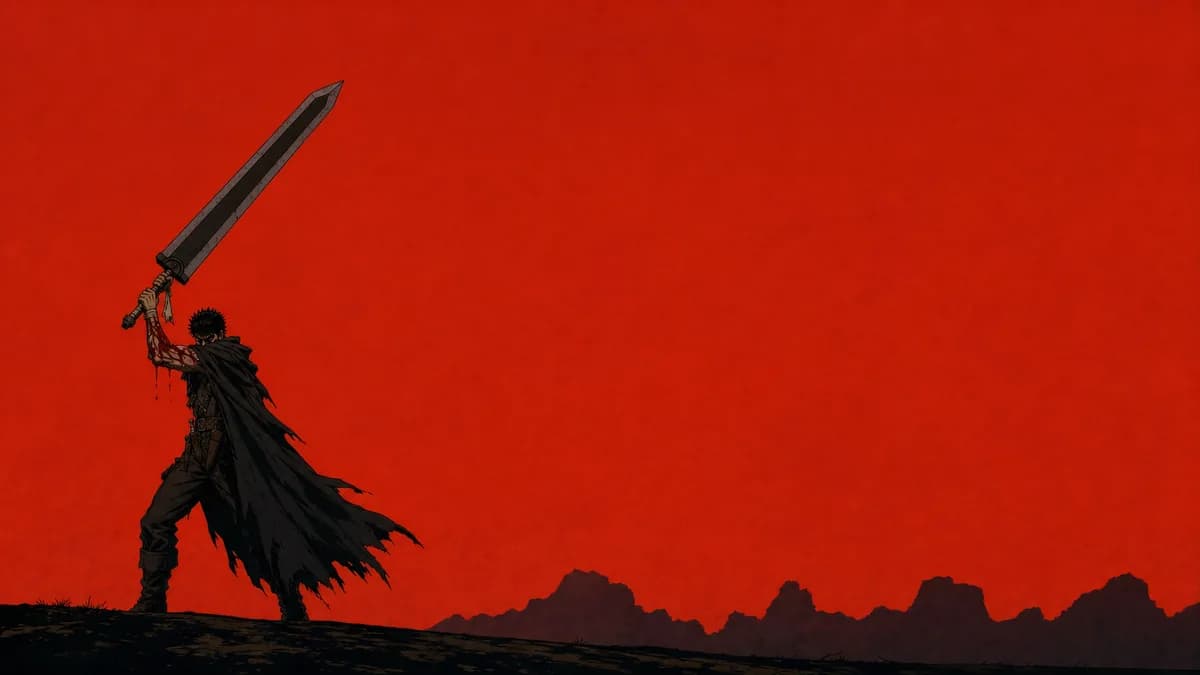
Ambition, Fate, and Betrayal
Berserk rises above standard sword-and-sorcery spectacle because it takes ambition seriously. Griffith's dream is never presented as ordinary villainy. The story understands the appeal of his hunger even while showing the human damage required to feed it. Again and again, the series considers who gets to own a life. Guts tries to make a path that belongs to him, while Griffith gives himself to a destiny larger than any individual person. Fate presses down on every choice, and the show is bold enough to suggest that the cosmos may be indifferent or openly hostile to the people the audience loves. Betrayal is handled with the same care. It does not arrive as a cheap surprise. It grows slowly from the fact that two men want things that cannot coexist. This is dark fantasy with serious ideas behind its violence, comfortable with moral gray areas and unwilling to offer easy reassurance. The series helped define what 'mature' anime could mean. Gore and nudity are both present, but maturity here also means treating adult ideas with respect. Few stories make a dream feel so tempting while showing, with equal clarity, how dangerous it can become. That tension is what stays in the mind afterward.
What Works and What Does Not
The qualities that made Berserk last are easy to identify. Its central trio is towering, the arc is genuinely tragic, the atmosphere is unmistakable, and Hirasawa's score feels immortal. When the writing meets the music at full force, very few anime can hit as hard. Its problems are just as visible. The animation is inconsistent and obviously restricted by its budget, which may frustrate viewers accustomed to glossy modern productions. The larger issue is that the series never really concludes. It detonates. The last stretch rushes into almost unbearable brutality, including a sequence so infamous that watching it has become a rite of passage. Then the anime stops in mid-plunge. There is no resolution, only a black-void cliffhanger that has enraged and haunted newcomers for decades. The closing act is extremely graphic, emotionally punishing, and unsuitable for the faint of heart. It refuses to give the audience catharsis on purpose. Some viewers will see that as a flaw, while others will regard it as the boldest choice available. Either response is understandable, but the story is plainly incomplete. It helps to approach the anime as a doorway into Berserk rather than the final destination. Knowing that in advance does not remove the sting, though it can make the sudden cutoff easier to accept.
The Verdict
Berserk (1997) is an uncomfortable watch because it intends to be one. The animation has visibly aged, the pacing places much of its setup near the front, and the ending hits hard before leaving the viewer suspended over an abyss. None of that has dulled its emotional power. This remains one of the medium's strongest tragedies, a story about ambition and loyalty told with the seriousness that helped reshape what dark fantasy anime could attempt. Guts, Griffith, and Casca stay in the mind long after the picture cuts to black. Hirasawa's score is likely to stay there too, looping for weeks. Viewers who can accept the dated visuals and prepare themselves for an ending designed to wound will find essential viewing here. It is a flawed and ferocious classic that has earned its place in the canon. Do not expect closure. Expect the need to find out what comes next. The score is a proud 93.
FAQ
Absolutely, provided you can accept one major caveat. The dated animation does not stop the series from delivering one of anime's most powerful tragedies. Its central trio is unforgettable, Hirasawa's score is haunting, and this remains the definitive telling of the Golden Age arc. Go in knowing that the story stops on a brutal, unresolved cliffhanger instead of offering a clean finish.