Space Westerns: Anime's Coolest Genre Fusion
 By Mika Tanabe · Editor
People often describe the space western by its surface details: a duster coat, a dusty planet, a battered ship kept flying through improvisation and spite. Those details come from something much more specific. The genre is shaped by money, especially the lack of it. The difference between a space western and a space opera has less to do with the frontier than with the invoice. A space opera asks who commands the fleet. A space western wants to know how the crew will make rent this week, then turns the answer into the plot. Outlaw Star demonstrates the rule with unusual clarity. Read the genre as an economic engine instead of an aesthetic and both its canon and its odd modern afterlife come into focus.
The invoice defines the genre
Put two shows next to each other. Legend of the Galactic Heroes: Die Neue These deals in constitutional questions, including who deserves to rule and whether democracy can survive contact with genius. Mobile Suit Gundam asks who gives the orders and what those orders cost the kid expected to follow them. Both series take place in space, but neither one is a western. Outlaw Star works differently. Gene Starwind is a jack-of-all-trades stranded on a backwater planet, taking whatever odd jobs and bounty work come his way. He winds up owning the ship that gives the series its name, and accident has more to do with that outcome than achievement. His story has no interest in governance. It follows a man with no capital, no supporting institution and a debt-shaped hole where a career ought to be. Cowboy Bebop uses the same engine and puts the accounting right on the table. Its crew is always one failed bounty away from an empty fridge. That is the genre's actual boundary. Coats and deserts have little to do with it.
Being broke creates the plot
The economics do real structural work. A crew that has to earn its keep will accept almost any assignment, and that rule gives the writers enormous tonal freedom without snapping continuity. Outlaw Star can move from space-pirate gunfights to a cooking contest, a race and a table-tennis match. None of those episodes feels like filler because the crew needs the payday, so their willingness to say yes makes sense. Cowboy Bebop uses the same freedom to follow a devastating character tragedy with a goofy caper without weakening either story. Space Dandy pushes the logic as far as it can go. Pay a man for each discovery and every installment is free to belong to a different director and even a different reality. A plot-locked epic has no such luxury because every hour must move the war forward. It cannot spare time for a detour, which limits its ability to catch the viewer off guard. Precarity gives the writers' room a dependable engine. The need for money can produce a fresh story every week while revealing character along the way.
The ship takes the town's place
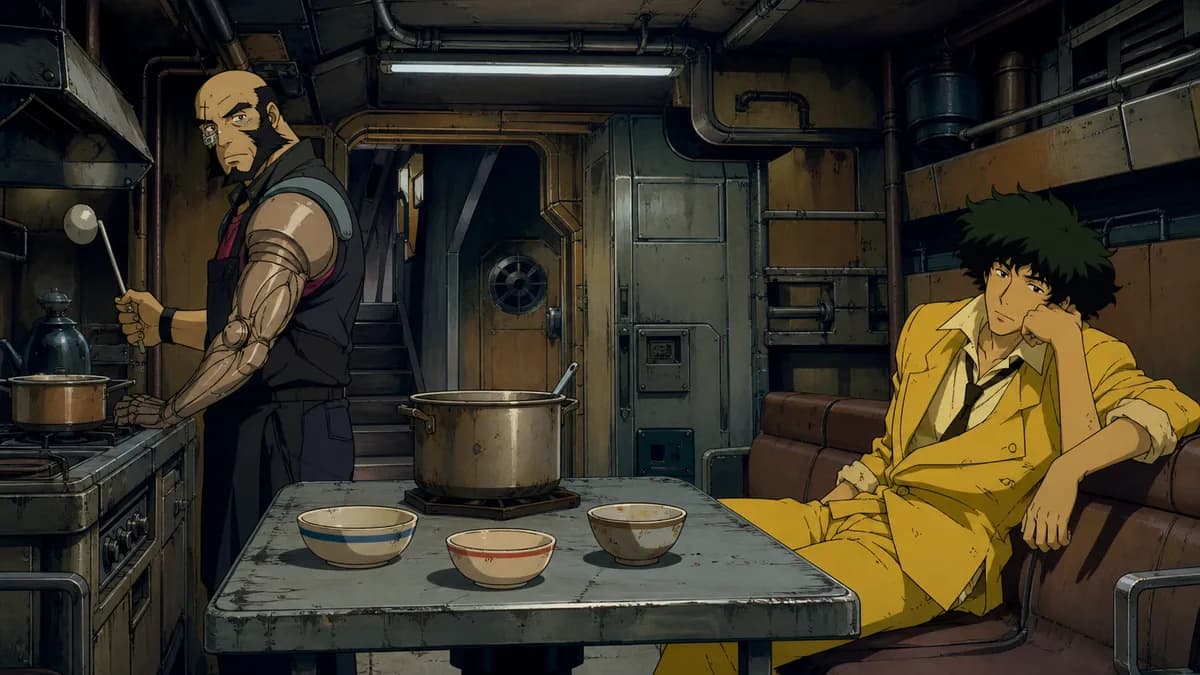
Westerns traditionally tell civic stories about the town, the sheriff, the saloon and the basic question of whether the place can be governed. Anime's space westerns quietly trade all of that for a household. The crew of the Outlaw Star is a group of strays who have nowhere better to go. There is Gene and his young partner Jim Hawking, along with Melfina, the assassin Suzuka and the unstoppable Aisha Clanclan. Gilliam II, the ship's own AI, rounds them out as the family's dry-witted furniture. Law does not hold this group together. Dinner does. That substitution also explains why the form travels so well beyond space. Wolf's Rain and Michiko & Hatchin tell this kind of story after replacing the ship with a road, while Black Lagoon replaces it with a boat. The genre keeps its political imagination deliberately small. Its concern is not the shape of a just society. It watches five people who owe each other nothing and asks, through their choices, whether they will keep showing up for one another.
A used future shows the cost
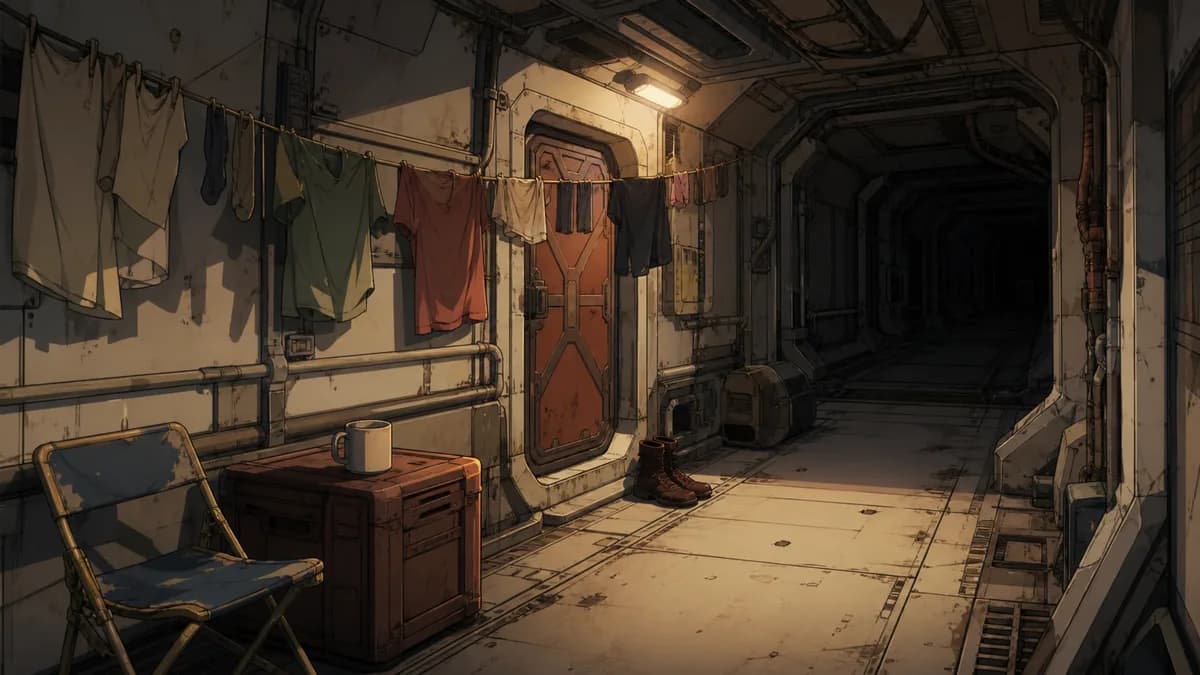
Sunrise established the visual grammar that makes those economics readable, and Outlaw Star is a particularly clear example. Takehiko Itou created the property and its original character designs, while Shouji Kawamori provided design assistance for the hardware. Together, they produced machinery that appears maintained instead of freshly manufactured. Wear patterns are visible, and the interiors make you think about the person who has to repair them. The used future puts a balance sheet into linework rather than treating age as decoration. Kou Ootani's score and Akino Arai's closing theme complete the effect. Their wistfulness makes all that wear feel like accumulated history instead of simple decay. Outlaw Star adds its own variation by placing magic beside engineering. Enchanted weapons and salvaged lost technology receive the same casual treatment as a fuel bill. This is why the series feels like pulp adventure, while Bebop feels like noir. Trigun occupies the third position. It applies the same broke-gunslinger calculation to a parched world where scarcity defines the whole setting.
The best objection: perhaps it is only a vibe
The strongest case against this reading is that space western may be a marketing label placed over shows that share an atmosphere and little else. Cowboy Bebop is noir with a jazz section. Outlaw Star is a treasure hunt driven forward by a MacGuffin, the Galactic Leyline. Trigun is a pacifist parable dressed in a gunslinger's coat. Put them in one category and three genuinely different works can shrink into a mood board filled with revolvers and cigarettes. Plenty of anime also follows broke characters without coming anywhere near the western. The con artists in Great Pretender and the hungry drifters in Samurai Champloo operate under the same shortage of cash. Used as a name for a vibe, the label does flatten the shows and hides much of what makes each one distinct. My test, however, concerns permission rather than mood. It asks which plots the structure allows a show to tell. In this form, another job is always waiting and the payment is never enough. Macross Frontier remains outside the category despite all its ships and spectacle because its people have ranks, salaries and orders. The genre's true opposite is the institution, not the desert.
The frontier moved somewhere else
The form did not disappear. Its frontier changed location. The premise requires a place where no institution catches people when they fall, and modern anime usually finds that place in a city's underclass instead of an outer rim. Cyberpunk: Edgerunners is a space western after removing space from the equation. It follows broke outsiders who take jobs paid in cash and blood, then build a found family that cannot outlive its own economics. Akudama Drive runs the calculation faster. Megalo Box moves it into a fighting ring, and Odd Taxi locates it in the fares of a night-shift driver. The classic form still covers plenty of ground. Trigun Stampede rebuilds the desert from the beginning, Carole & Tuesday exchanges bounties for a demo tape, and Planetes proves the engine still turns when the work is orbital sanitation and nobody pulls a gun. The quality audiences have called cool all these years is precarity, beautifully photographed. Outlaw Star commits one quiet heresy by allowing its crew to win.
FAQ
The distinction is structural, not visual. Space opera organizes its story around power and command. A space western builds its story around work and money, then follows people who lack institutional support and must accept whatever job is available. Remove the ranks and salaries. If the plot can still run, the show belongs in western territory.