
Shinichiro Watanabe: The Director Who Scores Anime Like Music
 By Mika Tanabe · Editor
Ask what genre a Shinichiro Watanabe show belongs to and the usual labels only get you halfway there. Cowboy Bebop looks like science fiction, but it moves and feels like jazz with spaceships. Samurai Champloo wears the clothes of a samurai epic while running on hip-hop. This is what makes Watanabe such a quietly radical anime director. He does not settle on a story and bring in a composer afterward. He starts with a sound, then shapes a world that can live inside it. The soundtrack does not sit on top of the drama as decoration. It controls the rhythm, establishes the mood, and often determines the genre itself. The same method runs through Cowboy Bebop, Samurai Champloo, Kids on the Slope, Carole & Tuesday, and now Lazarus. Music leads, and the rest of the production follows its beat.
The Soundtrack Leads
Watanabe's filmography is easier to understand as a discography than as a list of genres. Arrange the shows by sound and his choices become clear. Cowboy Bebop draws on bebop jazz and blues. Samurai Champloo runs on turntablist hip-hop. Kids on the Slope puts straight-ahead jazz in the hands of the characters. Carole & Tuesday turns pop songwriting into plot. The musical idiom comes first in every case, and it decides what follows: how quickly a scene cuts, what colors define the world, and what kind of cool its characters can carry without looking forced. Most directors work in the opposite order, handing a composer a locked edit and asking for music that supports what is already there. Watanabe treats the score like a co-writer with its own authority. That makes his musical collaborators genuine creative partners rather than interchangeable hired hands. The most famous is composer Yoko Kanno. Her fingerprints cover the sound of his best-known work, and many viewers remember her themes long after the plots have faded.
Cowboy Bebop Uses Jazz as Its Structure
Cowboy Bebop presents the idea in its purest form. Its episodes are called "sessions," a label that describes how the show is built. It plays like a jazz set, with a loose sequence of standalone riffs linked by mood instead of a rigid arc. Each episode takes a solo in a different tone before the band comes together again. Yoko Kanno and the Seatbelts are not adding music to finished action. The action is cut to their playing. A shootout swings because the music swings, while much of the show's melancholy settles into the ballads rather than the dialogue. Form and content line up perfectly. The characters are drifters who live from gig to gig and carry pasts they cannot resolve. Jazz gives that life a fitting structure. It improvises, refuses easy resolution, looks cool on the surface, and grieves underneath. A tighter plot could not explain these people as well. This late-90s landmark still holds up because its storytelling and soundtrack express the same idea in two different forms.
Samurai Champloo Makes Anachronism the Engine
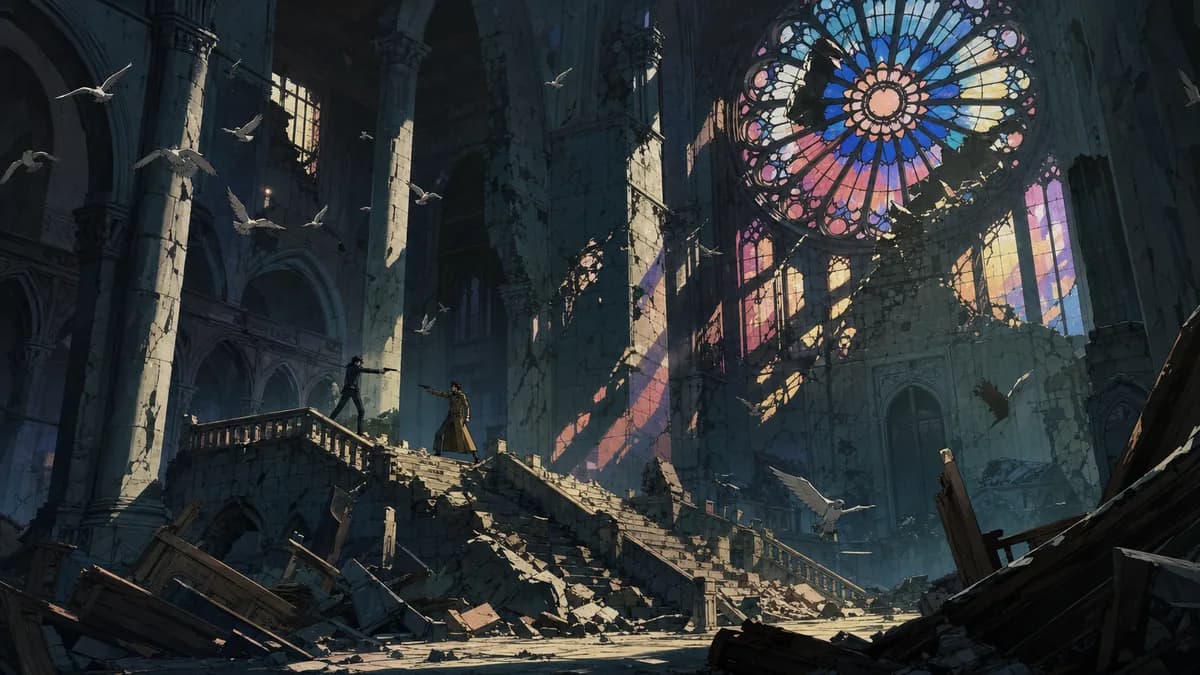
Samurai Champloo pushes the same method into riskier territory. Putting hip-hop into Edo-period Japan sounds like the setup for a costume-party gimmick, yet the anachronism becomes the show's central idea. The late producer-DJ Nujabes and the other beatmakers supply a lo-fi, boom-bap pulse. Watanabe directs in time with it. Scene changes land like record scratches, sword fights follow the phrasing of a freestyle, and graffiti and beatboxing stroll into feudal Japan as if they had always lived there. The music is not laid over the setting for extra style. It argues that both cultures share the same spirit. A wandering swordsman and a wandering MC become versions of one restless figure, separated by centuries but driven by a similar urge. Even the title nods to mixing. That mixture carries the show's themes as well as its look and sound. Watanabe uses genre fusion to say something about outsiders and improvisation, along with the stubborn effort required to find your own way. The collision of musical and historical worlds is how Samurai Champloo develops those ideas.
When Music Becomes the Plot
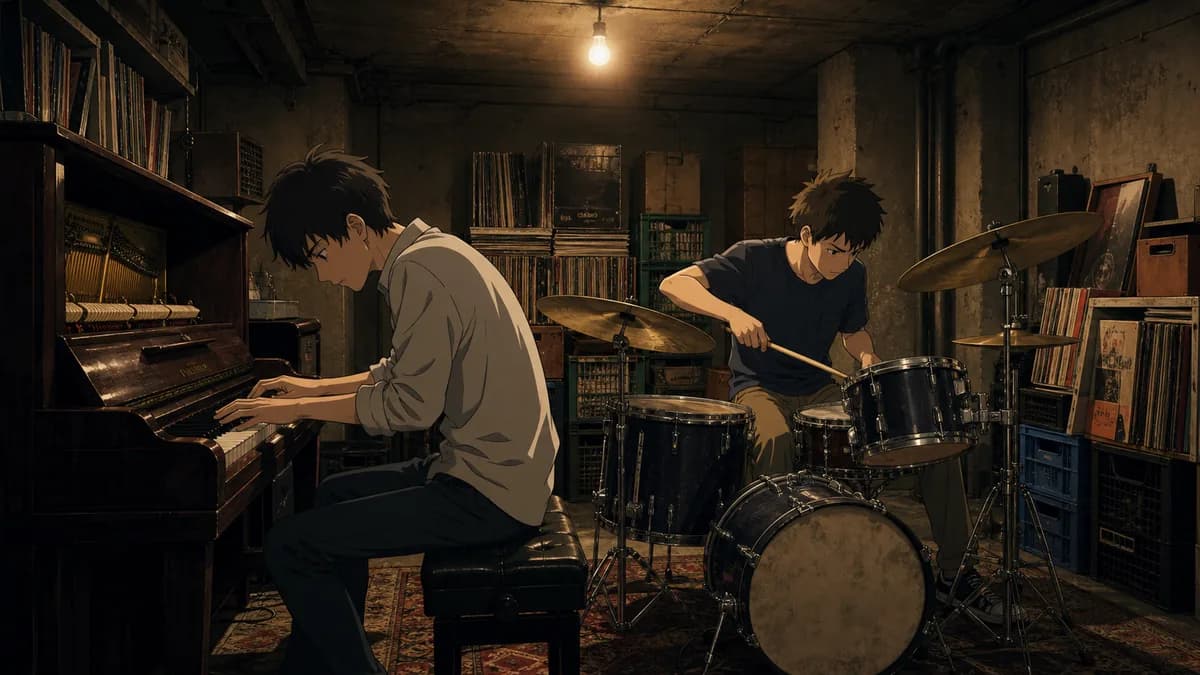
In some shows, Watanabe turns the musical metaphor into the literal subject. Kids on the Slope follows teenagers discovering jazz in a seaside town. Its centerpiece is a rooftop jam session animated with startling instrumental accuracy. The fingering and breathing are there, as is the way that playing together quietly dissolves the differences between the boys. Carole & Tuesday takes the approach further. The entire near-future series rests on two girls writing songs, and its original tracks carry emotional weight that dialogue would usually be asked to handle. These productions make Watanabe's method especially easy to see. He trusts a performance to advance the narrative rather than pause it. A solo can reveal a character. A duet can work as a love scene. A live set can deliver a climax with a force that no monologue could match. The songs do not fill time between pieces of the story. They are the story in Kids on the Slope and Carole & Tuesday, while the surrounding drama is arranged to bring the characters to the moment when the music finally plays.
The Style-Over-Substance Criticism
The fairest criticism of Watanabe is that he directs for vibes. On a bad day, that can mean gorgeous surfaces and killer needle-drops stretched across a plot that wanders or loses force before the end. There is evidence for the charge. Terror in Resonance begins as a taut thriller, then becomes dreamier and less coherent by the finish. His fondness for episodic structures can also make him look less interested in the machinery of plot than in sustaining a mood. That criticism makes sense if plot is assumed to be a story's main purpose. Watanabe's work rejects that assumption. In his shows, tone and music carry the substance. The ache inside a Bebop ballad or the snap of a Champloo transition is part of the meaning, not an attractive garnish placed over it. Demanding airtight plotting from these series is like criticizing a great album because its tracklist feels loose. Looseness belongs to the jazz tradition that informs his directing. It is a deliberate value and a matter of craft, even when viewers who prefer tight narrative engines find it frustrating.
Lazarus and the Life of the Method
Decades into his career, Watanabe's method has not aged out. Lazarus, his newest series, keeps the formula while refreshing the sound. Its jazz-and-electronic score is anchored by artists such as saxophonist Kamasi Washington and paired with kinetic fight direction that has a live-action flavor. The result shows that a music-first approach can still produce new work instead of recycling nostalgia. Its staying power makes the strongest case for Watanabe. A director who spent his career chasing trends would probably have a dated filmography by now. His work survives because genre was never the final target. He pursued a feeling, then allowed sound to guide him toward it. You can hear his influence whenever an anime lets the soundtrack take control. Every "lo-fi anime beats to study to" playlist sits downstream of Champloo. Any series that treats its composer as a real author owes something to what Watanabe proved could be done. His career rests on a simple wager: a groove can serve as the foundation for an entire world. A continuing run of landmark shows suggests that wager paid off.
FAQ
Start with Cowboy Bebop. There is little debate about it. The series is his most complete statement, and it stands on its own without requiring any homework. If its mixture of jazz, noir, and melancholy works for you, the choices across the rest of his filmography become much easier to understand. Samurai Champloo is the natural show to watch next.