The Makoto Shinkai Effect: How One Director Rewired Anime Romance
 By Mika Tanabe · Editor
Conversations about Makoto Shinkai usually begin with the light. People remember sunlight passing through a train window, rain drawn with obsessive care, and skies that seem photographed instead of painted. Those images deserve the attention, but they are the visible layer of a deeper change. Shinkai altered the structure of anime romance by taking the obstacle out of his characters' hands. There is no rival to defeat, no misunderstanding to clear up, and no badly received confession to repair. What separates two people in a Shinkai film is distance, time, weather, or even the ground beneath them. The force is vast, impersonal, and nobody's fault. Because of that change, his romances can grow to the size of disaster movies without breaking their emotional logic. Anime romance still draws from the blueprint he established: intimacy becomes a struggle between two people and a world that will not cooperate.
When the Obstacle Stopped Being a Rival
For decades, anime romance tended to build its conflict around obstacles that could be confronted in conversation. Toradora! follows two people who refuse to admit what everyone around them can already see. Kaguya-sama: Love Is War makes the confession itself a battle of pride, since the first person to say it loses. Tsuki ga Kirei finds its ache in shyness and in the strain of growing up according to somebody else's schedule. Each barrier exists inside a person. However difficult it may be, there remains a chance that the characters could talk their way through it. Shinkai removes that chance. 5 Centimeters per Second gives us the clearest form of his alternative. It is an original story in which geography serves as the antagonist, and its particular cruelty comes from the fact that nobody does anything wrong. Trains continue to follow their timetables. Families move for ordinary reasons. Two people can care deeply and still fail to stay close because the distance simply wins. Once the obstacle becomes impersonal, longing no longer behaves like a plot problem with a waiting solution. It becomes a condition the characters have to live through. Audiences in every language already recognize that feeling. It does not depend on a culturally specific explanation, which is one reason Shinkai's emotional structure travels so easily while remaining intensely personal.
How Shinkai Makes Longing Visible
This is where the famous Comix Wave Films look begins to carry the argument instead of serving as decoration. Shinkai gives his backgrounds more loving attention than his faces, a habit critics have treated as a weakness for years. That criticism gets the function of those images backwards. When the world is the force separating the characters, the world needs to be the most vivid presence on screen. A staircase matters. So does a level crossing, or the weather hanging over a city. These places and conditions play the antagonist, so Shinkai gives them the visual detail that another director might reserve for a face. A Silent Voice offers a useful comparison. Kyoto Animation keeps its camera low and watches shoes or fidgeting hands because the obstacle in that film is social. Its conflict exists at human scale, and the framing stays close to the bodies carrying it. The Garden of Words shows Shinkai's method in its most concentrated form. Its rain-soaked garden is rendered with enough precision that the humidity feels almost tangible. The place carries emotional weight that dialogue would make cheaper by spelling out. Shinkai developed a visual grammar in which a single held image of a location can do the work of a monologue. A large part of the anime industry now uses that grammar fluently, even when the filmmakers have no interest in copying his plots.
From a Train Platform to a Continent
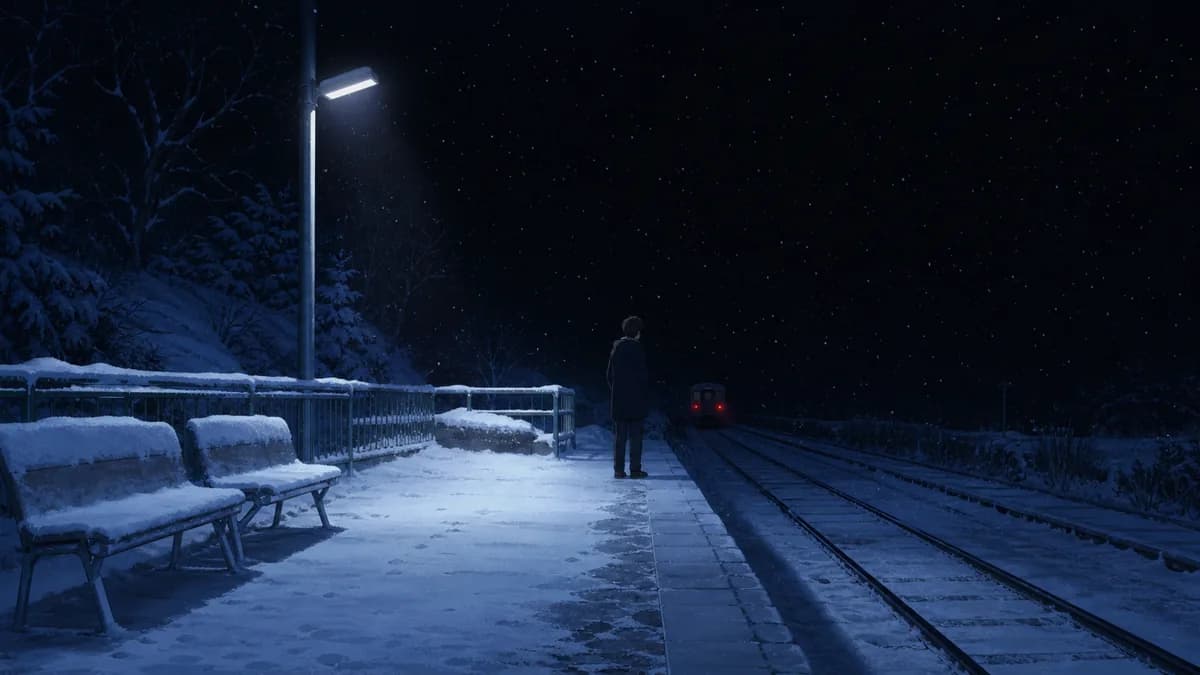
Seen in order, Shinkai's filmography shows a director who keeps raising the cost of wanting another person. 5 Centimeters per Second allows distance to win completely, then refuses to provide catharsis for the loss. Children Who Chase Lost Voices is the entry almost everyone skips. It takes the same ache into myth and adventure, and it is where Shinkai learned that grief moves better as a journey than as a mood. The Garden of Words then contracts the scale again. It focuses on two people and one season of rain, using that limited space to hold everything they cannot comfortably say. Your Name makes the leap that transformed his career. The obstacle becomes cosmic, and overcoming it requires a price as basic as memory. Weathering With You goes further by placing one person against everyone else. It refuses to act as if that calculation has an easy or morally tidy answer. Suzume brings the progression to completion. Doors lead to disaster and closing them supplies the plot, but the film is really about a girl trying to lock away her own past. Across these films, the supernatural scale keeps expanding while the emotional cause remains recognisable. The romance provides the vehicle for the story. The wound determines where it must go, whether the route runs through a rainy garden or stretches across a continent.
What the Industry Understood, and What It Copied
Shinkai's deeper effect on anime was financial rather than stylistic. After his breakout, the industry had room for a particular kind of pitch that could actually receive funding: an original theatrical feature with no franchise behind it and no manga source to adapt, aimed at teenagers, organized around one supernatural conceit, and scored by a pop-rock band. Ride Your Wave, Words Bubble Up Like Soda Pop, Josee, the Tiger and the Fish and Belle all passed through the door that success opened. None of them is a Shinkai imitation, and that difference explains the real reach of his influence. Movies that copied only his surface qualities did not last. Golden-hour light, a city at dusk, and a montage driven by a ballad could reproduce the appearance, but those ingredients were never the engine. The films that endured supplied an obstacle with its own logic. Ride Your Wave is formed entirely around grief. Josee keeps its friction firmly on the ground, between two difficult people and a world whose indifference is practical rather than cosmic. Belle operates through Mamoru Hosoda's own machinery. Shinkai expanded the range of projects that producers could imagine greenlighting. He did not hand the rest of the industry a mandatory form to follow. His commercial impact came from proving that this sort of original film could exist, while the strongest successors understood that they still needed a reason of their own to exist.
The Best Argument Against Shinkai's Reputation
The strongest counterargument deserves to be taken seriously. Mamoru Hosoda reached the emotionally enormous original feature before Shinkai did, first with The Girl Who Leapt Through Time and then with Wolf Children. Wolf Children also has more to say about love and parenthood than any Shinkai film. Shinkai's characters can look thin beside those in television romance, where a series has enough hours to construct a person properly. That extra time helps explain why Your Lie in April and Toradora! still hit harder for many viewers. Nor is the commercial gloss an imagined complaint. Suzume fills its frame with immaculate product placement, the visible result of a movie that also functions as an economy. The charge that Shinkai engineers tears has real force. None of this overturns the claim about his influence, because that claim does not require him to be the finest writer of his era. It requires him to have changed the default, which he did. Hosoda's films remain singular works and never turned into an industry template. Suzume also provides a partial response to the criticism of Shinkai's character writing. Tamaki, the prickly aunt, is the most adult and least flattering relationship he has written. Her bond with Suzume does not resolve according to romantic logic, and its discomfort gives the film a human tension that the cosmic plot cannot supply on its own.
What It Means to Rewire a Genre
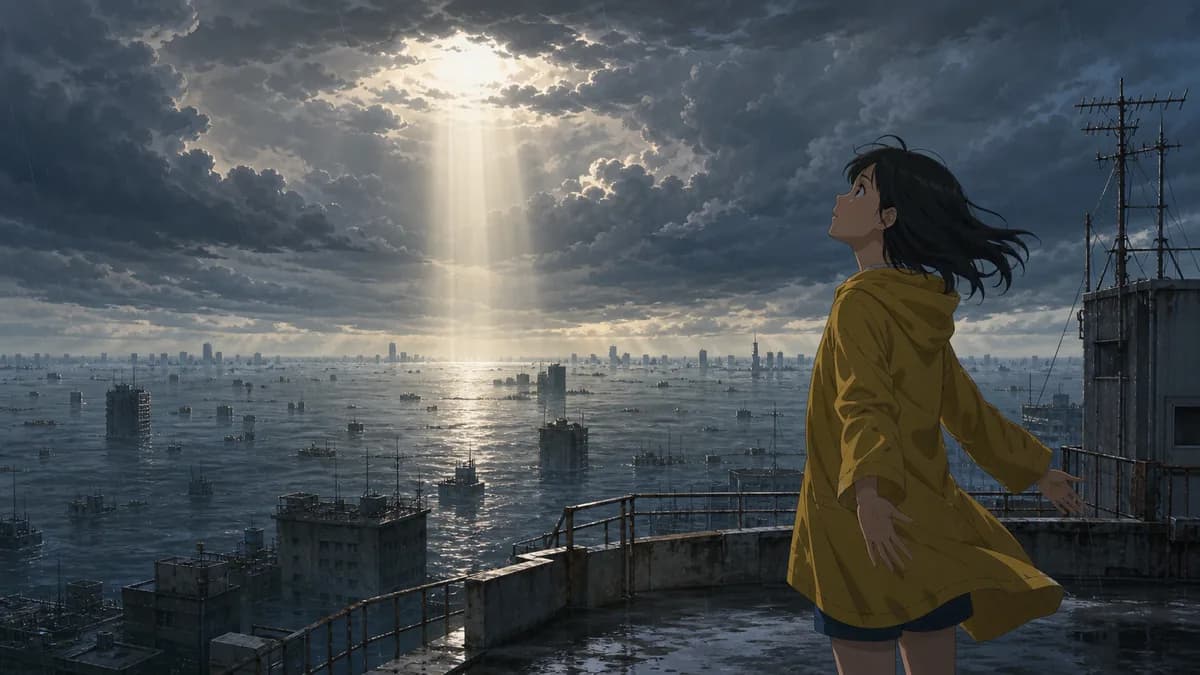
Shinkai's effect does not mean that everybody imitates him. Most direct attempts have been embarrassing, because reproducing bright skies and wistful music is easier than understanding why his stories hold together. His influence appears in a quieter shift of the defaults. An anime romance can now use an impersonal antagonist without sacrificing intimacy. A background can carry an entire scene without dialogue stepping in to explain the emotion. A story about two teenagers can also contain a national wound, including earthquakes, ruins, and a country's memory of catastrophe, without collapsing beneath that burden. Suzume performs exactly that trick through a wandering deity in animal form and a chain of doors. The scale belongs to disaster cinema, but the feeling still begins with one girl and what she has been unable to face. The audience has changed along with the form. For an enormous number of people, the way into anime is now a self-contained two-hour original rather than a long-running shonen. That difference shapes who is watching before the first frame appears. Suzume streams on Crunchyroll and Netflix, and it offers the clearest view of Shinkai's whole mechanism operating at once. Longing drives the intimacy, spectacle gives the obstacle its size, and the film treats both as parts of the same argument. His real legacy lies in making that combination feel like a natural foundation for anime romance rather than an unusual exception.
FAQ
Start with Your Name. It is the clearest entry point and the easiest film to recommend to a friend who does not usually watch anime. Watch Suzume next to see Shinkai's late-period style working at full power. Keep 5 Centimeters per Second for the point when you want his particular ache in its most concentrated form, with no resolution added to soften it.