Vinland Saga Review: A Viking Epic Finds Its Conscience
 By Mika Tanabe · Editor
Vinland Saga takes its time revealing what kind of story it wants to be. It first looks like a Viking revenge tale, with a feral boy named Thorfinn pursuing the mercenary who murdered his father across the frozen fringes of eleventh-century Europe. WIT Studio plants that chase in real history. The fjords are icy, the raids are caked in mud, and men fighting over the English crown quote scripture in one moment and gut somebody in the next. Makoto Yukimura has a much longer argument in mind, though. A story that starts with the urge to kill gradually asks why any warrior would decide to stop. We watch a historical epic develop a conscience, while the series asks its audience to examine its own appetite for the bloodshed on screen.
A Revenge Plot Opens Into History
The initial hook could come from a blunt piece of genre pulp. Thors, one of the finest warriors of his age, is killed by Askeladd, a mercenary captain with a silver tongue. His young son Thorfinn then joins Askeladd's warband. He gives away his childhood in exchange for the hope of an honorable duel and the revenge he believes will follow it. Yukimura gets real mileage from that premise by refusing to send the story down a straight path. Much of the season grows into a broad political thriller. Askeladd's men are caught up in a Danish civil war and the struggle for the English throne, and the timid prince Canute is pulled directly into the machinery of power. Thorfinn still clings to his vendetta, but it no longer occupies the center of every event. It becomes one obstinate line inside a far bigger account of war and political ambition. The patient structure is a daring choice, especially for a series that first sells itself through revenge. It also gives the history proper weight. Battles alter what comes afterward, while useful alliances spoil as soon as the people inside them change. By the time the political plot has taken hold, the original revenge setup looks less like the destination and more like an invitation into the story. War itself is the real subject, along with the men who keep its machinery moving and the damage it does to them.
Characters Who Carry the Story
The series takes a serious risk with Thorfinn. For long portions of the season, its protagonist hardly seems like a complete person. Revenge has emptied him out and left behind a quiet, surly knife of a boy who mostly kills and glowers. The choice is intentional, but that does not stop it from becoming frustrating at times. It succeeds because the people around Thorfinn have so much life in them. Askeladd is the character who keeps the entire production beating. He can be cunning and funny, yet he is also tired and morally evasive. His hidden loyalties lend the middle arcs much of their weight. He belongs among the finest characters anime has produced, and the series understands exactly how dependent it is on him. Canute supplies a different pleasure. Watching the trembling boy become someone far colder is one of the show's quietest and most satisfying turns. Thorkell charges through the story with gleeful, muscular chaos. Bjorn's loyalty comes attached to a body count. Thors is gone, but his memory remains over each new act of violence, posing a question that none of these men can answer. These supporting characters have to provide the feeling and human complexity that Thorfinn keeps locked away. Much later, he is finally forced to take on that emotional work himself.
Animation, Art, and Sound
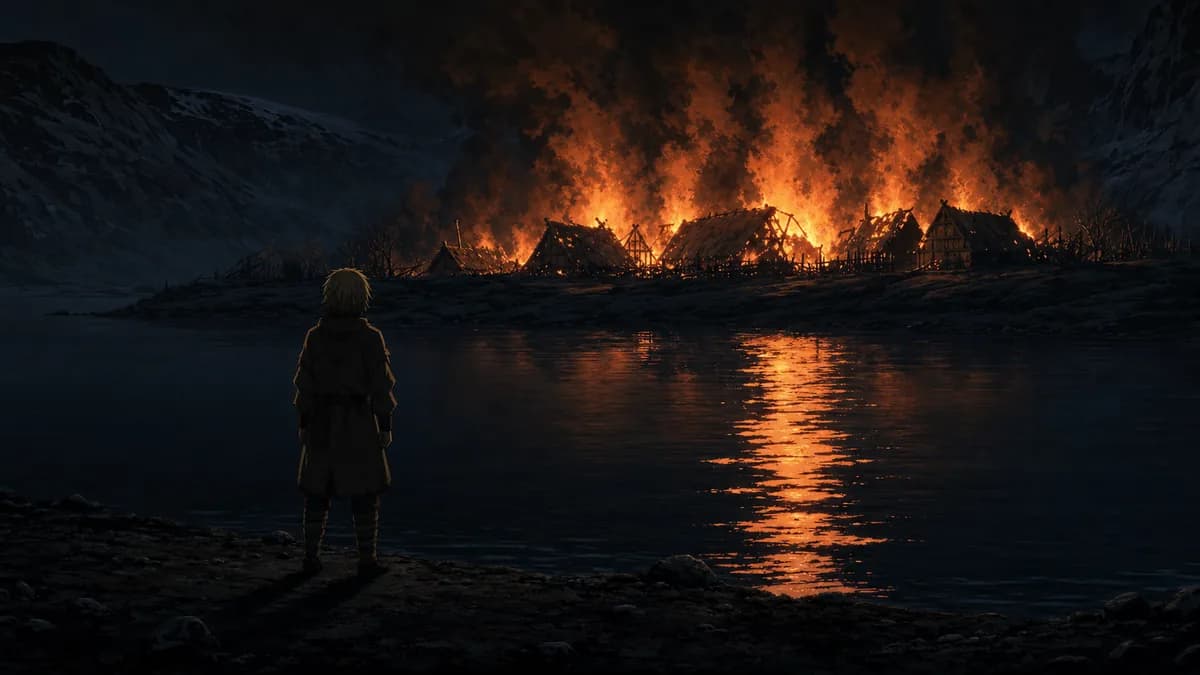
WIT Studio was working near the height of its ability here, which is apparent in almost every episode. The hand-drawn fights are clear and properly heavy. An axe seems to have real mass, a collapsing shield wall creates palpable panic, and the violence feels specifically medieval. It never turns into the weightless flashing common to weaker action series. Yuusuke Takeda's art direction gives the snowbound cliffs and longships a painterly chill. Burning villages look frightening rather than decorative, and the whole world appears inhabited while remaining deeply hostile to human life. The sound work supports that physical quality. Every crunch underfoot and every gust of wind gives the spectacle a bodily presence. Rock-driven opening songs bring a burst of adrenaline without ruining the somber mood, while the score has the restraint to disappear when a scene needs silence. The CGI is the noticeable flaw. Ships and larger crowd scenes sometimes acquire a stiff, plastic look, briefly breaking the spell cast by the otherwise beautiful imagery. The English dub is unusually good as well, and it deserves consideration even from viewers who normally default to subtitles. Taken as a complete production, Vinland Saga sits securely in anime's top tier for craft.
Why Its View of Violence Matters
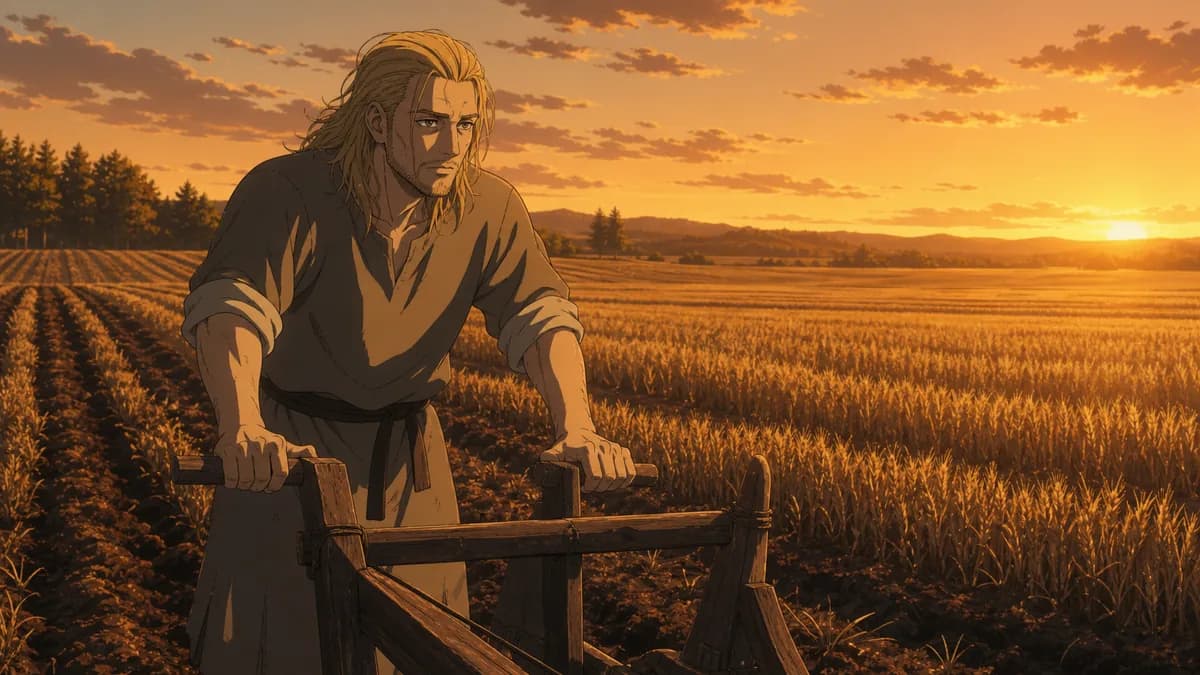
Many action anime present violence as the answer to a problem. Vinland Saga regards violence as the problem itself. Its moral backbone comes from an idea Thorfinn's father states early: a true warrior has no need for a sword, and nobody is truly your enemy. Everything that follows puts that belief under pressure in a world seemingly designed to refute it. Raids and thralldom are ordinary parts of life. Kings scheme for power, while holy men give their blessing to massacres. The series stands apart because it rarely allows the audience to enjoy killing without discomfort. A death may look triumphant for a moment, but the camera stays long enough to make its cost impossible to ignore. The story examines masculine fantasies about glory and revenge, along with the use of faith as a weapon. It also shows the steady decay that vengeance causes in a person's soul. Vinland Saga shares some of the raw material of loud shonen adventure, and that family resemblance makes its choices look even sharper. Yukimura handles those familiar ingredients with seinen seriousness. Victory in combat is never the only concern. The story keeps returning to the harder matter of whether a given fight had any value in the first place, especially once the surviving characters must live with what they have done.
Where It Excels and Where It Stalls
Vinland Saga has enormous strengths, especially Askeladd, its careful historical texture, the quality of its production, and thematic aims that most action series never attempt. It still has clear faults, and overlooking them would give the wrong impression of the experience. The pacing is a genuine slow burn. Its early stretch returns repeatedly to bleak raids and demands considerable patience before the political plot starts working at full speed. Thorfinn is the largest obstacle for some viewers. For much of the run, he is passive and monosyllabic, with a scowl standing in for most outward emotion. Anyone who needs an immediately likable protagonist may find him difficult to follow. The court intrigue in the middle also spreads too widely on occasion and loses some momentum. The biggest reservation concerns the season's structure, since this entire run is explicitly a prologue. It stops just when its real thesis begins to emerge. As a result, the ending can feel like an opened door instead of a complete resolution. Viewers looking for easy catharsis or a tidy arc will not find either here, nor will they get a cheerful hero. The season rewards a specific kind of patience, asking its audience to stay with a damaged boy and an ugly world before revealing what all that suffering is meant to set up.
The Verdict
Vinland Saga is an uncommon action epic because it uses excellent action to challenge the very desire for it. The argument never becomes a sermon because the series has the skill to keep its ideas dramatically exciting. Its score of ninety-three reflects a production working at an exceptionally high level, with beautiful visuals and an intelligent script held together by Askeladd, an all-time great character. It falls short of perfection because the early pace can be punishing and Thorfinn asks for a viewer's loyalty well before he has done anything to earn it. This is not comforting television, and easy catharsis is not part of the offer. Instead, the season builds slowly and coldly toward an inquiry into the purpose of a life devoted to violence. Anyone willing to remain inside that discomfort will find few historical dramas in anime that land with comparable force. The Viking spectacle may be the first attraction, but the conscience that develops through it is what makes the series last.
FAQ
Yes, provided you are ready for its pace and severity. Vinland Saga presents itself as a Viking action series, but it develops into a patient and brutal historical drama with serious thematic weight. Once it moves beyond the simplest version of its revenge story, it becomes one of the most rewarding seinen epics available.