
Snow White with the Red Hair Review: A Comfort-Watch Romance That Gets It Right
 By Mika Tanabe · Editor
Plenty of romances depend on misunderstandings. Snow White with the Red Hair takes the more satisfying route and follows two people who say what they mean, respect each other's goals, and choose to grow closer. Shirayuki is a herbalist whose rare apple-red hair catches the attention of a spoiled prince in Tanbarun. When he decides that her hair gives him the right to claim her, she cuts it off and leaves his kingdom. She has already rescued herself before Zen, the much kinder prince she meets across the border in Clarines, appears. That opening choice establishes Shirayuki as someone with skill, judgment, and no interest in letting a title determine her future. Studio Bones presents the shoujo fairy tale in soft pastels and gives its story room to breathe. Instead of chasing one cliffhanger after another, the series builds its appeal through warmth and steady character work. The result is soothing without feeling empty. Its comfort comes from watching capable people treat one another well and work toward lives they actually want.
The Story and Its Fairy-Tale Setup
The premise gets moving without much fuss. Shirayuki works as a skilled pharmacist in the kingdom of Tanbarun, where people value what she knows until Prince Raji notices her striking red hair. He orders her to become his concubine, treating her appearance as if it makes her his property. Shirayuki neither submits nor waits around for someone else to solve the problem. She cuts off the locks that drew Raji's attention and flees across the border into Clarines. There she happens to meet a young man called Zen. He later turns out to be the second prince of Clarines, though he carries that status with far more grace than Raji ever showed. A weaker version of this story could have let royal favor fix Shirayuki's life from that moment onward. The series refuses that shortcut. Shirayuki studies for a position as a court herbalist and earns it through her own ability. Her relationship with Zen matters deeply, but it does not replace her work or hand her an identity. The light court intrigue, the kidnapping arc, and the arrival of visiting nobles all put pressure on the same idea. Shirayuki wants to build her place in this world on merit, while she and Zen construct their partnership with equal care. Most of the drama grows from the choices the characters make rather than a pile of convenient misunderstandings. Even when danger enters the story, Shirayuki is treated as an active person in her own life, never as a prize left waiting for rescue. That straightforward respect for her decisions gives the familiar fairy-tale setup a welcome sense of purpose.

Why the Characters Work
Shirayuki and Zen are the reason the series is recommended so often, and their relationship deserves the praise. Affection comes after genuine liking and respect. When friction appears, they speak to each other instead of letting silence turn a small problem into an episode's worth of manufactured conflict. The writing also refuses to treat jealousy or secrecy as proof of passion. Shirayuki remains the center of the story. She is composed and competent, with a quiet stubborn streak that keeps her moving when a situation would be easier to avoid. Her profession defines her as clearly as her feelings for Zen do. Zen meets her as an equal without taking over her story. Their difference in social station is real, but they discuss it honestly and deal with what it means rather than allowing it to become a melodramatic barrier. The people around them keep the gentle tone from becoming cloying. Mitsuhide and Kiki serve as Zen's loyal aides, and their grounded presence suits the prince they support. Obi brings a different energy as an agile, wisecracking messenger. He regularly steals a scene, yet the show does not let him seize the entire story. Zen's elder brother Izana offers a cooler political counterweight, bringing the demands of the palace into sharper focus. Palace pharmacists Ryuu and Garack give Shirayuki a professional home, which matters because her career is never treated as decorative background for the romance. Across the cast, people tend to think about their responsibilities and make adult choices. The series trusts that consideration, honesty, and mutual regard can hold attention without anyone behaving foolishly for the sake of a plot twist. Anime romance should offer that kind of maturity more often.
A Softer Side of Bones
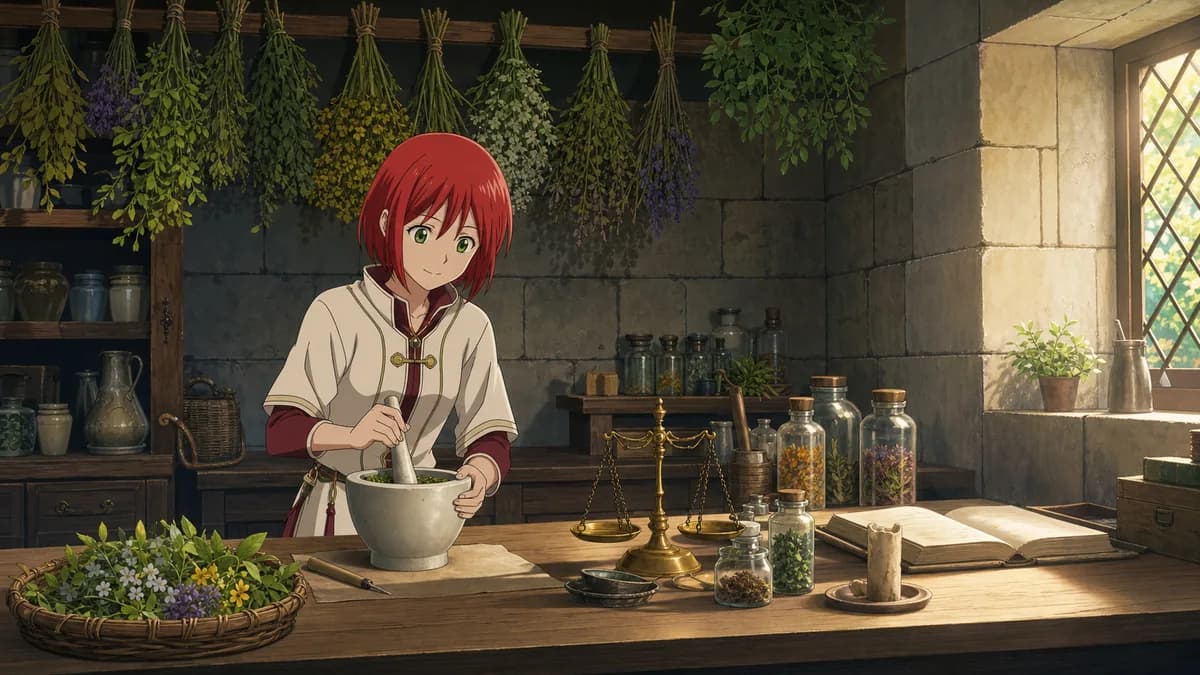
Studio Bones works in a notably gentle mode here. Kumiko Takahashi's character designs are clean and expressive, giving the cast enough detail to communicate feeling without making every reaction oversized. The color palette favors soft pastels. Powder blues and warm creams surround Shirayuki's apple-red hair, which the production uses as the emotional focal point the story requires. The backgrounds give the European-styled kingdoms an inviting storybook beauty. Palace corridors feel open and calm, while herb gardens and quiet forest paths support the series' measured pace. Director Masahiro Andou keeps scenes easy to read and pays close attention to small physical choices. A glance can carry the weight of a conversation, and a steadying hand can say enough on its own. That approach fits a story concerned with feeling rather than fighting, so the lack of spectacle rarely feels like a limitation. Michiru Ooshima's orchestral score is another understated strength. It gives scenes a fairy-tale lift while resisting the urge to announce every emotion. One production detail has become a particular favorite among fans: Saori Hayami voices Shirayuki and also performs the tender opening theme. The show's most recognizable character and its signature song therefore share the same voice. None of these elements strains for attention. The designs, restrained direction, and music work toward the same warm atmosphere. The finished series looks handsome and feels consistent, with mood taking priority over flash at every turn.
A Heroine Who Rejects the Old Script
Shirayuki's self-possession is what separates Snow White with the Red Hair from many romances built on a similar fairy-tale foundation. The title suggests a passive beauty who needs someone to pull her out of danger. The opening quietly overturns that expectation. Shirayuki carries the name of the old story but refuses to follow its script. She saves herself at the first opportunity, then spends the series pursuing a vocation instead of looking for another rescue. Her expertise as a herbalist establishes her value, and her ambition continues as the romance develops beside it. Falling for Zen does not erase the work she has chosen or reduce it to a quaint character detail. The series makes a clear case for agency and equality inside a love story. A healthy partnership requires two whole people, with neither person made smaller to flatter the other. Consent and self-determination matter from the beginning because the entire plot starts with Raji trying to deny Shirayuki both. Zen's appeal comes partly from understanding that her choices belong to her. The romance also rejects the usual cycle of uncertainty suggested by the phrase 'will they, won't they.' Shirayuki and Zen are allowed to be together, and the writing looks for meaning in the practical ways they support each other's growth. It does not need an endless chain of false obstacles to keep them interesting. Sincerity powers the relationship, and the show has enough confidence in its characters to let that sincerity remain visible. The familiar imagery may come from a fairy tale, but the values belong to a heroine determined to author her own future.
Where the Gentle Approach Falls Short
The same qualities that make the show reassuring also limit how gripping it can become. Its stakes remain low. Shirayuki and Zen settle into their relationship early, and the possibility of a real break between them rarely hangs over the story. Viewers who want romance mixed with serious angst or peril may find the experience too gentle. The conflicts include a jealous noble, a kidnapping, and court maneuvering, but they usually end cleanly and leave no lasting scars. Since one problem seldom adds pressure to the next, tension does not have much chance to accumulate. The season also feels clearly like a first movement. It introduces the world, establishes Shirayuki's direction, and develops the relationship, then stops instead of reaching a large climax. Much of the deeper payoff is left for the sequel. Even the pastel calm can start to feel sleepy when the viewer is not in the right mood for its pace. These limits do not suggest that the series has misunderstood itself. It knows the experience it wants to provide and remains consistent about providing it. Enjoyment depends on whether warmth sounds better than adrenaline at the moment you press play. With that expectation in place, the show seldom lets its audience down. Anyone approaching it for escalating danger and sharp romantic friction may end up checking the clock. Anyone looking for thoughtful companionship and conflicts that do not leave the cast emotionally wrecked is much more likely to appreciate the restraint.
The Verdict
Snow White with the Red Hair has earned its place as a comfort-watch favorite because its kindness comes with intelligence and clear character choices. Shirayuki is a self-possessed professional who handles her own rescue, builds a career, and continues with her life. Her relationship with Zen ranks among anime romance's healthiest because they communicate like adults and respect each other as equals. Studio Bones surrounds them with pastel warmth, expressive character work, and Michiru Ooshima's lovely score. It is an easy series to choose when you want to finish an evening feeling safe and glad instead of exhausted. Its limitations are equally clear. The stakes stay low, most conflict remains soft, and the first season spends more time setting up the world than delivering a grand payoff. Viewers who read that restraint as a lack of ambition will have better options elsewhere. For anyone who wants a gentle, grown-up romance that understands mutual respect, this comes remarkably close to the ideal.
FAQ
Yes, especially for viewers who put character and warmth ahead of plot twists. It is a dependable comfort watch within shoujo romance because Shirayuki is defined by her competence, while her bond with Zen feels mature and believable. Expect warmth rather than high stakes, and the series is unlikely to disappoint.