
Re:Zero Review Confronts Isekai's Cruelest Masterpiece
 By Mika Tanabe · Editor
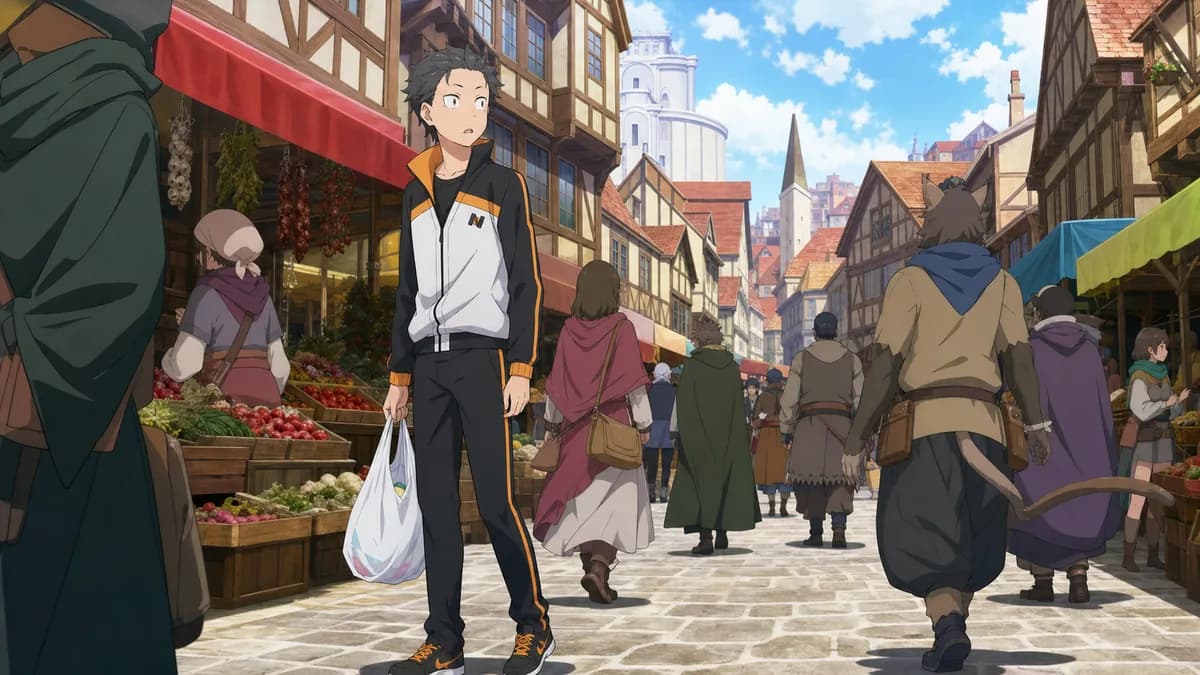
Most isekai hand their hero a menu of superpowers and a harem to match. Re:Zero hands Subaru Natsuki a knife in the gut and a reset button he never asked for. Yanked from a late-night convenience-store run into a bustling fantasy capital, this ordinary shut-in quickly learns the shape of his one 'gift': whenever he dies, time rewinds to an earlier checkpoint, and he alone remembers the horror he just lived through. White Fox built a series that weaponizes that premise into something far closer to psychological horror than power fantasy. My thesis is blunt. This is the show that cracked the isekai boom wide open by asking what repeated death would actually do to a human mind, and it earns its reputation as the genre's cruelest, most human landmark.
Story & Premise
Subaru Natsuki is nobody special, a friendless teenager who assumes his sudden transportation to a sword-and-sorcery world is the start of a grand adventure. It is not. Within his first night he is robbed, hunted, and murdered in a filthy alley beside the silver-haired half-elf who showed him kindness. Then he wakes at the moment he first arrived, gut-punched to find everything reset and everyone he met a stranger again. This is 'Return by Death,' the engine powering everything: a checkpoint mechanic paid for in genuine dying. Subaru cannot choose when it triggers, cannot control where it drops him, and cannot make a single soul believe what he carries. Each loop becomes a grim puzzle box: clock the threat, die learning its shape, then crawl back with hard-won knowledge as his only weapon. What starts as bright fantasy curdles, arc by arc, into the study of a boy trying to out-suffer fate itself. The premise's real brilliance is making death matter more, not less. The plot rewinds, but the trauma never does.
Characters
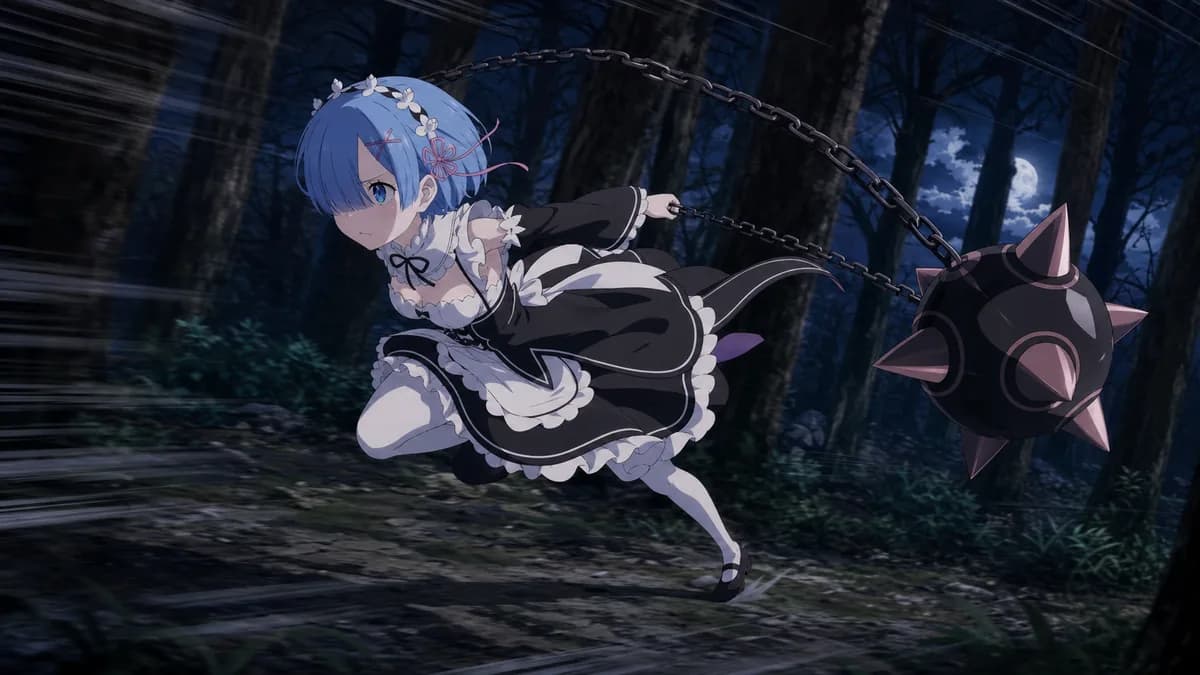
The cast is where Re:Zero either loses you or owns you. Subaru is a deliberately divisive lead: motor-mouthed, self-pitying, and prone to mistaking his own kindness for a debt others owe him. That is the point. The show is dissecting the entitled 'nice guy,' and it makes you sit in his flaws before it lets him grow. Emilia, the silver-haired half-elf he latches onto, is gentler and lonelier than her cool exterior suggests, an outsider distrusted for resembling a hated witch. Then there is Rem. A blue-haired maid who starts as near-background decor and becomes the emotional core of the entire series, Rem earns a mid-season arc so devastating and so beloved that it reshaped how a generation talks about supporting characters. Around them orbit a superb ensemble: the razor-tongued twin Ram, the smug mage Roswaal, the reality-bending librarian Beatrice, and Emilia's cat-like spirit Puck, each hiding far more than they show. The relationships here are not decoration. They are the stakes every loop is fighting to protect.
Animation & Sound
White Fox, under director Masaharu Watanabe, pulls off a quietly essential trick: the show has to look inviting enough to sell the isekai daydream, then ugly enough to make its horror land. Kyuuta Sakai's character designs keep the cast expressive and warm in daylight, which is exactly why it hurts when the animation tips into body horror: mangled limbs, curse-blackened flesh, the wet aftermath of a loop gone wrong. The direction understands restraint too, holding on a character's face until the dread becomes unbearable. A supersized, double-length opener gives the world room to breathe before the knife comes out. Sound does heavy lifting under director Jin Aketagawa: silence stretched to a snapping point, the sudden swell of strings when a scene turns, opening themes that visibly darken as the story does. This is not the flashiest production on the shelf, and the action is more functional than jaw-dropping, but its audiovisual choices are ruthlessly aimed at one goal. They make you feel every death Subaru can never take back.
Themes & What Sets It Apart
Strip away the fantasy trappings and Re:Zero is a story about trauma and what it costs to keep getting up. Every isekai promises escape and empowerment; this one hands its hero the opposite. Subaru has no combat cheat, no stat screen, no growing crowd of admirers who ask nothing of him, only the obligation to die, feel it fully, and remember. The genre usually treats a second world as a reward. Re:Zero treats it as a meat grinder that happens to grant do-overs, and it is fascinated by the psychological toll of those do-overs: the despair of watching loved ones die on repeat, the temptation to simply give up, the corrosive belief that suffering ought to be rewarded with love. Its sharpest move is the deconstruction of the wish-fulfillment protagonist. Subaru's worst moments come not from villains but from his own assumption that being the hero entitles him to the girl, the glory, the gratitude. Watching the series dismantle that fantasy, then rebuild something humbler and truer in its place, is what elevates it from clever gimmick to genuine statement.
Strengths & Shortcomings
The strengths are considerable: a premise unlike anything else in its lane, a mid-season emotional gut-punch that ranks among the medium's best, and the rare nerve to make a power fantasy genuinely hurt. But a premium verdict owes you the flaws. Chief among them is Subaru himself, who is deliberately, aggressively grating in the early going: the constant riffing, the pop-culture quips falling flat on a world that cannot get the joke, the self-pity. It is intentional and it pays off, but plenty of viewers bounce before the payoff lands. Pacing is the other honest knock. This is a slow burn that front-loads a sunny fantasy before baring its teeth, and the loop structure means some stretches, the mansion arc especially, circle the same ground until patience frays. The tonal whiplash between comedy, romance, and gore will not sit right with everyone. And because the story only widens from here, this run resolves emotionally but leaves the larger mystery, the witches, the world, Emilia's fate, wide open. A phenomenal opening movement, not a complete symphony.
The Verdict
Re:Zero earns its 91. This is the series that took a genre drowning in low-effort power fantasies and asked a genuinely brutal question, what repeated death would do to an ordinary mind, then answered it with more courage and craft than almost any peer. The points I am holding back are honest ones: an early Subaru who tests your patience on purpose, a slow-burn structure that loops longer than some viewers will forgive, and a story that closes its first movement with the biggest questions still open. None of that dents the achievement. If you can push past the grating opening stretch and let the show break your heart around its midpoint, you will understand why fans treat it as a modern classic. Come for the isekai hook; stay for the cruelest, most human coming-of-age story the genre has produced. It is worth every death.
FAQ
Yes, emphatically, as long as you know what you are signing up for. It is one of the defining anime of the modern isekai wave, and it uses a familiar 'trapped in another world' setup to tell a genuinely harrowing story about trauma, persistence, and love. Give it a little time to reveal its real hand and it becomes very hard to shake.