
Kaguya-sama: Love Is War Review: A Near-Perfect Rom-Com
 By Mika Tanabe · Editor
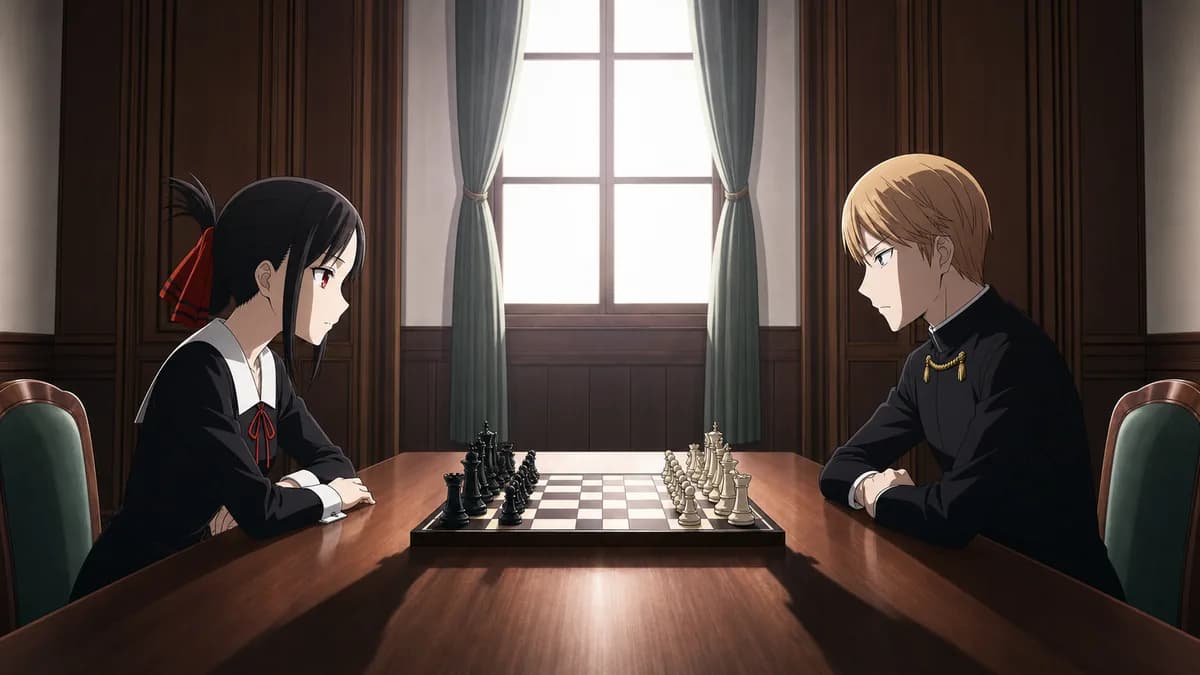
Most romance anime feed on longing. Kaguya-sama: Love Is War feeds on ego. Miyuki Shirogane and Kaguya Shinomiya are the brightest students at the elite Shuchiin Academy, and they are hopelessly in love with each other. Neither will admit it. In their minds, the first person to confess loses, so both would prefer to stage an elaborate psychological campaign and force the other one to crack. Creator Aka Akasaka and A-1 Pictures take this wonderfully silly idea much further than it ought to go. Every minor interaction becomes a battle of wits with absurdly low stakes and enormous tension. Sharing an umbrella is treated like a chess endgame. A lunch invitation carries the danger of a nuclear standoff. The joke stays funny because the series commits to it without losing sight of the vulnerable teenagers beneath all the strategy. It earns the laughter, then slowly earns the affection that follows.
The Story and Its Ridiculous War
Kaguya-sama runs on a lovely contradiction. Its leads suit each other perfectly, yet neither has the nerve to move first. Miyuki is the scholarship-kid student council president who has fought his way to the top of the class. Kaguya is the sheltered daughter of a titanic financial conglomerate. They have both decided that confessing first means losing and surrendering power in the relationship forever. Dating would be the obvious solution, but pride sends them in the opposite direction. They scheme instead. Episodes are divided into titled vignettes, with each one turning some ordinary school interaction into a fresh skirmish. They battle over sharing an umbrella, tricking the other person into asking about movie tickets, or simply holding their nerve in a staring contest of the heart. The format could have worn out its welcome quickly. It does not, largely because the presentation keeps changing the temperature of the joke. A booming narrator describes every exchange as if calling a championship match. We hear the characters' frantic thoughts, follow their increasingly complicated calculations, and watch a supposedly foolproof plan blow up in seconds. Those reversals give each vignette its snap. They also expose what the war is hiding. Miyuki and Kaguya are lonely, guarded kids who ache to be close to someone. Both are scared that openly wanting affection will leave them exposed. The schemes are funny because the objective is so small, but the feelings behind them are never treated as small.
A Student Council Worth Knowing
The premise depends on its two leads, but Kaguya-sama soon proves that it has a terrific ensemble. Kaguya Shinomiya initially looks like she might settle into the familiar ice-queen role. Instead, she becomes a sharp portrait of arrested development. She can plan several moves ahead and still be completely baffled by everyday affection. When her careful strategy fails, the brilliant heiress may sulk, start another scheme, or erupt with startlingly feral anger. Miyuki works because his weaknesses line up neatly with hers. Everyone at school sees a flawless president. In private, he is a sleep-deprived grinder whose status rests on pride and relentless effort. His impressive competence tends to disappear as soon as sincere emotion enters the room. The rest of the student council keeps their duel from becoming too tidy. Secretary Chika Fujiwara is chaos in human form. She has no idea what Miyuki and Kaguya are planning, which makes her uniquely gifted at ruining those plans. Her cheerful obliviousness can wreck an entire operation, and she regularly walks away with the episode. Treasurer Yuu Ishigami first appears to be a hunched boy who mutters about doom, a reliable source of punchlines whenever the room needs a gloomy interruption. The series gradually gives him real depth and one of its most satisfying emotional throughlines. Kaguya's ferociously capable attendant, Ai Hayasaka, also receives plenty of sharp comic material. Together, these characters grow into a friend group that feels genuinely enjoyable to be around, even when half of them are sabotaging the other half by accident.
Direction, Animation, and Sound
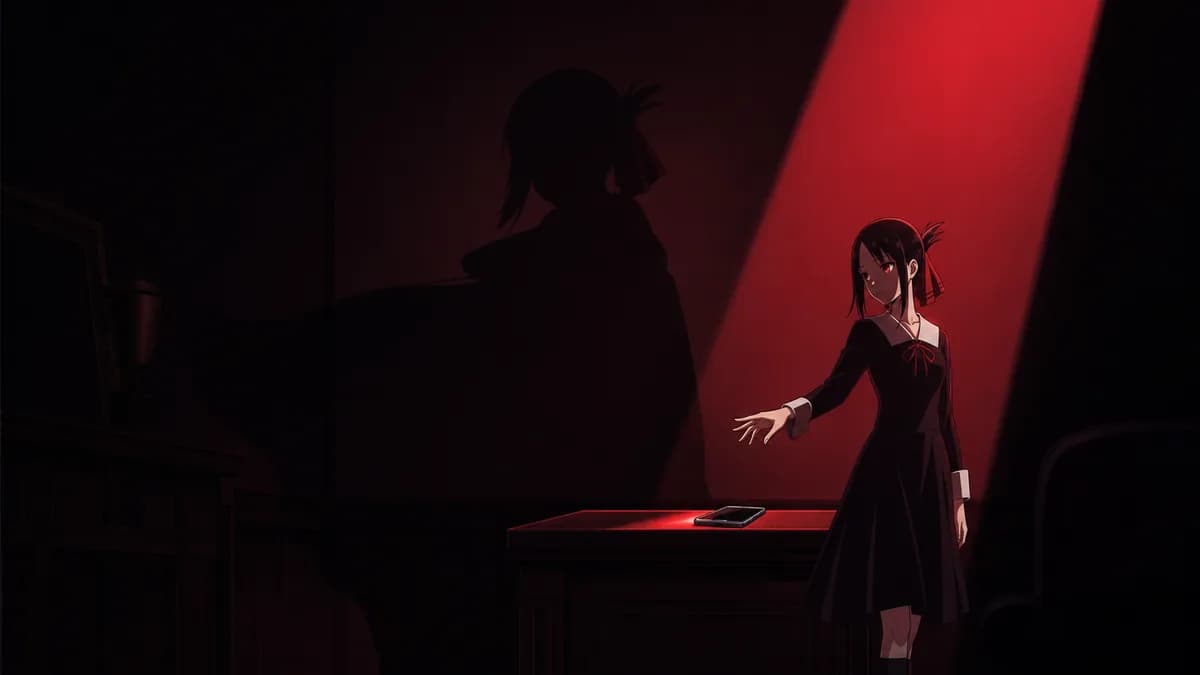
The adaptation earns its reputation through sheer comic invention. Under the wildly inventive direction associated with Shinichi Omata, A-1 Pictures never treats the material as a routine series of conversations between teenagers. A quiet exchange can begin with crisp, controlled framing, burst into a shoujo-sparkle fantasy, slip into hard-boiled noir, and finish with a full-body collapse once somebody's composure gives way. The shifts are aggressive, but they are always in service of the joke. Facial distortion is one of the show's best tools. An arched eyebrow can land a punchline by itself, while a dignified face suddenly crumpling into gremlin mode can replace a whole page of dialogue. The narrator holds all these clashing styles together. Every petty encounter is delivered with the grave authority of a war documentary, so the extreme presentation feels like the natural expression of what Miyuki and Kaguya believe is happening. Kei Haneoka's score is just as flexible, changing genre to suit the particular bit. The ending sequences deserve their reputation as well, especially a certain impossibly catchy dance number that became a cultural event in its own right. None of this would work if the individual elements were competing for attention. The sound direction, visual gag construction, and comic timing lock together with remarkable precision. Pauses last exactly long enough. Reactions arrive on the right frame. Even the busiest sequence feels carefully choreographed rather than noisy for its own sake.
Why the Comedy Has Real Weight
Beneath the gags, Kaguya-sama has an unusually exact understanding of why intelligent people can be hopeless at love. Pride and vulnerability come from the same wound here. Every new strategy is another defense mechanism, allowing Miyuki or Kaguya to desire something intensely without ever saying so aloud. The phrase 'love is war' works because it gives physical shape to a familiar private fear: admitting your feelings seems to hand power to the person hearing them. Many romantic comedies use that anxiety as fuel for delay. This series stands apart because it respects the fear even while turning its consequences into farce. It never sneers at Miyuki or Kaguya for protecting themselves. It understands why those defenses exist and lets the audience see how exhausting they are. Class and isolation add a quieter pressure beneath the slapstick. Kaguya's gilded-cage wealth leaves her lonely. Miyuki's grinding poverty produces a different route to the same place. Inside the student council room, that loneliness begins to ease with a warmth neither of them knows how to request directly. Their friendship with the others matters for the same reason. It gives both leads a place where affection can develop before they have learned how to name it. The comedy draws you in, but the lasting pull comes from watching two guarded people lower their armor by degrees. Each small concession means something because the show has made their resistance so easy to understand.
Where the Formula Starts to Strain
The sketch-based, multi-segment structure is both the show's strongest device and its clearest restriction. Most vignettes return everyone to the status quo once the closing gag lands. As a result, the central relationship moves at a glacial pace. Anyone waiting for steady romantic progress may find the stalemate frustrating, especially during this first stretch. The repetition is intentional. These episodes keep finding clever variations on the same joke, but they are still working inside a loop, and the series occasionally revisits a gag that it handled better somewhere else. The confession promised by the premise remains deliberately out of reach. Viewers who want a quick romantic payoff should expect the sweetness to arrive in carefully measured portions. The booming narration and rapid escalation also demand a particular taste. Their manic energy is central to the series, and it will not suit everyone. These limitations are tied directly to what the show does well. The reset gives the writers room to test the premise from dozens of angles, while the slow pace lets the cast gain enough depth to support all that repetition. What might have remained a thin collection of sketches becomes a patient character story. Once you settle into the longer arc, that patience produces an enormous payoff. The wait is real, and so is the reward.
The Verdict
Kaguya-sama: Love Is War shows just how much range a romantic comedy can have. Its setup is one of the oldest in fiction: two people are in love, and neither will admit it. The series recasts that familiar problem as a hyper-stylized psychological duel, then finds room inside the duel for loud absurdity and unexpectedly tender character work. The first season is the tightest and most confident comedy A-1 Pictures has produced. Its reliance on stalemate asks the audience to be patient, and the deliberately slow central romance keeps it a hair short of perfection. Still, the delay is easier to accept when the company is this good. Miyuki, Kaguya, and the rest of the student council become one of anime's most beloved friend groups, while the romantic slow burn eventually leads somewhere meaningful. I give it a 9.1/10. If you want a series that gets the laugh right before it reaches for the feeling underneath, few romantic comedies do it better. Later installments improve on an already excellent beginning.
FAQ
Absolutely. Kaguya-sama: Love Is War ranks among anime's finest romantic comedies. Its direction keeps finding inventive ways to stage a joke, and the characters reveal far greater depth than the gag-driven setup initially suggests. Anyone who likes sharp writing, expressive animation, and a patient romance with genuine emotional stakes should watch it. That combination earns the series a 9.1/10 from us.