
K-On! Review: The Quiet Revolution of Girls Doing Nothing
 By Mika Tanabe · Editor
Here is the great joke of K-On!: it is a show about a high-school band in which the band barely practices. Kyoto Animation takes four, then five, girls, hands them instruments and a clubroom, and mostly films them drinking tea, eating cake, and drifting through the gentlest possible version of adolescence. On paper it sounds like nothing. In motion it is quietly hypnotic. Yui Hirasawa signs up for the Light Music Club thinking it'll be easy, cannot play a note, and stays anyway, and somewhere in that lazy, sun-warmed premise the show finds a wellspring of warmth that turned it into a cultural juggernaut. This is comfort viewing elevated to an art form, and its influence still hums under half the slice-of-life you watch today.
Story & Premise
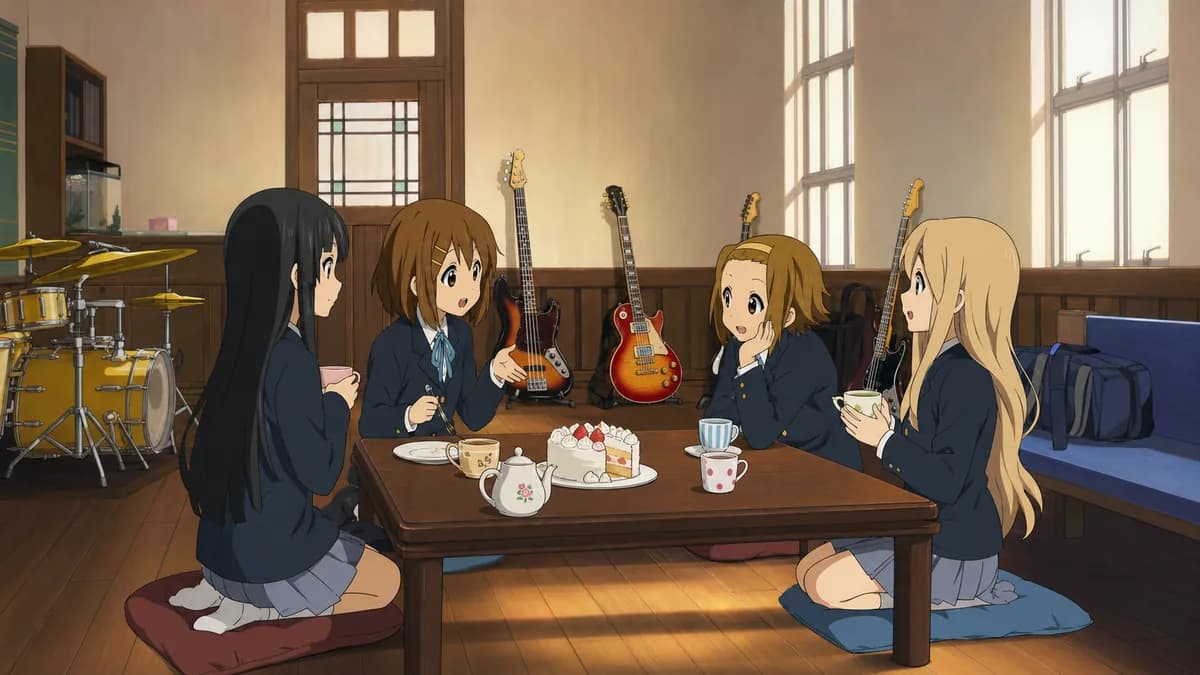
The setup could fit on a napkin. Sakuragaoka High's Light Music Club is one member short of survival when Yui Hirasawa wanders past a recruitment poster and signs up, half-convinced 'light music' means something like light exercise. The problem: she has never touched an instrument. The club's founders, drummer Ritsu, bassist Mio, and keyboardist Mugi, are desperate enough to keep her anyway, so they play her a little song, her imagination catches fire, and she stays on as guitarist. That is essentially the whole engine. From there the series simply follows the club through a school year: buying Yui's first guitar, cramming for exams so nobody flunks out and loses the room, a beach training camp, the school festival looming as their one real deadline. Plot barely exists in the conventional sense. What replaces it is rhythm, the small rituals of a club that is really an excuse for these girls to be together, with tea and sweets always closer to hand than the sheet music.
Characters
The whole thing lives or dies on its five leads, and they're drawn with more care than the featherlight tone suggests. Yui is the airhead engine: scatterbrained, food-motivated, weirdly gifted the moment she actually focuses, a black hole of affection who adores her bandmates and her guitar, Gita. Mio is the shy, sensible heart, a lefty bassist with cool stage presence and a comically fragile core that shrieks at anything remotely scary. Ritsu, the drummer and self-appointed club president, is the tomboy spark plug who drags everyone into trouble. Mugi, the wealthy keyboardist, is deceptively the funniest, endlessly delighted by the ordinary middle-class life she's never really had. Then there's Azusa, the serious underclassman guitarist who joins later expecting an actual band, only to be smothered in Yui's cat-like doting. The comedy comes from how these temperaments bounce off each other, but the real trick is that you grow to love them as friends, which is why the passage of time eventually lands so hard.
Animation & Sound
This is Kyoto Animation near the height of its powers, and it shows in the details nobody strictly needed to animate: the exact weight of a fringe blown by a fan, the way Yui slumps over a desk, fingers finding fret positions with researched accuracy. The instruments are rendered lovingly, real models you could go buy, and the club's daily nothingness gets the same lush lighting and buttery motion a lesser studio would save for a climax. It's gorgeous in a way that quietly insists this small world matters. And then there's the music. Crucially, the voice cast performs the band's songs themselves, so the bubbly opening and the surprisingly moody, leather-cool ending aren't anonymous session work but the same girls you've been watching, which collapses the gap between character and performance. When the club finally plays, the payoff is earned precisely because you've spent so long watching them not play. The songs became real hits, and the seiyuu-as-band model K-On! supercharged has shaped the industry ever since.

Themes & What Sets It Apart
Strip away the tea and the gags and K-On! is really about time, and how you only notice it running out near the end. It belongs to the iyashikei, or 'healing,' tradition, anime designed to soothe rather than thrill, and it's a foundational text of the cute-girls-doing-cute-things wave that dominated slice-of-life for years. Its genius is treating the mundane as worthy of gorgeous, meticulous attention: a bandmate's off-day, a shared cake, a quiet clubroom in afternoon light. That's the whole thesis, that ordinary togetherness is precious, and it only bares its emotional teeth once you realize these afternoons cannot last and graduation is coming. What sets it apart is how effortlessly it made all this feel valuable rather than empty. It didn't invent the moe hangout comedy, but it perfected and popularized the form so completely that a long line of descendants, right up to modern band shows like Bocchi the Rock!, are still working in the space K-On! cleared. Few 'nothing happens' shows have ever mattered this much.
Strengths & Shortcomings
Let's be honest about the ceiling here, because K-On! is not for everyone. The very thing that makes it soothing, the near-total absence of plot, stakes, or conflict, is also a real barrier. Nobody has a rival band to beat, no villain threatens the club, and 'will they practice or eat cake?' is about as tense as it gets. If you need forward momentum, a goal, a fight, you may find it maddeningly slack, a pretty screensaver of girls being nice to each other. That reaction is valid; the show simply isn't trying to grip you. Its strengths are the flip side of exactly that: unmatched warmth, flawless comic timing, characters so lived-in they feel like your own friends, and a craft level that makes doing nothing look sublime. It also asks some patience, since the earliest stretch can read as slight before the chemistry locks in. Meet it in the right mood and it's transcendent comfort food; meet it impatient and you'll wonder what everyone's on about. Both readings are the show working as intended.
The Verdict
K-On! is one of those rare shows whose reputation is entirely earned by feel rather than plot. If you come in wanting a story, you'll bounce off it; come in wanting warmth, company, and the sensation of a slow afternoon that never has to end, and it's close to perfect at what it does. Kyoto Animation turned a slip of a premise, five girls and a barely-active band, into a genuinely important work: the show that crystallized the cute-girls-doing-cute-things era and proved that 'nothing happening,' rendered with enough love and craft, can move you more than most high-stakes drama. It's cozy, it's gorgeous, it's quietly melancholy about growing up, and it's funnier than its gentle reputation lets on. Not everyone will click with it, and that's fine. But for the right viewer it's a foundational comfort watch. Score: 91/100, a small, warm, quietly revolutionary classic.
FAQ
If you enjoy warm, low-key slice-of-life, absolutely. It's a landmark of the genre and some of the coziest, most beautifully animated comfort viewing anime has produced. Just know going in that its charm is atmosphere and character, not plot, so it rewards a relaxed mood over an appetite for drama.