When the Sequel Wins: Anime Second Seasons That Beat the Original
 By Mika Tanabe · Editor
Anime fans spend too much time asking whether a second season can live up to the first. Plenty of shows settled that question years ago. Some of the medium's best runs came second, and they improved because they refused to repeat the original formula. The interesting part is how they pulled it off. Most great follow-ups do not pile on extra servings of whatever worked before. They take that pleasure out of reach. Instead of raising the stakes around a question the story has already answered, they ask a different question and force the characters to live with it. Vinland Saga provides the strongest example. Its second run removes the violence that helped sell the first, leaves its hero without the purpose that drove him, and becomes a better show in the process.
Escalation Is the Easy Choice, With Modest Returns
Most sequels follow simple arithmetic. The opponent gets stronger, the map gets wider, the power system gains another tier, and the old action receives a larger number. Solo Leveling Season 2: Arise from the Shadow scales up the threat. Sword Art Online: Alicization constructs a larger world for its cast to be trapped inside. The Rising of the Shield Hero Season 2 supplies a new calamity while its hero's underlying situation barely changes. Overlord II expands the board around a protagonist who was already unbeatable. None of those choices amount to incompetent television. Several of those seasons are genuinely fun. The limit is what escalation can accomplish. By the end of a first season, the audience has already accepted the premise, learned the rules, met the hero and agreed that the stakes matter. A sequel that repeats the pitch at greater volume is still making an argument the show has already won. A larger version of a familiar attraction may entertain, but it cannot surprise viewers in the same way. That explains the odd combination common to escalation sequels. They can be enjoyable yet strangely weightless, however polished the work may be. Real skill is going into them, but the story uses that skill to defend ground captured during the previous run. The sequel gets busier without becoming deeper. Bigger enemies and wider settings can create fresh incidents, but incidents alone do not change what the series has to say.
Vinland Saga Sets Aside the Sword
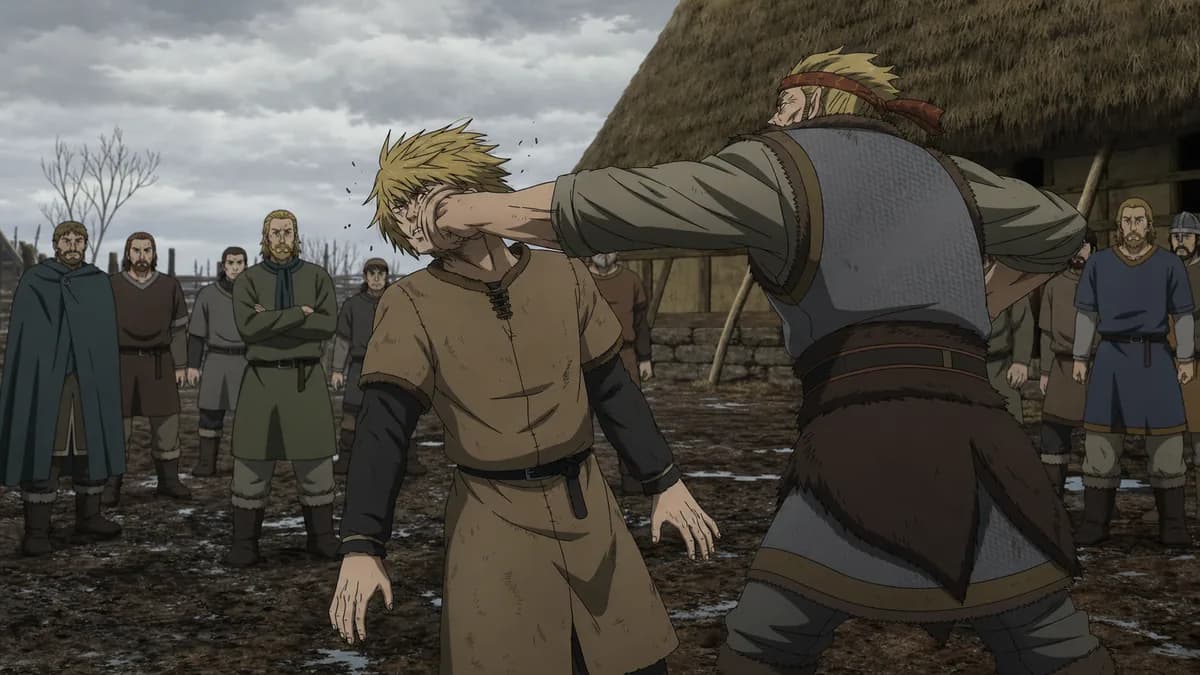
A light structural warning belongs here because Vinland Saga is the main example. Its first run is a war story about mercenary bands, a campaign for the crown of England and a boy pursuing the man who killed his father across the frozen edges of it. The story runs on a clean, urgent question: will Thorfinn Karlsefni get his revenge, and what will remain of him if he succeeds? The second run refuses to answer that question with a harsher battle or a more dangerous enemy. Instead, it removes the conditions that allowed the question to exist. Thorfinn is taken away from the fighting altogether, and the war epic gives way to a quiet, slow story about agricultural work. The same character remains, but the genre beneath him changes. That shift can look like a successful adaptation losing its nerve if all you want is the first season's momentum. Makoto Yukimura's manga points the other way. It is arranged in movements that challenge one another. Seen that way, the follow-up acts less like the next instalment and closer to a rebuttal. The story turns back and examines the violence it previously made exciting. Thorfinn's old goal no longer gives the plot its forward pull, so the series has to find out who he is without it. The loss of that familiar engine is precisely why the second run can reach places the first could not.
A Meaningful Change Comes With a Cost
A change in scenery is not enough by itself. The real mechanism is sacrifice. A sequel can surpass its original when it puts the show's most dependable pleasure in actual danger. Mob Psycho 100 II gives the clearest demonstration outside Vinland Saga. A series built around a boy with overwhelming psychic power becomes increasingly concerned with his determination not to use it. Eventually, the spectacle that attracted everyone matters less than the person trying to resist it. Re:Zero Season 2 nearly stops its loop-thriller engine so it can dig into what is happening inside its lead. Some viewers who came for the earlier pace dropped away, which is a real cost rather than an incidental complaint. Kaguya-sama: Love Is War - Ultra Romantic takes a similar gamble with different material. It risks the gag machine that established the franchise by allowing the running joke to develop into sincere feeling and begin to resolve. Each of these seasons places its selling point on the table instead of guarding it. That creates the possibility of genuine improvement, but it also creates an obvious danger. The viewers most attached to the original attraction may be the first to leave once it disappears. The scale of that possible loss roughly matches the scale of the available gain. A sequel cannot transform itself while guaranteeing that everybody who loved the earlier version will approve. If the familiar appeal remains untouched and dominant, the new season has probably preserved the formula rather than discovered a stronger one.
The First Season Has to Move In
Second seasons also benefit from a practical advantage that has little to do with creative nerve. A first season has two jobs. It must tell its story while teaching viewers how its world works. That means establishing the rules, geography, tone and cast, then giving the audience a reason to care about any of them. This setup consumes runtime, even when handled well, and every new story has to pay the cost. A sequel receives that work as an inheritance. It can begin at speed because the audience already understands the people, their history and the terms of the conflict. The available time can go toward consequence instead of introduction. Haikyu!! Season 3 can devote almost its whole run to a single match because two seasons of team-building have already filled that match with meaning. Jujutsu Kaisen Season 2 can begin in the past and count on viewers to recognise the distance between the man someone used to be and the man they already know he becomes. Later, Attack on Titan can allow its monsters to resolve into people because the earlier story supplied the fear and mystery needed for that reversal to matter. A first season cannot make those moves at any budget. It has not yet accumulated the history they require. This advantage does not automatically make a second run better. It simply gives the writers room to spend nearly all their time on decisions, consequences and changed relationships. The best sequels use that room to reconsider the original story instead of restating its setup with extra volume.
The Objection: Failed Sequels Fade From Memory
Survivorship bias is the strongest argument against this view, and it needs a direct response. For every second run that improved on its original, several weakened something that was already complete. Cowboy Bebop, Samurai Champloo and Odd Taxi work as finished pieces. Continuing any of them would impose a tax on the work rather than offer a gift. The method praised here also has an obvious way to fail. Change the central question and the show may lose the audience that arrived for whatever was removed. Vinland Saga's own follow-up proves the risk. Plenty of viewers signed up for Viking combat and chose not to follow the series onto a farm. Their disappointment is legitimate. It does not show a failure of taste. Retention gives a bad answer to the question of whether a sequel surpassed its original. A season that keeps everybody by changing nothing has succeeded at extending demand, but it has not necessarily improved the story. It has only decayed at a slower rate, which is a separate achievement. The possibility of losing viewers is also built into the method. It is not an accidental consequence that can be removed while keeping all the benefits. The chance of improvement comes from exposing the series to exactly that loss. The objection still stands in an important respect. Very often, one is the right number of seasons. A complete first run does not owe anyone a continuation, however well it sold. Commercial demand can show that people want another instalment, but it cannot prove that the story contains one. The deciding issue is whether the original left behind a second question worth asking. Without that question, another season is repetition with a production budget.
FAQ
For this argument, Vinland Saga has the strongest case. Its follow-up removes the engine that powered the entire first run and finds greater depth after doing so. Mob Psycho 100 II comes next, and it is easily the more accessible watch.