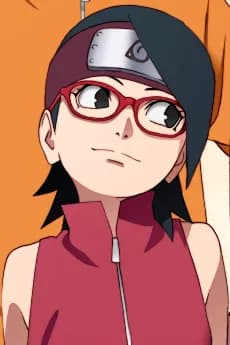
Sarada Uchiha
Naruto universe
Sarada Uchiha watches the people around her with the focus of someone already measuring what a decision will cost. That attention gives her scenes a pleasing tension: she can be earnest without seeming naive, and confidence never quite erases the effort behind it. The series asks you to stay with a young person trying to make her own judgment count, even when the people closest to her carry histories she cannot simply inherit.
By Mika Tanabe
Appearance
Sarada's design makes her easy to read at a glance without turning her into a walking emblem. Her glasses give her face a distinctive point of focus, while the clean lines of her outfit keep the impression practical. At 147 cm, she has a compact silhouette, but the animation does not use that to make her feel insignificant. Her posture often supplies the contrast: she holds herself with deliberate intent, as though she would rather be taken seriously than be fussed over. There is a directness to her expressions that suits a character who wants answers and expects to be part of the conversation. When she is quiet, the pause still feels active. You can see her taking stock, not fading into the background.
Personality
Sarada's ambition is most appealing when the show lets it look like work. She cares about becoming capable, and that care can make her impatient with easy reassurance. She wants to understand what people mean, not just accept the version that is most comfortable, which gives her conversations a useful edge. Yet she is not written as permanently severe. Her warmth comes through in the way she invests in people and takes their concerns seriously. The combination keeps her from feeling like a slogan about determination. There is pride in her, but also a visible need to test whether that pride has earned its place. I find that uncertainty more engaging than a character who is always right on the first try.
Sarada Uchiha’s Story
Spoiler-free introduction
Early on, Sarada is presented as a thoughtful young ninja with a strong sense of what she wants from her future. Her confidence has a questioning side: she notices when the adults around her leave things unsaid, and she is not content to treat silence as an answer. That instinct gives the early material its emotional pull. Watching her try to make sense of her place among the people she cares about feels intimate, even when the show is moving through a larger adventure. The safe way into her story is to watch how she listens, what she chooses to challenge, and how much care sits beneath her ambition. You do not need a catalog of background details to understand the stakes she feels. Her attention is already enough to make a small exchange land.
Spoilers beyond the early story
As Sarada's story develops, the questions that first give her scenes their tension become harder to keep at a distance. The show tests how she responds when the identity she is building meets expectations shaped by the people around her. Her changing understanding does not erase the qualities that made her compelling at the start. Instead, it gives her ambition a more personal weight, and asks whether conviction can survive disappointment without hardening into certainty. The later material is best approached with room for her reactions to matter on their own. It is not simply a sequence of answers; the emotional interest lies in what each answer asks her to reconsider, and in the judgment she brings to what follows.
Abilities
Sarada's action scenes are satisfying when they feel connected to her attentiveness. She approaches a problem with concentration, and that quality makes her presence in a fight legible even when the pace picks up. The pleasure is in watching her commit to a choice and make it count, rather than treating combat as a pause from her character work. Her confidence gives the movement snap, while her thoughtful side keeps the action from feeling automatic. Those scenes fit the same person we meet in quieter moments: someone who wants to be prepared and who takes the result seriously.
Watch Sarada Uchiha’s Story
Start with Boruto: Naruto Next Generations (2017), the place to follow Sarada's story. It is available on Crunchyroll, Hulu, and Netflix. Her appeal builds through small acts of attention as much as through the larger action, so give the character scenes time to settle instead of watching only for plot turns. Sarada has a clear ambition, but the more rewarding question is how she forms her own view while caring deeply about the people around her. Kokoro Kikuchi voices her in Japanese, and Cherami Leigh voices her in English. Both performances give her determination room to sound youthful without making it feel flimsy.
Start here: Boruto: Naruto Next Generations (2017) — on Crunchyroll, Hulu, Netflix
- Boruto: Naruto Next GenerationsMain · 2017Crunchyroll, Hulu, Netflix
Questions
- Who is Sarada Uchiha?
- Sarada Uchiha is a young ninja in the Naruto universe and a central character in Boruto: Naruto Next Generations. Her story has a strong focus on ambition, self-understanding, and the way she reads the people around her.
- How tall is Sarada Uchiha?
- Sarada is 147 cm tall. The character's compact design still carries a confident, direct presence on screen.
- Who voices Sarada Uchiha in English?
- Cherami Leigh provides Sarada's English voice. Kokoro Kikuchi voices her in Japanese.
- Where can I watch Sarada Uchiha?
- Sarada appears in Boruto: Naruto Next Generations (2017), which streams on Crunchyroll, Hulu, and Netflix. Start there to follow her story.
- When does Sarada Uchiha first appear?
- Sarada appears in Boruto: Naruto Next Generations (2017). That is the starting point for watching her character story.
- Is Sarada worth watching for?
- Yes, especially if you enjoy characters whose confidence has to coexist with real questions about who they want to become. Sarada brings an observant, personal energy to the series, and her ambition gives her quieter scenes a clear direction.