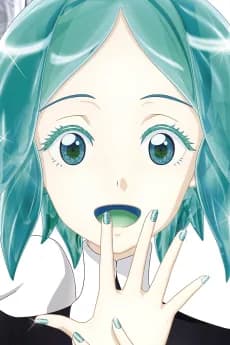
Phosphophyllite
Land of the Lustrous universe
Watching Phosphophyllite begins with a peculiar tension: their brightness invites affection, while their hunger to matter makes every hopeful gesture feel exposed. Phos can be funny without becoming a mascot and vulnerable without asking the audience for pity. Their presence gives the series its most unsettled energy. You keep noticing how quickly enthusiasm can become embarrassment when the world refuses to reward it. Tomoyo Kurosawa and Sarah Wiedenheft preserve that mixture of eagerness and strain, which is essential to why the character stays with you.
By Mika Tanabe
Appearance
Phosphophyllite has a screen presence built around clarity and interruption. The design catches the eye, but the animation rarely lets that beauty settle into a pose. Small changes in posture do much of the expressive work. Phos can seem ready to charge into importance, then suddenly look uncertain about where to put their confidence. That instability keeps quiet scenes active. The polished presentation continually reveals how badly they want to be taken seriously.
Personality
Phos is impulsive in a recognizably social way. They want approval and resent being underestimated, often turning frustration into a performance before admitting that it hurt. The comedy lands because their confidence is sincere at the instant they display it. So is the doubt that follows. Their vanity is tender, born from trying to imagine a useful version of themselves. Beneath the fuss and bravado, Phosphophyllite is affected by what they encounter. Kurosawa gives each shift a slightly different pressure. Wiedenheft brings the same alertness to the English track, keeping Phos lively without sanding away the irritation in their voice.
Phosphophyllite’s Story
Spoiler-free introduction
Early on, Phosphophyllite is defined by wanting a meaningful place in a world that already seems to know what to do with everyone else. Their attempts to close that distance create humor, but the humor has a nervous edge. The audience is asked to enjoy Phos's overconfidence while recognizing the ache beneath it. That balance gives the opening its pull. Phosphophyllite is not appealing because they begin fully formed. They are appealing because every setback becomes evidence in an argument they are having with themselves about usefulness and worth. The story watches that argument closely, often through pauses and reactions rather than speeches. Nothing in this early stretch requires advance knowledge, and the character's emotional logic is legible almost at once.
Spoilers beyond the early story
Later material changes the emotional temperature around Phosphophyllite. Qualities that once played as comic impatience begin to feel heavier, and the desire to become useful stops sounding harmless. The character remains understandable even when familiarity no longer feels comfortable. You can trace the pressure behind their choices without being asked to approve of every choice. Earlier scenes gain a different sting because the continuity of identity no longer seems like a simple possession. It feels vulnerable to experience. Phosphophyllite's development is difficult to reduce to improvement or decline. It resembles watching a person revise the answer to who they believe they must be, then discover that each revision has a cost. The series trusts the audience to sit with that cost instead of turning it into a neat lesson.
Abilities
Action around Phosphophyllite works because capability never feels like a clean statistic. Movement exposes mood. Confidence can make a moment reckless, while hesitation can make the same space seem enormous. Their physical involvement carries emotional information before dialogue catches up, so action continues the character work. The strain matters as much as the result. Greater effectiveness does not automatically bring greater ease, and spectacle cannot answer what Phosphophyllite believes usefulness will give them.
Watch Phosphophyllite’s Story
Start at the beginning and resist reading ahead. Phosphophyllite's story depends on remembering how light their earliest frustrations feel, then noticing when that feeling changes. Either voice track serves the character well. Choose the performance that keeps you closest to the pauses, because much of Phos's appeal lives in the instant after bravado falters. The legal viewing option on this page is the cleanest route into the story.
Start here: Land of the Lustrous (2017) — on Amazon Prime Video
- Land of the LustrousMain · 2017Amazon Prime Video
Questions
- Who voices Phosphophyllite in Japanese?
- Tomoyo Kurosawa voices Phosphophyllite in Japanese. Her performance makes Phos's eagerness sound quick and bright, then allows uncertainty to register without announcing it too heavily.
- Who voices Phosphophyllite in English?
- Sarah Wiedenheft voices Phosphophyllite in English. She keeps the character's energy sharp while giving their wounded reactions enough space to feel genuine.
- Is Phosphophyllite the main character?
- Yes, Phosphophyllite has the main role. The series asks the viewer to track changes in their outlook closely, so their reactions carry much of its emotional weight.
- How old is Phosphophyllite?
- Phosphophyllite is over 300 years old. The striking part is how youthful their need for recognition can feel, which gives their impatience an unusual tension on screen.
- Is Phosphophyllite worth watching for?
- Yes, especially if you like character development that makes earlier scenes feel different in retrospect. Phos can be charming and difficult within the same beat, and the show never rushes to make that contradiction comfortable.