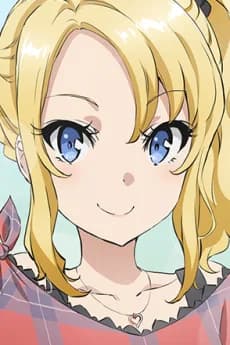
Nodoka Toyohama
Bunny Girl Senpai universe
Nodoka Toyohama gives Bunny Girl Senpai a useful change of angle: the same story can look different when someone else has to live beside its familiar pressures. Watching her, I pay attention to the social work of being understood, and to the awkwardness that follows when people think they already know what a person is like. The series benefits from that friction. Nodoka is not a detour from its emotional concerns; her presence asks the viewer to reconsider how those concerns sound when they reach a different person.
By Mika Tanabe
Appearance
Nodoka's strongest first impression comes from the way the performance shapes a conversation. Maaya Uchida gives her a clear, youthful presence without flattening every line into one mood. There is room for hesitation and for confidence to share the same exchange, which makes her feel like someone choosing how much to reveal in real time. That matters in a series where a pause can carry as much weight as a declaration. The English performance by Cristina Vee keeps that sense of immediacy, giving English-speaking viewers a natural route into the character. The two performances make Nodoka feel present in dialogue, not like a profile waiting for the story to fill in its blanks.
Personality
Nodoka is most rewarding when the viewer allows her reactions to remain a little untidy. She can be read in more than one way from moment to moment, and the show gains texture from that uncertainty. I found myself listening for the difference between what a person means to say and what she can comfortably put into words. That is a more interesting measure of confidence than simply making a character forceful. Nodoka's scenes invite attention to small shifts in tone, to the effort behind an ordinary exchange, and to the vulnerability that can sit under a composed surface. The writing gives her enough room to feel like a person with her own perspective, rather than a convenient explanation for someone else's feelings. Her value to the viewing experience lies in that perspective: she makes familiar emotional questions feel newly personal without demanding that the audience treat every moment as a grand revelation.
Nodoka Toyohama’s Story
Spoiler-free introduction
Early on, Nodoka is best approached through the impressions she makes in conversation. The important starting point is not a checklist of background details, but the experience of watching her decide how to meet the people around her. Her part in the story gives the series another way to examine self-image and the assumptions people carry into close relationships. Those ideas are present without requiring the viewer to know what comes later. Let the scenes establish their own rhythm, and notice how much character can come through in an exchange that might seem ordinary at first.
Spoilers beyond the early story
As Nodoka's story develops, the initial impressions become harder to hold as simple answers. The series asks the audience to reconsider what it means to see another person clearly, especially when a relationship has already gathered expectations around it. Nodoka's later material draws emotional force from that reconsideration. I think the strongest way to watch it is to let the character's own reactions carry the weight, rather than reducing her to a turn in somebody else's story. The change in perspective is the point of the deeper material, and describing its particulars in advance would take away the moment when the viewer can understand why it matters.
Watch Nodoka Toyohama’s Story
For Nodoka's story, start with Bunny Girl Senpai on Crunchyroll, Hulu, or Netflix. The continuation is Rascal Does Not Dream of a Dreaming Girl, available on Crunchyroll and Netflix. Her Japanese voice is Maaya Uchida, and Cristina Vee performs her in English. Either audio track keeps the focus where it belongs: on how Nodoka comes across in the scenes she shares with others. This is a character best met through the performance itself, since much of her appeal rests in the shades of a reaction rather than in a summary of events.
Start here: Bunny Girl Senpai (2018) — on Crunchyroll, Hulu, Netflix
- Bunny Girl SenpaiMain · 2018Crunchyroll, Hulu, Netflix
- Rascal Does Not Dream of a Dreaming GirlSupporting · 2019Crunchyroll, Netflix
Questions
- Who voices Nodoka Toyohama in English?
- Cristina Vee is Nodoka Toyohama's English voice actor. Maaya Uchida performs the character in Japanese, so viewers can choose either version.
- When does Nodoka Toyohama first appear?
- Nodoka first appears in Bunny Girl Senpai (2018). That is the place to begin if you want to follow her story in order.
- Where can I watch Nodoka Toyohama's story?
- Bunny Girl Senpai streams on Crunchyroll, Hulu, and Netflix. Rascal Does Not Dream of a Dreaming Girl is available on Crunchyroll and Netflix.
- Is Nodoka Toyohama worth watching for?
- Yes, especially if you enjoy character writing built through conversation and changing impressions. Nodoka gives the story another personal angle, and the voice performances help make that angle engaging.
- What is Nodoka Toyohama's birthday?
- Nodoka Toyohama's birthday is March 14. It is a small detail, but an easy one to remember if you follow the character.