Canute
Vinland Saga universe
Canute's first impression rests on a pause: he seems to be listening for the danger in a conversation before deciding whether to answer. That quietness gives his scenes a particular tension. People around him can fill the silence with certainty, while he makes you wait for a sign of what he thinks. I found that restraint more affecting than a grand entrance could have been. The pleasure of watching Canute is the effort of reading a face that does not volunteer its meaning.
By Mika Tanabe
Appearance
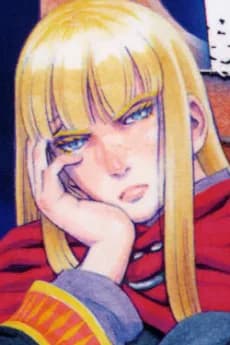
Canute is drawn with a fine-boned face and a composed, almost delicate bearing. His look can invite the wrong assumption that he will be easy to read or easy to move. The animation makes small shifts count: a held gaze, a lowered chin, the instant his expression firms. His height and build do not dominate the frame, so posture and eye contact do much of the work. There is a contrast between the youthful softness of his features and the seriousness he brings to a scene. That contrast stays legible without turning him into a visual riddle. You can see why other people might underestimate him, and you can also see how little the show asks you to do so.
Personality
Canute's reserve is not blankness. It feels like a habit of taking in more than he is willing to show, which makes every exchange carry a second question: what did he hear, and what will he let the other person know? Kenshou Ono gives that caution a measured rhythm in Japanese, while Griffin Burns brings a different texture to the English performance. Both versions understand that a soft answer can still have weight. Canute can appear vulnerable without asking the viewer to protect him, and the show does not confuse gentleness with a lack of will. I appreciate how uncomfortable that makes the usual shortcuts. A raised voice would tell us what to think; Canute's pauses leave us responsible for watching closely. His composure can soothe a scene, then make the same scene feel less secure because you cannot assume that calm means agreement. The question is never simply whether he is strong enough to act. It is whether the choice in front of him has changed the person who must make it.
Canute’s Story
Spoiler-free introduction
Early on, Canute is compelling because the show does not rush to translate his quietness into a neat explanation. He listens, watches, and gives little away. That leaves the audience sharing the uncertainty of the people trying to understand him, without making him feel like a puzzle planted only to be solved. His presence asks for attention at a human scale: the hesitation before a response, the pressure carried by a simple look, the way a conversation changes when nobody can tell what he will say. You can watch safely for his temperament and for the care in his performance, without needing to know where his story leads. The tension comes from observing him in the moment, not from waiting for a surprise the page has spoiled. Let the silences remain silences for now. They are part of the experience, and Canute is more interesting when you have room to form your own first impression.
Spoilers beyond season one
Canute's later presence changes the terms on which that early quietness can be read. The same controlled delivery that once suggested hesitation begins to carry intention, and the viewer has to reconsider what composure costs him. This is the point where his characterization becomes harder to keep at a comfortable distance. He is not granted a simple conversion from uncertainty into certainty; the show asks you to sit with the human consequences of a person trying to give his convictions real force. I find that tension more persuasive than a clean heroic ascent. Canute can become more commanding while also becoming harder to approach, and the gap between those impressions matters. His story keeps asking whether resolve can preserve tenderness, or whether power changes the language a person uses even when the goal still feels necessary. The details of that shift are best experienced in the series itself.
Watch Canute’s Story
Start with Vinland Saga (2019), then continue with Vinland Saga Season 2 (2023) if you want the fuller shape of Canute's character. The first season gives his restraint room to register, and the later season makes you revisit the impression you formed. Vinland Saga is a patient watch when it wants to be; it gives expressions and pauses time instead of explaining every feeling aloud. For Canute, that patience is a strength. Watch in Japanese with Kenshou Ono or in English with Griffin Burns, and choose the performance that best suits your ear. The legal services available are Crunchyroll, HIDIVE, and Netflix for Vinland Saga (2019), and Crunchyroll and Netflix for Vinland Saga Season 2 (2023). If you are here for Canute, begin at the start. His quieter scenes work better when you have felt the contrast around them for yourself.
Start here: Vinland Saga (2019) — on Crunchyroll, HIDIVE, Netflix
- Vinland SagaMain · 2019Crunchyroll, HIDIVE, Netflix
- Vinland Saga Season 2Supporting · 2023Crunchyroll, Netflix
Questions
- How tall is Canute?
- Canute is 170 cm tall. His composed posture gives him a strong screen presence without relying on size.
- Who voices Canute in English?
- Griffin Burns voices Canute in English. Kenshou Ono performs the character in Japanese, with each version giving his restraint a distinct sound.
- When does Canute first appear?
- Canute first appears in Vinland Saga (2019). Start there to meet him before continuing to Vinland Saga Season 2 (2023).
- Where can I watch Canute's story?
- Vinland Saga (2019) streams on Crunchyroll, HIDIVE, and Netflix. Vinland Saga Season 2 (2023) streams on Crunchyroll and Netflix.
- Is Canute worth watching for?
- Yes, especially if you enjoy a character whose expression makes you pay attention to what is left unsaid. Canute gives the series a quieter kind of tension, and the performances make that stillness engaging.
Spoilers: tap to reveal
- Occupation
- King of Denmark and England
- Family
- Wife