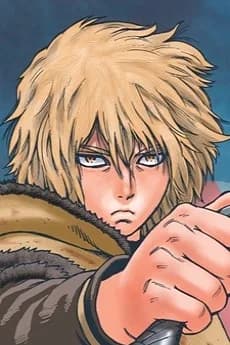
Thorfinn
Vinland Saga universe
Thorfinn enters your attention as a contradiction the show refuses to make comfortable: a child-sized swordfighter with the concentration of someone for whom violence has become work. Watching him is tense because his competence offers no relief. It sharpens the distance between what his slight body suggests and what his occupation demands. The series lets that discomfort linger, and Yuuto Uemura keeps even restrained moments charged. Thorfinn can seem sealed off, yet the pressure around that silence makes him difficult to dismiss.
By Mika Tanabe
Appearance
Thorfinn's visual impression is compact rather than imposing. That scale matters whenever he is framed as an assassin: the threat arrives through intent and control, not physical grandeur. His swordfighter identity therefore reads in the set of his body before it reads as spectacle. Even before he moves, the contrast puts the viewer slightly on edge.
Personality
Thorfinn treats attention like a survival tool. He watches for openings and holds himself tight, which can make ordinary conversation feel like something he has no room to entertain. His silence does not land as blankness. It feels pressurized, especially when the discipline of Askeladd's Band gives him somewhere to direct it. He is not written to request easy affection from the audience. His narrow focus can be abrasive, but it also keeps the series honest about how a life built around fighting can limit the person living it. The rewarding part is noticing when that focus stops looking like strength and starts looking like confinement.
Thorfinn’s Story
Spoiler-free introduction
Early on, Thorfinn's identity sits very close to his work as an assassin and swordfighter. Askeladd's Band supplies the social pressure around him, while his youth makes his competence feel deliberately wrong rather than triumphant. The show does not need a long explanation to establish the viewing tension. You can admire his control and still dislike what has required it. His early story works best as a study in fixation: action gives him a language, but that language is too small for a whole person. Watch the quiet beats closely, because Uemura often makes the restraint more revealing than the outbursts.
Spoilers beyond season one
The shift from Askeladd's Band to Ketil's Farm changes the meaning of Thorfinn's stillness. What once read as readiness begins to feel like the difficult space left when an old purpose can no longer organize every thought. This is where the character becomes unusually satisfying to follow. The story is willing to let his earlier identity remain heavy instead of treating change as a clean replacement. His eventual movement toward life as a sailor and explorer gives that change practical form. Arnheid Village then matters as a measure of what he can help make, rather than another stage on which he can prove he is dangerous. Watching Thorfinn later is quieter, but never softer in the careless sense. The tension comes from whether discipline learned for violence can be redirected without pretending the past has vanished.
Abilities
Thorfinn's swordfighting is presented through economy. His smaller stature makes wasted motion look especially costly, so the action draws attention to timing and commitment instead of spectacle alone. His assassin work adds a colder edge: effectiveness can be impressive while the habit behind it remains disturbing. This is why his fights carry character information. They show how completely he can reduce the world to the next movement, and why stepping outside that frame would be difficult.
Relationships
- Thors Snorresson
- Thors gives Thorfinn's hard concentration an emotional counterweight. The family connection makes that self-possession feel less complete than Thorfinn wants it to appear.
- Helga
- Helga belongs to the family context that keeps Thorfinn from reading only as a weapon. Her place in his life helps ordinary human attachment remain present around the edges of his severity.
- Ylva
- Ylva sharpens the sense that Thorfinn has a family identity beyond fighting. That contrast gives his closed-off manner a more personal ache without requiring the show to explain every feeling aloud.
Watch Thorfinn’s Story
Begin with the 2019 entry shown in the watch panel. The later season assumes that emotional groundwork, and jumping ahead would flatten the change in how Thorfinn is framed. For legal streaming, use the services displayed beside each entry, since the available providers are not identical. Thorfinn rewards chronological viewing because repeated gestures acquire different emotional meanings as his occupation and surroundings change.
Start here: Vinland Saga (2019) — on Crunchyroll, HIDIVE, Netflix
- Vinland SagaMain · 2019Crunchyroll, HIDIVE, Netflix
- Vinland Saga Season 2Main · 2023Crunchyroll, Netflix
Questions
- How tall is Thorfinn?
- Thorfinn is listed at 100 cm and 20 kg. Those measurements describe one point within the broad span of his life shown by the series, so they should not be treated as a fixed visual description for every appearance.
- Who voices Thorfinn in English?
- Aleks Le voices Thorfinn in English. Yuuto Uemura provides the Japanese performance, with both actors carrying much of the character through control rather than constant explanation.
- When does Thorfinn first appear?
- Start with the 2019 series entry in the watch panel. It is the intended starting point, before the later season changes the emotional context around his choices.
- Where can I legally watch Thorfinn's story?
- The watch panel pairs each series entry with its legal streaming services. Use the providers beside the 2019 entry first, since the service choices differ between the two entries.
- Is Thorfinn worth watching for?
- Yes, especially if you prefer character work that makes action psychologically expensive. Thorfinn's swordfighting gets your attention, but the changing meaning of his restraint is what makes a chronological watch pay off.