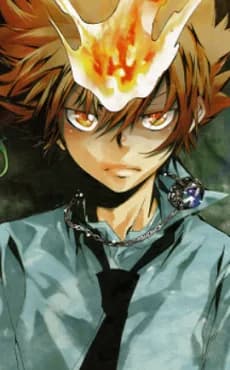
Tsuna Sawada
Katekyo Hitman Reborn! universe
Tsuna Sawada begins from the deeply familiar embarrassment of a boy who would rather disappear than be noticed. That awkwardness gives Katekyo Hitman Reborn! a useful pulse: every burst of confidence has to fight its way past his instinct to retreat, and the comedy lands because his nerves never feel like a pose. Watching him means sitting with the uncomfortable distance between the person he thinks he is and the person other people keep asking him to become.
By Mika Tanabe
Appearance
Tsuna’s small frame and ordinary schoolboy presentation make his unease legible before he says anything. He does not carry himself like someone prepared to command attention; a hunched posture or a startled look can do more character work than a speech. The contrast matters when the show asks him to stand his ground. His presence does not suddenly become imposing, so a moment of resolve feels earned through expression and timing rather than a visual makeover. At 157 cm, he is not drawn to dominate a frame, and that keeps the audience close to his reactions. A glance toward someone else can register as a search for reassurance, while a pause can show him weighing a choice he wishes had never landed on him. The design supports the series’ comic rhythm without turning him into a joke. His embarrassment is visible, but it is also a real obstacle he must work through.
Personality
Tsuna’s first response to pressure is often panic, and the show lets that response be messy. He flusters, protests, and looks for a way out; the humor comes from how plainly he wants a normal day. Still, he is not emotionally vacant beneath the fuss. When someone needs him, concern can pull him into action before confidence catches up. That distinction is the reason his growth is satisfying to watch. He does not become compelling by losing his gentleness or suddenly enjoying authority. Instead, he has to act while still feeling afraid, which gives his courage a human scale. The title Juudaime carries an expectation he has not asked for, and the friction between that expectation and his self-image powers much of his appeal. Tsuna can be frustrating when he hesitates, but the hesitation is part of the character rather than a pause inserted to manufacture suspense. His decency has weight because it costs him effort.
Tsuna Sawada’s Story
Spoiler-free introduction
At the start, Tsuna is an unremarkable student who has little faith in himself and no appetite for being singled out. The arrival of an unusual tutor disrupts the routine he would prefer to keep, setting comedy against the pressure of sudden expectations. Early episodes are strongest when they let Tsuna react honestly: he is embarrassed by attention, overwhelmed by demands, and still capable of caring about the people caught up in his day. You can begin here without needing to know where the larger story leads. The pleasure is in watching a reluctant boy try to meet a challenge before he has any reason to believe he can.
Spoilers beyond the opening setup
As the story widens, Tsuna’s relationship with responsibility becomes harder to avoid. The useful change is not a clean conversion from timid to fearless; the old discomfort remains part of how he responds. What shifts is his willingness to let other people matter more than his desire to escape the situation. That makes his stronger moments feel connected to the awkward boy introduced at the beginning. The show keeps testing whether care can hold up under pressure, and Tsuna’s answers are most affecting when they come with visible doubt still attached.
Abilities
The series is action-shaped, but Tsuna’s appeal does not depend on presenting him as naturally composed or eager for a fight. Physical danger makes his nerves part of the scene: his reactions carry the question of whether he can move past fear when someone needs him. The action works best when it expresses a decision, not when it asks the audience to forget his temperament. His story treats capability as something tangled up with responsibility, so watching him act can feel emotionally different from watching a more assured hero do the same thing.
Relationships
- Reborn
- Reborn’s blunt pressure is a steady source of comedy and frustration for Tsuna. Their dynamic works because Tsuna’s protests remain sincere even as the demands placed on him keep changing the shape of his days.
- Nana Sawada
- Nana gives Tsuna’s everyday life a point of warmth. The contrast between that familiar comfort and the attention he would rather avoid helps the comedy retain a human center.
Watch Tsuna Sawada’s Story
Start with Katekyo Hitman Reborn! (2006). Tsuna’s story is easiest to enjoy when you can watch his awkward reactions accumulate into choices, and the early comedy establishes exactly how little he wants the role that keeps finding him. The available places to watch it are Crunchyroll, Hulu, and Tubi TV. Give the opening stretch room to establish its rhythm: the show’s interest in Tsuna depends on seeing his fear and kindness in the same scene, not on treating confidence as an instant switch.
Start here: Katekyo Hitman Reborn! (2006) — on Crunchyroll, Hulu, Tubi TV
- Katekyo Hitman Reborn!Main · 2006Crunchyroll, Hulu, Tubi TV
Questions
- How tall is Tsuna Sawada?
- Tsuna Sawada is 157 cm tall. His compact, unassuming presence suits the way he reacts to unwanted attention.
- When is Tsuna Sawada’s birthday?
- His birthday is October 14. The date is a simple detail, while the series builds its portrait through his choices and reactions.
- Who voices Tsuna Sawada in Japanese?
- Yukari Kokubun voices Tsuna Sawada in Japanese. The performance supports both his flustered comic reactions and his more sincere moments.
- Where can I watch Tsuna Sawada’s story?
- Katekyo Hitman Reborn! (2006) is available on Crunchyroll, Hulu, and Tubi TV. Start with that series to follow Tsuna’s story.
- Is Tsuna Sawada worth watching for?
- Yes, especially if you enjoy a lead whose courage arrives with visible nerves still attached. His awkwardness gives the comedy its timing and makes his moments of resolve feel personal.
Spoilers: tap to reveal
- Family
- Giotto