Taro Sakamoto
Sakamoto Days universe
Taro Sakamoto can make the ordinary business of running a store feel like a dare. The pleasure of watching him comes from seeing a man built for violence give his attention to everyday life, then wondering how long that calm can hold when the action starts. His size is part of the joke, but it is not the whole joke: the contrast between his formidable presence and his unshowy priorities gives the comedy its particular ease.
By Mika Tanabe
Appearance
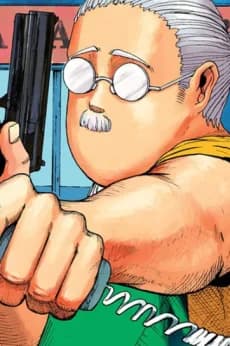
Sakamoto's 188 cm frame and 140 kg build make him immediately imposing, even when he is doing something as mundane as minding the shop. The show gets mileage from that visual mismatch. His silhouette promises a hard action scene, while his daily role points toward a quieter kind of responsibility. I find that tension more memorable than a design built only to look dangerous. He occupies the frame with the confidence of someone who does not need to advertise himself, and the small details of an ordinary day can land as a punchline beside him. When the fighting takes over, the same physical presence makes the shift feel clean and satisfying rather than arbitrary.
Personality
Sakamoto's appeal rests on the steady attention he gives to the life he has chosen. He is an assassin and a store owner, a combination that gives even a pause a little charge: the audience knows he can be dangerous, while the scene may ask him to care about something plain and immediate. That makes his restraint fun to watch. He does not need a speech to sell the contrast; the show can let his priorities sit beside the spectacle and trust us to feel the difference. The comedy works best when it treats him as a person with a daily rhythm, not as a gag wearing a big body. There is warmth in that rhythm, and a stubborn seriousness about the people close to him. I appreciate how little fuss the performance needs to make that warmth legible.
Taro Sakamoto’s Story
Spoiler-free introduction
Early on, Sakamoto is presented through the friction between his past as an assassin and his present as the owner of Sakamoto's Store. The series lets that premise do two jobs at once: it gives the action a reason to be extravagant, and it gives the comedy an everyday center. Watching him take ordinary responsibilities seriously is part of the fun, because the show never asks the audience to forget the danger suggested by his occupation. The result is a lead whose quiet moments carry anticipation without making every scene grim. This is the safe place to start if you want the basic viewing experience without later story turns.
Spoilers beyond Sakamoto Days (2025)
As the story continues, the balance between domestic calm and action becomes a more useful way to read Sakamoto than either side on its own. His old work keeps pressing against the life he values, so a comic beat can carry genuine stakes without changing the show's generous tone. I think the character is strongest when the series lets both facts remain present: competence does not erase tenderness, and tenderness does not make him less formidable. That continuing tension gives the later material a different weight, while preserving the grounded pleasure of seeing him care about the day in front of him.
Abilities
Sakamoto's assassin background makes the action scenes part of his character rather than a break from it. His imposing build gives each movement a satisfying visual weight, while the contrast with his measured everyday manner keeps the fights from feeling like generic displays of force. The appeal is in the switch: he can look settled and unhurried, then make the scene feel newly alert. The series uses that shift for comedy as well as excitement, and the two tones fit because both depend on how much control he appears to have.
Relationships
- Aoi Sakamoto
- Aoi gives the domestic side of Sakamoto's life a personal center. Their connection helps the store feel like a commitment with emotional meaning, not simply a convenient setting for jokes between action scenes.
- Hana Sakamoto
- Hana adds to the sense that Sakamoto's daily priorities extend beyond himself. The character's gentler edges are easier to appreciate when the story lets care register through small moments rather than grand declarations.
Watch Taro Sakamoto’s Story
Start with Sakamoto Days (2025) on Netflix. It establishes the pleasure of the character quickly: ordinary shopkeeping gives the action a point of contrast, and Sakamoto's calm presence keeps the comedy from feeling frantic. His story is especially appealing if you like action leads whose tenderness is visible in what they protect and attend to, rather than announced in speeches. Tomokazu Sugita voices him in Japanese, while Matthew Mercer voices him in English; both performances give his quiet moments room to breathe. The series understands that a peaceful routine can be its own source of suspense when the person trying to preserve it has an assassin's past.
Start here: Sakamoto Days (2025) — on Netflix
- Sakamoto DaysMain · 2025Netflix
- Sakamoto Days Part 2Main · 2025Netflix
Questions
- How tall is Taro Sakamoto?
- Taro Sakamoto is 188 cm tall. His height contributes to the imposing silhouette that makes the contrast with his ordinary storekeeping so effective.
- Who voices Taro Sakamoto in English?
- Matthew Mercer voices Taro Sakamoto in English. Tomokazu Sugita performs the Japanese voice.
- Where can I watch Taro Sakamoto's story?
- Sakamoto Days (2025) and Sakamoto Days Part 2 (2025) are on Netflix. Start with Sakamoto Days (2025) for the beginning of his story.
- Is Taro Sakamoto worth watching for?
- Yes, especially if you enjoy action comedy built around a lead who takes ordinary responsibilities seriously. Sakamoto's mix of calm domestic warmth and formidable presence gives the show a distinctive rhythm.