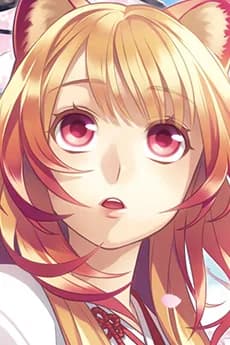
Raphtalia
The Rising of the Shield Hero universe
Raphtalia makes the early stretch of The Rising of the Shield Hero uncomfortable in a useful way: the show asks you to watch a young person learn how to stand beside someone while carrying a maturity her body does not explain. The mismatch between her mental age of 10 and biological age of 18 is not a trivia hook. It changes the feeling of scenes built around trust, because confidence and vulnerability can sit together without cancelling each other. Raphtalia is compelling when the story lets her be earnest without making that earnestness look naive. You can feel how much she is choosing to offer, and that choice gives even quiet exchanges a little weight.
By Mika Tanabe
Appearance
The character design makes Raphtalia readable at a glance, but her appeal comes from the way a composed look can give way to an open reaction. Her expressions matter because the show does not treat her as a fixed emblem of toughness or sweetness. A pause can leave her guarded; a small change in her face can make the same scene feel newly personal. That expressiveness keeps her presence warm without sanding away the strain underneath it. She is easy to recognize in a frame, yet the more memorable detail is how quickly her attention can shift from watching someone else to letting the audience see what she feels.
Personality
Raphtalia has a steadiness that feels chosen, not granted by the script as a shortcut to likability. She can be sincere without seeming sheltered, and her care for another person has a practical edge: it asks something of her. The writing works best when she is allowed to show uncertainty alongside resolve. That combination gives her a particular kind of courage, one that does not need a speech to announce itself. Her gentleness never reads as passivity, and her serious moments do not erase the warmth that makes them matter. Watching her, I find the pauses as revealing as the declarations. She often seems to be measuring what a moment asks from her before she answers it.
Raphtalia’s Story
Spoiler-free introduction
Early on, Raphtalia gives the series an emotional point of contact. The world around her can feel harsh and transactional, so her attempts to build trust land with more force than a simple gesture of kindness. She is not presented as someone untouched by what has happened around her. The tension comes from seeing her remain capable of care anyway, while still registering the cost of offering it. Her connection with the central character supplies the early story with a human scale. Instead of asking you to respond only to the surrounding conflict, the show gives you a reason to notice whether two people can begin to rely on each other. Raphtalia's openness makes that question tender, but the hesitation around it keeps it from feeling easy. Her early scenes are strongest when they let trust form in small increments and leave room for discomfort to remain visible.
Spoilers beyond the early story
As Raphtalia's story continues, the pleasure of watching her shifts toward seeing what she makes of the person she has become. The series keeps returning to the difference between being treated as fragile and being allowed to make a choice. That distinction gives her later presence a firmer emotional shape. She can be tender and still insist on her own judgment; affection does not turn her into an accessory to someone else's story. I think that is where she earns the strongest investment. Her growth is not a clean march from pain to confidence, and the story is better when it resists pretending that one good bond can settle every feeling. The later material asks you to notice how her own values hold up under pressure, and how much independence can exist inside loyalty.
Watch Raphtalia’s Story
Start with The Rising of the Shield Hero (2019). Raphtalia's early presence depends on the audience feeling the distance between guardedness and trust, so beginning at the beginning gives those changes room to register. The first season streams on Crunchyroll, Hulu, and Netflix. Her later story continues across the seasons, with availability varying by season: the second is on Crunchyroll, Disney Plus, Hulu, and Netflix, the third on Crunchyroll and Hulu, and the fourth on Crunchyroll. Watching in order is the most satisfying way to follow her, because her emotional shifts matter more when you have seen what the earlier scenes ask her to risk. The series is easy to approach as a fantasy adventure, but Raphtalia is a strong reason to stay attentive to its quieter exchanges too.
Start here: The Rising of the Shield Hero (2019) — on Crunchyroll, Hulu, Netflix
- The Rising of the Shield HeroMain · 2019Crunchyroll, Hulu, Netflix
- The Rising of the Shield Hero Season 2Main · 2022Crunchyroll, Disney Plus, Hulu, Netflix
- The Rising of the Shield Hero Season 3Main · 2023Crunchyroll, Hulu
- The Rising of the Shield Hero Season 4Main · 2025Crunchyroll
Questions
- Who voices Raphtalia in English?
- Erica Mendez voices Raphtalia in English. Her performance gives the character warmth without making her resolve sound effortless.
- Who is Raphtalia's Japanese voice actor?
- Asami Seto voices Raphtalia in Japanese. The performance suits the character's mix of sincerity and composure.
- When does Raphtalia first appear?
- Raphtalia first appears in The Rising of the Shield Hero (2019). That is the best place to begin if you want her character to unfold in order.
- Where can I watch Raphtalia's story?
- The Rising of the Shield Hero (2019) streams on Crunchyroll, Hulu, and Netflix. Later seasons are available on Crunchyroll, with Hulu, Disney Plus, and Netflix also carrying some seasons.
- Is Raphtalia worth watching for?
- Yes, especially if you like character writing where care and self-possession have to coexist. Raphtalia gives the series some of its most affecting quieter moments, and her presence makes the emotional stakes feel personal.