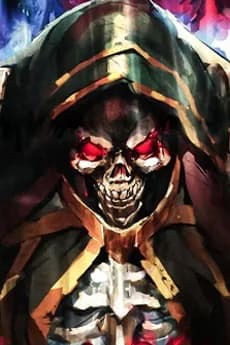
Momonga
Overlord Universe
Momonga makes power feel strangely solitary. As Ainz Ooal Gown, he carries himself with the assurance of someone expected to command, while the performance leaves room for the effort behind that certainty. Watching him means sitting with the gap between a grand public presence and a private-seeming hesitation; the tension is quiet, and it gives even a composed moment an edge.
By Mika Tanabe
Appearance
Momonga's screen presence is built around control. He tends to read as deliberate before he reads as approachable, and that distance becomes part of the pleasure of watching him. The height of 177 cm is a useful physical detail, but it says little about the impression he makes: his bearing does the work, holding attention without needing a hurried gesture or a loud display. The series lets that composed image carry weight. When he is still, the pause feels chosen; when he speaks, the confidence sounds practiced enough to make you wonder what it costs to keep it intact. His design supports a character who is watched by others, and the framing encourages the audience to watch him watching them. There is a polished quality to his presentation, yet it does not flatten him into a simple emblem of authority. The small shifts in delivery matter because the exterior gives so few easy openings. You can read poise as a tool, a habit, or a shelter, and the show benefits from leaving those readings in play.
Personality
Momonga's defining pleasure as a lead is the friction between command and self-consciousness. He can occupy the position of an adventurer, guildmaster, and monarch, but those roles do not automatically make him emotionally legible. I read him as someone measuring how he is being received even while he is trying to project certainty. That makes his restraint active rather than blank: the audience is invited to listen for a pause, a careful choice, or a shift in tone. The show understands that competence can be funny and unsettling in the same scene. His composure can win a moment before it explains anything about him, which keeps the character from becoming a set of impressive labels. The pleasure is not in guessing a secret answer to every gesture. It is in noticing how much work goes into sustaining an image, and how the performance lets strain flicker without turning every scene into a confession. Momonga is compelling company when the show trusts that tension and gives it time to breathe.
Momonga’s Story
Spoiler-free introduction
Early on, Momonga is presented as a figure whose authority and uncertainty share the same screen. The safe way to meet him is to watch how he handles attention: he wants to appear composed, and the choices that support that appearance can be as revealing as any direct explanation. The show gives his pauses room, so a small hesitation can alter the mood without changing the scale of the scene. His role as an adventurer offers a public shape for that performance, while the name Ainz Ooal Gown carries the weight of someone people are prepared to follow. You do not need to know where his story is headed to enjoy the contrast. The early appeal lies in seeing a commanding presence work to stay commanding, then deciding whether that effort reads as confidence, nerves, or both. That uncertainty is part of the character's texture, not a puzzle the viewer has to solve before watching can begin.
Spoilers beyond the opening stretch
As the story develops, Momonga's public role becomes harder to separate from the person trying to inhabit it. His choices ask the viewer to think about what authority does to a performance: each successful display can make the next one feel more necessary. The shift is engaging because it does not require the character to announce a new self. Instead, the weight accumulates in how confidently he can act and how carefully the audience has learned to read that confidence. There is a cost to being treated as an answer by the people around you, even when the show lets the scale of events grow around that idea. Momonga remains watchable because composure never erases the question of effort. The later material rewards attention to tone and timing, especially when a decisive exterior leaves the viewer unsure how much of the person underneath has been allowed to speak.
Abilities
The series gives Momonga an action-shaped presence, but his strongest on-screen advantage is the way he makes a display feel controlled. As an adventurer, he has reason to be read through what he can do; as a viewer, you may find yourself tracking how he chooses to present capability as much as the capability itself. That distinction keeps action scenes tied to character. A show of force can establish command, but the performance around it decides whether the moment feels assured, calculated, or faintly strained. The tension suits him: he wants to be seen as capable, and the audience can feel the labor in maintaining that impression. His scenes are most interesting when action sharpens that question instead of serving as a pause between stretches of explanation.
Relationships
- Ainz Ooal Gown
- The name carries a public weight that changes how Momonga's authority lands. It gives the viewer a way to feel the expectations surrounding him without reducing his quieter reactions to a simple joke about status.
- Satoshi Hino
- Hino's Japanese performance gives Momonga's composure texture through measured delivery. The restraint leaves small inflections exposed, so confidence can sound carefully maintained rather than effortless.
- Chris Guerrero
- Guerrero's English performance makes the character's command easy to follow while preserving an audible sense of calculation. That balance helps the voice carry both the scale of the role and its more inward pauses.
Watch Momonga’s Story
Start with Overlord (2015). It is the clearest way to understand why Momonga holds attention: the performance gives you a composed figure to read, while the character's uncertainty keeps that composure from feeling settled. Crunchyroll, Hulu, Netflix, and Tubi TV carry the series, so there are several legal ways to begin. If you stay with him, the appeal is in watching the same public confidence gather different shades of meaning over time. I would recommend the show for a character study with theatrical scale, not because every moment is subtle, but because Momonga's bearing gives the bigger gestures a human question to push against. His story is easier to enjoy when you let the pauses count as part of the action.
Start here: Overlord (2015) — on Crunchyroll, Hulu, Netflix, Tubi TV
- OverlordMain · 2015Crunchyroll, Hulu, Netflix, Tubi TV
- Overlord IIMain · 2018Crunchyroll
- Overlord IIIMain · 2018Crunchyroll
- Overlord IVMain · 2022Crunchyroll
- Overlord: The Sacred KingdomMain · 2024Crunchyroll, Netflix
Questions
- How tall is Momonga?
- Momonga is 177 cm tall. The detail is a small part of his presence on screen, where posture and delivery do more to shape the impression he makes.
- Who voices Momonga in English?
- Chris Guerrero voices Momonga in English. His performance gives the character a firm command while leaving room for careful, inward beats.
- When does Momonga first appear?
- Start with Overlord (2015), where Momonga is a main character. The series introduces the contrast between his public confidence and more private uncertainty early on.
- Where can I watch Momonga?
- Overlord (2015), where Momonga is a main character, is available on Crunchyroll, Hulu, Netflix, and Tubi TV. Crunchyroll is also a place to watch his story in the later Overlord releases.
- Is Momonga worth watching for?
- Yes, if you enjoy a character whose confidence feels carefully performed. Momonga gives the series an absorbing tension between command and self-consciousness, and the voice performances make that balance easy to track.