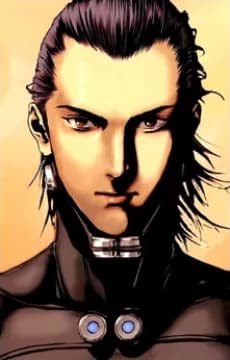
Masaru Kato
Gantz universe
Masaru Kato makes the ordinary fact of being a teenager feel suddenly exposed. Watching him means sitting with the awkward distance between the person he wants to be and the person a frightening situation may require him to become. His scenes invite attention to hesitation, concern, and the small choices that give those feelings shape. That is a more rewarding way into Gantz than waiting for a character to announce what he stands for.
By Mika Tanabe
Appearance
Kato is introduced in Gantz (2004), where the high-school setting gives his presence an immediate, legible scale. He is young enough that responsibility feels newly placed on him, yet the series does not ask the viewer to treat youth as a simple excuse. The pleasure of watching him comes from that pressure: a familiar stage of life made strange by circumstances that refuse to stay familiar. His scenes are easiest to read when you notice how he responds before deciding what those responses mean. A pause can carry concern; a firm answer can sound like an effort to steady himself. The performance gives those moments room to register without turning every beat into a declaration. Kato's appeal grows through attention, not through a polished first impression. The English voice performance by Jessica Boone helps keep that human scale in view, while Mayumi Yamaguchi's Japanese performance offers the original reading of the role.
Personality
Kato is compelling because his concern for other people feels like a choice with weight behind it. That quality changes the way you watch him: care does not arrive as a neat badge of virtue, and it does not erase uncertainty. He can be read through the tension between wanting to help and having to face what helping asks of him. The show benefits from leaving that tension visible. A viewer can disagree with a decision and still understand the impulse that produced it, which makes his presence more engaging than a string of easy endorsements would be. His youth matters here as context, not as a shortcut to innocence. The character asks you to take his feelings seriously while staying alert to the difference between a good intention and a good result. For me, that friction is where Kato becomes worth following. He gives the series a human point of contact, and the contact is imperfect in a way that invites thought instead of applause.
Masaru Kato’s Story
Spoiler-free introduction
Early on, Kato is presented as a young person trying to orient himself while the world around him becomes difficult to read. The safest way to watch these opening scenes is to stay close to his immediate responses. His concern for other people gives the material an emotional reference point, but it does not settle every question about what he should do. The series lets uncertainty remain part of the experience. Rather than treating his feelings as an answer, it lets them shape the questions a viewer carries from one scene to the next. That approach makes his early presence approachable without making it predictable. You can notice the care in his reactions and still wait to see how he handles pressure. This is the level of the story to take in before choosing whether you want more detail.
Spoilers beyond the opening stretch of Gantz
With more of Kato's story in view, it becomes possible to read his concern as an active commitment, not simply a temperament. That reading gives his choices a sharper edge: wanting another person to be safe can place demands on him, and good intentions do not make every decision uncomplicated. The most useful question to carry into the later material is how he understands responsibility when his own needs and another person's needs pull in different directions. I will leave the concrete turns of the story unstated here. The character writing is more satisfying when you watch those turns for yourself and decide where sympathy ends and judgment begins. Kato's emotional force comes from that ongoing negotiation, from seeing care tested by circumstances rather than accepted as proof of moral perfection.
Watch Masaru Kato’s Story
Start with Gantz (2004), the listed screen appearance for Masaru Kato. Crunchyroll and Netflix are the services where you can watch it. For his character story, it is worth beginning there and letting the early scenes establish their own terms before reading further. Kato works best as a character you observe closely: his concern can be moving, but the series leaves room to question what that concern can accomplish. The show is not asking for instant certainty about him. Give the performance time to make its small shifts legible, then judge the decisions as they come. If you want the Japanese voice track, Mayumi Yamaguchi performs Kato; Jessica Boone voices him in English. Either way, the central attraction is the same: a recognizable human response under unfamiliar pressure, rendered with enough uncertainty to keep the viewer thinking.
Start here: Gantz (2004) — on Crunchyroll, Netflix
- GantzMain · 2004Crunchyroll, Netflix
Questions
- Who voices Masaru Kato in English?
- Jessica Boone voices Masaru Kato in English. Mayumi Yamaguchi performs the role in Japanese.
- Where can I watch Masaru Kato's story?
- Masaru Kato appears in Gantz (2004), which is available on Crunchyroll and Netflix. Start there for his screen story.
- When does Masaru Kato first appear?
- Masaru Kato first appears in Gantz (2004). That is the place to begin if you want to follow his story on screen.
- Is Masaru Kato worth watching for?
- Yes, especially if you enjoy characters whose concern for others does not make every decision simple. Kato gives Gantz a human point of contact, and his uncertainty makes that perspective more interesting to follow.