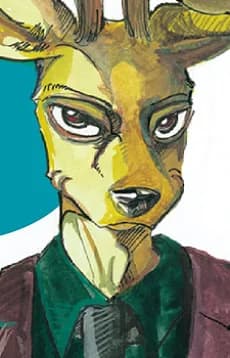
Louis
Beastars universe
Louis can make a polished public gesture feel like a challenge. In Beastars, he carries himself with the exactness of someone who knows other people are measuring him, and that makes even his composure feel strenuous. I find him most engaging when confidence and strain occupy the same moment: he wants to be seen as capable, yet the effort behind that image remains visible. His presence gives the series a sharp social edge, because watching him means noticing what it costs to keep control when a room has already decided what you represent.
By Mika Tanabe
Appearance
Louis's red deer design gives his bearing a delicate outline, but he never feels fragile on screen. The contrast is useful: his posture and careful presentation seem chosen, as if he has learned that a visible lapse will be read before he can explain it. Beastars lets the face and body language do much of this work. A held expression can seem like poise, irritation, or a refusal to let someone else set the terms. That ambiguity makes his visual presence active rather than ornamental. He is striking because the viewer keeps testing the image he presents against the tension underneath it, not because the show needs to pause and announce that he matters.
Personality
Louis is proud, disciplined, and acutely aware of status. The interesting part is how hard he works to make those traits look like simple certainty. He has a strong sense of what he wants others to see, and his scenes become tense when the audience can sense that maintaining the picture requires effort. That pressure does not make him easy to excuse or reduce to a victim of expectation. He can be demanding, and the show benefits when viewers are allowed to feel both admiration and resistance. His authority has a personal quality: it comes with a belief that he must prove himself, even when the very act of proving it exposes the insecurity he would rather keep covered.
Louis’s Story
Spoiler-free introduction
Early Beastars presents Louis as a student whose confidence commands attention and whose ambition is plainly serious. You can understand his appeal without knowing where his choices lead: he is compelling because he treats every public moment as a test of how much respect he can claim. Watch the precision of his reactions and the difference between appearing composed and feeling at ease. His scenes have a taut, deliberate quality that fits a series interested in how people read one another. Louis gives that question a particularly uncomfortable face, since he seems to know that being judged is part of daily life and refuses to let the judgment go unanswered.
Spoilers beyond season one
As the story develops, the contradiction at the heart of Louis becomes harder to keep at a distance. His determination to hold authority and his need to define himself pull in directions that cannot always be reconciled through sheer will. That evolution changes the feeling of his earlier confidence: it can look like strength, but also like a rule he has imposed on himself. I would avoid treating his later choices as a neat lesson about power. The more rewarding response is to notice how the character keeps negotiating the price of control, and how each new context makes his practiced certainty feel different.
Abilities
Louis's chief strength on screen is command. He can focus attention through posture, timing, and a way of speaking that suggests he expects to be taken seriously. The series makes this a practical form of power: what he can persuade others to see in him affects how he moves through conflict. His discipline also gives his decisions a sense of purpose, though it can harden into rigidity. Watching him is satisfying when that force meets resistance, because confidence alone cannot settle whether a choice is wise. The question becomes how much control he can hold while remaining honest about what drives him.
Relationships
- Ogma
- Ogma is part of the personal frame around Louis, and that connection gives his drive a family dimension without reducing him to it. Louis still reads as someone intent on making his own standing count, which keeps their relationship from becoming a shortcut explanation for his ambition.
- Azuki
- Azuki's connection to Louis places another expectation close to him. Their relationship is worth watching for the way it makes his private obligations feel distinct from his public self, while leaving room for the audience to judge how he handles that pressure.
Watch Louis’s Story
Start with Beastars (2019), available on Netflix. Louis is a strong reason to watch if you enjoy a character whose self-control has visible seams. He gives the drama a composed surface and a restless undertow, so small reactions can carry as much weight as a declaration. The show also lets you disagree with him without making that disagreement the only interesting response. Pay attention to how he presents himself, then to what the performance lets show through. Yuuki Ono voices Louis in Japanese, and Griffin Puatu voices him in English.
Start here: Beastars (2019) — on Netflix
- BeastarsMain · 2019Netflix
- Beastars Season 2Main · 2021Netflix
Questions
- How tall is Louis?
- Louis is 172 cm tall. His posture contributes strongly to the authority he projects on screen.
- Who voices Louis in English?
- Griffin Puatu is Louis's English voice actor. Yuuki Ono voices him in Japanese.
- When does Louis first appear?
- Louis first appears in Beastars (2019). The series establishes his proud, composed presence early on.
- Where can I watch Louis's story?
- Louis's story appears in Beastars (2019) and Beastars Season 2 (2021), both on Netflix. Start with Beastars (2019).
- Is Louis worth watching for?
- Yes, especially if you enjoy characters whose confidence carries visible pressure. Louis can be difficult to admire without reservation, and that friction is part of what makes his scenes hold attention.
Spoilers: tap to reveal
- Occupation
- Current president of the Horns Conglomerate