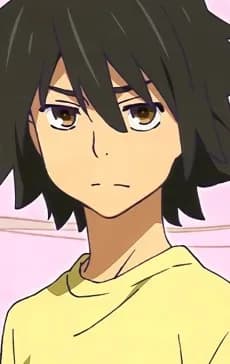
Jinta Yadomi
Anohana universe
Jinta Yadomi can make a pause feel like an answer he has decided not to give. Watching him means sitting with the awkwardness of someone who would rather seem difficult than explain himself cleanly, and that makes his quiet moments more active than they first appear. He has a blunt, resistant surface, but it never reads as effortless cool. There is strain in the performance, a sense that keeping people at a distance takes work. Anohana is strongest when it lets that resistance remain uncomfortable instead of sanding it down into an easy charm.
By Mika Tanabe
Appearance
Jinta's everyday look fits the unpolished impression he gives off. At 165 cm, he does not dominate a frame through size; his presence comes from the way he holds himself and from the gap between his guarded posture and what his face gives away. The design is simple enough that small changes in expression matter. A lowered gaze or a stubborn set to his mouth can carry the beat, particularly when he is trying to pass off a feeling as irritation. The show does not need to dress him up as a symbolic figure. He looks like someone caught in an ordinary day, which makes his discomfort feel close rather than theatrical.
Personality
Jinta's first defense is to act as if he has already opted out. The shrug, the short answer, the refusal to meet another person halfway: these choices can be funny, but Anohana does not let the comedy erase their cost. He is easy to misread if you take his surface at face value, and the series asks you to notice how often avoidance is itself a response. That does not make him secretly admirable in every moment. Sometimes he is frustrating, and the show is better for allowing that irritation to stand. His old nickname, Jintan, carries the warmth of a version of him that other people remember, while the person on screen has to decide what to do with that memory. The tension between those impressions gives his silences texture. Miyu Irino keeps his voice from becoming a single note of sulking; Griffin Burns brings a similarly youthful edge in English, with enough hesitation to keep the defensiveness human.
Jinta Yadomi’s Story
Spoiler-free introduction
Early on, Jinta is presented as someone who has pulled back from the people around him. The series lets you feel the friction before it explains every cause: an ordinary exchange can tighten when he refuses to respond, and even a joke can sound like a small barricade. That approach gives the viewer room to judge him, then reconsider the judgment as his reactions gather meaning. You do not need a full account of his past to recognize the discomfort of seeing someone dodge a conversation he clearly cannot leave alone. The early story works best if you watch his face and timing as closely as his words. Anohana is interested in the distance between what people remember and how they manage to meet one another now, and Jinta gives that distance a prickly, believable center.
Spoilers beyond Anohana's early story
As the story develops, Jinta's withdrawal becomes harder to treat as a personality quirk. The show gradually makes his resistance part of the emotional problem the characters have to face, and that shift changes how earlier scenes feel without turning them into clues in a puzzle. What matters is the pressure of being asked to respond when staying out of things has become its own choice. Jinta does not suddenly become eloquent or uncomplicated. His progress is more halting than that, which suits a character whose most recognizable habit is to close a door before anyone can ask him to open it. The later viewing experience depends on accepting that care can look clumsy, even when the person trying to show it has no polished language for the job.
Watch Jinta Yadomi’s Story
Start with Anohana (2011), where Jinta's guarded manner is part of the show's emotional rhythm from the beginning. Crunchyroll and Netflix stream it. I recommend watching with attention to the pauses and unfinished responses, since his characterization often sits in the beat after someone else has spoken. The series can make him aggravating, and that is not a reason to give up on him; the irritation is part of how his distance registers. Miyu Irino voices him in Japanese, and Griffin Burns voices him in English. Both performances keep his resistance from feeling like a pose. If you want a character whose story asks you to revise your first impression without demanding instant forgiveness, Jinta is a good reason to press play.
Start here: Anohana (2011) — on Crunchyroll, Netflix
- AnohanaMain · 2011Crunchyroll, Netflix
Questions
- How tall is Jinta Yadomi?
- Jinta is 165 cm tall. The detail suits a character whose screen presence comes through posture and expression more than sheer size.
- Who voices Jinta Yadomi in English?
- Griffin Burns provides Jinta's English voice. Miyu Irino voices him in Japanese.
- When does Jinta Yadomi first appear?
- Jinta's story begins in Anohana (2011), where he is a main character. Start with the series to follow his portrayal from its early scenes.
- Where can I watch Jinta Yadomi's story?
- Anohana (2011) streams on Crunchyroll and Netflix. It is the place to start with Jinta.
- Is Jinta Yadomi worth watching for?
- Yes, especially if you enjoy characters whose defensiveness can frustrate you before it begins to make emotional sense. Jinta's awkward pauses and resistance give Anohana a grounded center.