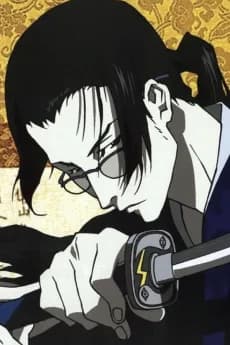
Jin
Samurai Champloo universe
Jin carries himself with the care of someone who knows a blade is only useful when the person holding it can wait. In Samurai Champloo, that patience gives his scenes a particular tension: the action may be quick, but he never seems in a hurry to prove what he can do. His ronin status matters because it leaves him without the reassurance of a settled place or duty. You watch him weigh each moment before he commits, and the restraint can feel almost stubborn beside a show that enjoys sudden turns. That friction is the pleasure of watching Jin. He makes composure feel like work, not a pose.
By Mika Tanabe
Appearance
Jin's most memorable feature as a screen presence is the impression of control. Even when the scene is moving quickly, he gives the eye somewhere steady to rest; his stillness has intention behind it. The show does not need to announce his competence every time he is present. A pause, a measured response, or the way he holds his attention can do the job. That economy makes him easy to read without making him simple. The more calmly he takes in a situation, the more you notice the effort that calm asks of him. His design and performance leave space for that quiet pressure to register.
Personality
Jin is disciplined in a way that can be both reassuring and hard to get close to. He is careful with his words, and his reserve rarely begs the audience to mistake silence for mystery. Instead, it gives his choices weight. When he acts, the sense is that he has already considered what acting will cost him. That makes his bodyguard work a useful lens on him: attention is part of the job, but he brings a private standard to it as well. He does not need to dominate a scene to hold it. His courtesy can read as distance, while his steadiness can be a form of care. I find that combination more convincing than the usual invincible-swordsman swagger, because the show lets composure feel like a habit he has to maintain.
Jin’s Story
Spoiler-free introduction
Early on, Jin is introduced through the contrast between his calm manner and the danger around him. He is a ronin making his way without the shelter of a formal master, and the work he takes gives his attention a practical purpose. Watch how he listens before he moves. The story establishes his discipline through small decisions and through the quiet space he keeps around himself, rather than pausing to explain every part of his past. You can start with the simple question of what his restraint is protecting. The answer is not handed over all at once, and that patience suits him. This is a safe place to meet Jin: it gives you his temperament and the terms on which he works, without asking you to know where his path will lead.
Spoilers beyond Jin's early appearances
As the series goes on, Jin's reserve becomes more revealing because it is tested by the people and demands around him. His discipline does not make every choice painless, and the show gains texture when his composure has to share space with uncertainty. The later material rewards attention to how he responds, not just to the outcome of a confrontation. There is a difference between being able to keep one's face still and having settled what one believes; Jin's story keeps those things distinct. I will leave the specific turns there. The useful way to watch this stretch is to notice what his silences do for him, and when they stop being enough. That shift gives his earlier calm a different resonance without reducing him to a puzzle with one hidden answer.
Abilities
Samurai Champloo is action-shaped, and Jin's skill with a sword is a central part of how he occupies that action. The pleasure is in his precision and economy. He does not make a display out of every movement; he gives the impression that a fight is a problem to solve cleanly, with no spare gesture. That quality also makes his stillness useful. When a scene turns physical, the change in pace feels sharp because he has not been performing intensity beforehand. His bodyguard work gives this ability a grounded edge: skill is something he must bring to a task, not a promise that every situation will go his way. The show lets restraint and force belong to the same person, which is why his action scenes feel connected to his character rather than pasted on as spectacle.
Watch Jin’s Story
Start with Samurai Champloo (2004), which is also where Jin's story is told. You can watch it on Amazon Prime Video, Crunchyroll, Hulu, or Netflix. The series is a good fit if you enjoy action with room for a character to think between movements. Jin gives that quieter rhythm a firm center: his watchfulness makes the pauses matter, and his swordsmanship makes the sudden bursts feel earned. I would recommend starting for his measured presence rather than expecting constant explanation. He becomes more interesting when you let the show take its time with what his discipline means to him.
Start here: Samurai Champloo (2004) — on Amazon Prime Video, Crunchyroll, Hulu, Netflix
- Samurai ChamplooMain · 2004Amazon Prime Video, Crunchyroll, Hulu, Netflix
Questions
- Who voices Jin in English?
- Kirk Thornton voices Jin in the English version. His performance keeps Jin measured, giving the character's restraint a clear presence without making every quiet moment sound solemn.
- Who is Jin's Japanese voice actor?
- Ginpei Satou voices Jin in Japanese. The performance suits a character whose attention often registers before he says much.
- Where can I watch Jin?
- Jin's story is in Samurai Champloo (2004), available on Amazon Prime Video, Crunchyroll, Hulu, and Netflix. It is a strong starting point if you want character focused action with a patient pace.
- When does Jin first appear?
- Jin first appears in Samurai Champloo (2004). The opening stretch gives you a spoiler safe introduction to his reserve and the way he approaches his work.
- Is Jin worth watching for?
- Yes, especially if you enjoy characters whose choices carry more force than their speeches. Jin's calm makes the action satisfying, and the show gives that calm enough pressure to stay interesting.