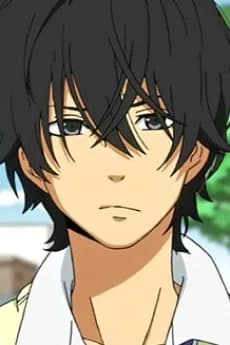
Haru Yoshida
My Little Monster universe
Haru Yoshida makes a first impression through sheer force of attention: when something matters to him, he has little patience for the social softening other people use to make a moment easier. Watching him can feel bracing and uncomfortable at once. He speaks with a directness that leaves no room to pretend a misunderstanding has been neatly settled, and the show gets much of its comedy from the distance between his certainty and everyone else's hesitation. That bluntness is not a polished pose. It gives his scenes a restless energy, because you are never quite sure whether his next honest reaction will be funny, generous, or a little too much.
By Mika Tanabe
Appearance
Haru's screen presence is defined less by a carefully managed image than by how quickly he can seize a scene. He has an alert, unguarded way of meeting a moment, and that makes even a quiet exchange feel capable of veering somewhere unexpected. The animation lets his intensity register without asking him to explain it first. A pause can read as concentration; a sudden response can puncture the comfortable rhythm the other person thought they had. There is a pleasing plainness to the way the show presents him. You watch his attention move, then watch the people around him decide what to do with it. That gives his appearances a sense of immediacy without turning every scene into a grand entrance.
Personality
Haru is direct to the point of social friction, but he is not written as someone who has mastered the art of being difficult. His certainty can make him seem intimidating, while his lack of polish leaves him exposed to the awkwardness he creates. That tension is where I find the character most engaging: he can be sincere and exasperating in the same beat, and the story allows both reactions to stand. The humor does not require him to become a joke. It comes from watching a person act on a feeling before he has learned how that feeling will land. When the show gives him a quieter stretch, his intensity still matters. It becomes a question of whether he can listen as readily as he speaks, and whether honesty can grow into care instead of stopping at bluntness.
Haru Yoshida’s Story
Spoiler-free introduction
Early on, Haru's direct manner unsettles the expected pace of ordinary conversation. He says what he means with little concern for whether the moment is prepared to receive it, and people have to make their own sense of his sincerity. The comedy often lives in that split: Haru can be completely earnest while the scene around him is scrambling to catch up. This is a useful way into the character because it leaves room for mixed feelings. His openness is refreshing, but it can also be a lot to handle. Pay attention to how often the show lets a pause or a reaction carry the part he has not learned to say gracefully.
Spoilers beyond the early story
As the story develops, Haru's emotional directness becomes something the series can test rather than simply use for a laugh. The later material gives more weight to the effort involved in understanding another person, especially when an immediate response is not enough. That shift does not erase the unruly energy that makes him memorable. It asks you to notice what sincerity demands after the first declaration, when the other person has their own pace and their own feelings. I find this part of his portrayal rewarding because it treats growing up as a practice, with clumsy moments still attached. The show keeps his edges visible while making his choices carry a different kind of weight.
Watch Haru Yoshida’s Story
Start with My Little Monster (2012), the main place to follow Haru Yoshida. The appeal is the character's unpredictable candor and the way a social scene changes when he refuses to perform the expected response. If you enjoy romantic comedy with awkward pauses and a lead who can be both disarming and difficult, Haru gives you plenty to read in the small exchanges. His story works best when you let those exchanges breathe instead of treating every blunt line as a punchline. My Little Monster is available on Crunchyroll, so you can begin there and follow the character in context.
Start here: My Little Monster (2012) — on Crunchyroll
- My Little MonsterMain · 2012Crunchyroll
Questions
- Where can I watch Haru Yoshida's story?
- Haru Yoshida's story appears in My Little Monster (2012). It streams on Crunchyroll.
- When does Haru Yoshida first appear?
- Haru first appears in My Little Monster (2012). Start with the series to see his story in context.
- Who voices Haru Yoshida in Japanese?
- Tatsuhisa Suzuki voices Haru Yoshida in Japanese. His performance suits the character's blunt energy and sudden shifts in mood.
- Is Haru Yoshida worth watching for?
- Yes, especially if you enjoy characters whose honesty can make a scene funny and uncomfortable at once. Haru's directness gives the show's quieter exchanges plenty of friction to work with.