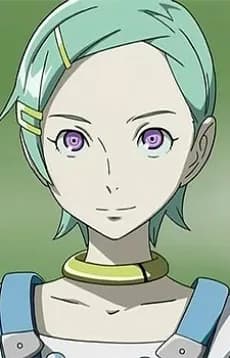
Eureka
Eureka Seven universe
Eureka's work at the controls gives her an unusually composed first impression: the machine can be moving at full force while she remains difficult to read. That contrast is the pleasure and the test of watching her in Eureka Seven. Her competence is immediately legible, but competence is not a substitute for intimacy, and the series benefits from letting those things stay separate. I would argue that Eureka is most rewarding when you resist treating a quiet expression as a complete answer. She gives action a human center without making every feeling easy to name.
By Mika Tanabe
Appearance
Eureka's screen presence is shaped by the demands of a story built around piloting and flight. She has to register as a person while the machinery around her claims much of the frame, and that balance lends her stillness a particular weight. Rather than relying on a parade of visual details, the show gives you time to notice how she occupies a scene. I find that a useful invitation: watch her as carefully when nothing is being explained as when the action is underway. Her design and performance leave room for attention to settle, which suits a character whose first impression does not tell you everything worth knowing.
Personality
Eureka's reserve asks for a viewer who can tolerate an unfinished impression. She is capable at her work, yet the assurance of a pilot does not make her inner life transparent. Kaori Nazuka gives that separation a measured presence in Japanese, while Stephanie Sheh keeps the same quality audible in English. Neither performance needs to turn every pause into a declaration. Eureka can hold your attention through the small uncertainty of whether you have understood her correctly. That makes her less instantly welcoming than a character who explains each reaction, but I think the patience is earned: the act of watching closely becomes part of the relationship between viewer and character.
Eureka’s Story
Spoiler-free introduction
At the beginning, Eureka is established through her work as a mech pilot. That gives the viewer something concrete to hold onto while the person behind the controls remains less plainly defined. The early pleasure is in seeing ability without mistaking it for a full introduction. Her scenes can be approached as scenes of action, but the interesting question is what her composed presence makes you notice about the person doing the work. Eureka Seven lets that question remain open, so a new viewer can meet her without needing a later explanation first. Start with the 2005 series and give her a little room to make her own impression.
Spoilers beyond the early introduction
As you continue, it helps to let Eureka's relationships complicate the first impression rather than replace it. Her connection to Renton Thurston brings another person's attention into the picture, and her family ties give the character a context beyond her work. Those details are best met at the pace the series gives them. Eureka remains more interesting when a connection adds texture to her choices instead of serving as a short explanation of who she is. The shift for the viewer is gradual: the skilled pilot remains present, while the person becomes harder to reduce to that role. This part of her story rewards noticing how your reading changes, without expecting every ambiguity to disappear.
Abilities
Piloting is the clearest way the series makes Eureka's competence visible. As a mech pilot, she is associated with action that asks for control and concentration; as an aircraft pilot, that association extends to another kind of flight. The detail matters because her skill gives the audience something observable when her feelings are less available. I prefer that balance to scenes that treat ability as a personality by itself. Eureka's work can hold the eye, but the more satisfying question is how a person carries herself while doing it. Her role makes action part of her characterization without turning her into a list of impressive tasks.
Watch Eureka’s Story
Begin with Eureka Seven (2005), available on Crunchyroll. It is the starting point for meeting Eureka through the contrast between assured work and a less immediately readable presence. Eureka Seven: Hi-Evolution (2017) is also available on Crunchyroll, but I would still begin with the earlier series. The character's appeal builds through attention, not through a rapid string of explanations. If you like watching a performance whose meaning can deepen while its surface stays composed, Eureka is a strong reason to settle in. If you need every character to announce what they feel as soon as they feel it, she may ask more patience than you want to give. I think that friction is a fair part of her appeal, and a better recommendation than pretending she works for everyone.
Start here: Eureka Seven (2005) — on Crunchyroll
- Eureka SevenMain · 2005Crunchyroll
- Eureka Seven: Hi-EvolutionMain · 2017Crunchyroll
Questions
- Who voices Eureka in English?
- Stephanie Sheh voices Eureka in English. Her performance preserves the character's composed presence and leaves room for the viewer to read the pauses.
- Who is Eureka's Japanese voice actor?
- Kaori Nazuka voices Eureka in Japanese. Her measured delivery suits a character whose competence is easier to read than every feeling.
- When does Eureka first appear?
- Eureka's starting point is Eureka Seven (2005). That is where a new viewer should begin getting to know her.
- Where can I watch Eureka?
- Eureka Seven (2005) and Eureka Seven: Hi-Evolution (2017) are available on Crunchyroll. Start with Eureka Seven (2005).
- Is Eureka worth watching for?
- Yes, if you enjoy a character whose competence is clear while her feelings take longer to read. Eureka's composed presence gives the action a human focus and makes close attention rewarding.
Spoilers: tap to reveal
- Family
- Amber Thurston
- Ao Fukai